Compiled with the help of artificial intelligence, based on Spanish-language information. Source below the article.
Green light for Tenerife’s mobility masterplan
Tenerife’s transport network is set for a major transformation under a new plan that will shape how people move around the island for the next two decades. The Tenerife Sustainable Mobility Plan (PIMSIT) has received the necessary environmental backing to continue its approval process, after the Tenerife Environmental Assessment Commission (CEAT) unanimously approved its Strategic Environmental Declaration on 11 August, the island’s Cabildo (council) confirmed yesterday.
The document brings together 91 measures across nine programmes, with target dates of 2035 and 2045. Its goal is to shift the balance away from private car use and towards buses, the tram, active travel, car-sharing and electric alternatives.
Next steps towards final approval
The environmental approval does not yet mean the PIMSIT is in force. The Cabildo must incorporate minor amendments suggested by the environmental commission and continue with the administrative process. The next stage is scrutiny by the island corporation’s plenary commission, before the document goes before the full Cabildo for final adoption.
One of the CEAT’s roles is the strategic environmental assessment of plans and programmes at island level, ensuring sustainability criteria are embedded in planning and potential environmental impacts are identified before decisions are made.
A strategic framework for the island
The PIMSIT is intended to become the reference framework for organising the island’s mobility in the medium and long term. The Cabildo has described it as a strategic tool to establish the model for managing travel across Tenerife over two decades, with particular attention to public transport and connections between different modes of travel.
The plan starts from a familiar reality on the island: the heavy reliance on private cars, congestion on key corridors, and the need for alternatives that allow people to travel more quickly, accessibly and sustainably. Rather than acting as isolated measures, the various initiatives are designed to form part of a common strategy for the whole of Tenerife, coordinating infrastructure, transport services and emerging mobility options so a single journey can combine different modes.
Eulalia García, the island’s councillor for mobility, said the document puts the citizen at the heart of planning, focusing on improving collective transport, car-sharing and intermodality. The aim, she said, is to widen travel options and gradually reduce dependence on the private car. Cabildo president Rosa Dávila has similarly argued that the PIMSIT will allow the island to anticipate future needs and set a common strategy for generations to come.
Nine programmes covering all aspects of mobility
The plan is structured around nine broad programmes spanning most elements involved in mobility on an island like Tenerife. These include a programme dedicated to public transport infrastructure, facilities and systems, alongside another focused on road infrastructure. There are also specific programmes for improving and strengthening collective transport, controlling and regulating private vehicles, and promoting active mobility.
Digital and innovative mobility, freight transport, electric mobility and matters relating to regulation, planning and funding also feature. The breadth of these areas ensures the PIMSIT is not simply about deciding where to build new roads or extend transport services. It also covers demand management, technology, walking and cycling, goods distribution and the transition towards lower-emission vehicles.
Two target dates: 2035 and 2045
The document sets two reference points: 2035 as the interim horizon and 2045 as the long-term perspective. This division allows the most immediate needs to be tackled first, while keeping sight of the changes Tenerife may undergo in the coming decades.
Boosting public transport
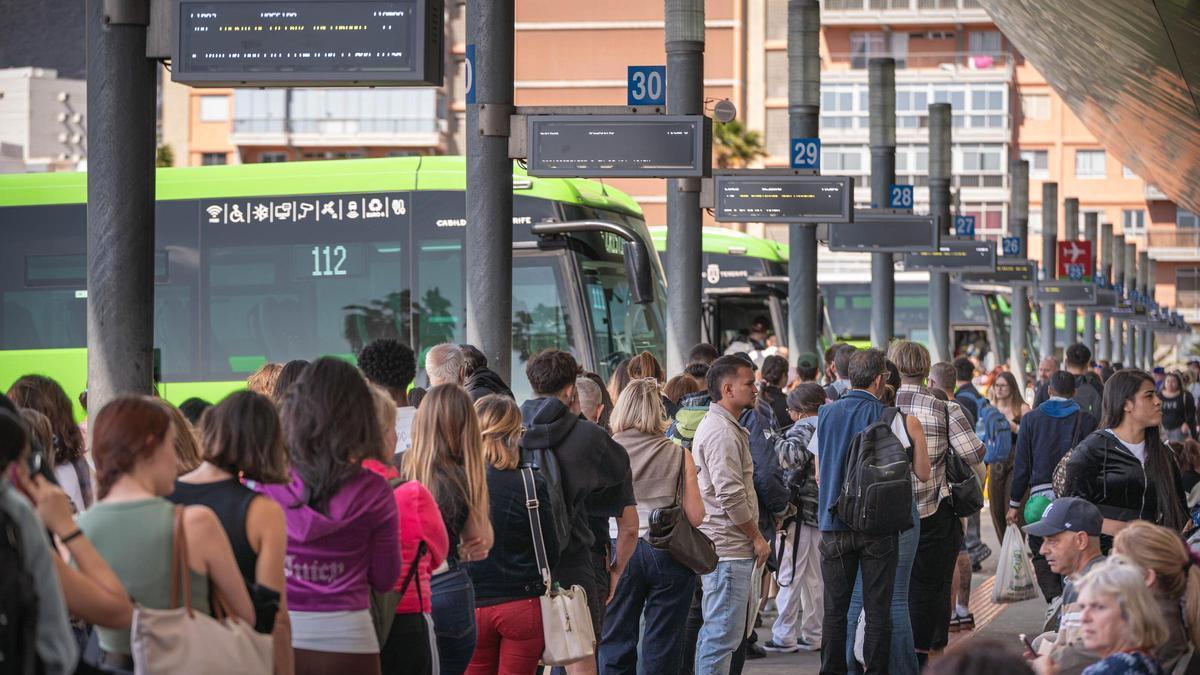
One of the central pillars of the PIMSIT is strengthening public transport. Proposals include modernising and improving the bus service (guaguas) to meet user needs and encourage more people to choose it over the car. On the rail side, the plan envisages extending the tram network, including prolonging Line 1 to Tenerife North Airport and extending Line 2 to La Gallega. Improvements and expansion of school transport are also planned, as part of a strategy to integrate different mobility services and make them more accessible.
The philosophy is to move towards a system where different options are better connected, allowing a traveller to combine bus, tram, walking, cycling, shared vehicles or an electric car within a single journey. Another proposal involves encouraging drivers to switch to collective transport before reaching the most congested areas. To that end, the PIMSIT includes a network of park-and-ride facilities across the island, where people can leave their cars and continue by public transport.
Road improvements and priority lanes
The strategy is complemented by plans for BUS-HOV (high-occupancy vehicle) lanes on the main corridors of the TF-1 and TF-5 motorways. These are designed to give priority to collective transport and car-sharing, making more efficient use of road capacity.
The plan also includes widening certain routes, such as adding a third lane to the southern motorway between San Isidro and Las Américas, and between Güímar and San Isidro. On the northern motorway, a similar scheme is proposed between Tenerife North Airport and La Orotava. These projects form part of a wider strategy to tackle congestion on the island’s main roads, combining improvements to existing infrastructure with measures to reduce car pressure on it.
Car-sharing, cycling and low-emission zones
Sustainable mobility under the PIMSIT is not limited to public transport. The document also includes measures to encourage other forms of travel, such as car-sharing and car-pooling platforms, designed respectively for shared vehicle use and organising shared journeys among people making similar trips. The aim is to make better use of each vehicle and reduce the number of cars needed for daily travel.
The plan also provides for urban green corridors and measures to promote active mobility, including journeys made without motorised vehicles, such as walking and cycling. Support for low-emission zones is also included, to be developed where appropriate and in line with each municipality’s planning. The overall package aims to ensure sustainable mobility depends not only on new infrastructure but also on changes in how daily journeys are organised.
Electric vehicle charging network
Electrification has its own dedicated section within the PIMSIT. The plan includes developing an island-wide network of charging points for electric vehicles to ease the transition to this form of mobility. The Cabildo has already been working in this area: according to the activity report from the island council’s department for natural environment, sustainability, safety and emergencies, its own planned network envisages 42 charging points, with a further 47 potentially added by councils that join the system, reaching a total of 89.
Electrification is thus embedded within a broader strategy. The PIMSIT is not simply about swapping combustion engines for electric ones, but about progressively changing the whole system to favour collective transport, shared journeys and active options.
Protecting the environment and adapting to climate change
A key part of the environmental assessment was ensuring the mobility plan is compatible with conservation of the island’s territory. The PIMSIT incorporates criteria relating to climate change adaptation, protection of natural spaces, vegetation, wildlife, landscape and heritage. The assessment pays particular attention to protected areas and sites within the Natura 2000 network.
Mobility in areas under heavy visitor pressure also gets specific treatment, such as Anaga, Teno and the surroundings of Teide National Park, where increased travel could affect particularly sensitive landscapes. Measures proposed for these areas include access management, stronger public transport, park-and-ride facilities and shuttle services. The Cabildo has already introduced specific measures towards a more controlled mobility model on Teide, including access control systems and a network of shuttle buses from various points around the island.
The plan also requires future infrastructure to be more resilient to the effects of climate change, with these criteria incorporated as planned measures move from the planning stage into development.
Public consultation and participation
The development of the PIMSIT has involved several rounds of public consultation. The Cabildo initially opened a period for gathering opinions from citizens and organisations linked to mobility. The draft plan and its strategic environmental study were then put on public display for 45 days between December 2023 and February 2024. Later, the initial approval document and its corresponding environmental study were again subject to public information and consultation in October 2025.
Contributions were received from public administrations, town councils, professional bodies, political organisations and members of the public, helping to bring different perspectives into the document before it moves towards approval. The process also reflects how mobility planning touches many aspects of daily life, from commuting and school runs to access to public services, freight transport, tourism and the protection of natural spaces.
Monitoring and indicators
The PIMSIT also includes a monitoring system to check whether the measures deliver the expected results. Progress will be analysed using indicators linked to pollution emissions, public transport use, active mobility, road congestion and electrification. This will provide data on how mobility on the island evolves and allow the measures to be assessed as they are rolled out.
Indicators are particularly important in a plan with a 20-year horizon, as mobility conditions are likely to change over that period. The Cabildo itself stresses that the PIMSIT is intended as a long-term planning instrument, not merely a catalogue of construction projects.
Recent growth in public transport use
The strategy also builds on a recent surge in public transport use in Tenerife. According to figures from the Cabildo, TITSA recorded 87.3 million passengers, an 81% increase on 2022. Free public transport is among the factors cited by the corporation for this growth, which it estimates has avoided more than 63 million private car journeys, easing pressure on the island’s main roads.
The public transport company has also been renewing its fleet, with 351 new buses introduced over three years, while capacity has reached 160 million seats, according to the figures provided in the press release.
What’s happening in the Canaries – straight to your phone
News, weather alerts and practical updates – direct from the islands, in English. We live here and know what’s going on – before the international media catch up. Everything lands on our WhatsApp channel – no middlemen, no algorithm. Curated for families, expats and travelers.

Canary Islands international air arrivals fall 1.3% in September

Helicopter evacuates US cruise passenger near Tenerife
El Hierro airport sees 3.6% rise in September passengers

Gran Canaria approves €509k works to shore up GC-200 slope

Canary Islands gets €47.5m for free public transport in 2026
Canary Islands airports see 0.9% fall in September passengers
El Rejo road in La Gomera to close for six hours on Tuesday

Man, 65, seriously injured in GC-1 crash in Agüimes
Las Palmas traffic changes for emergency sewer works