Cabildo backs Tigaiga tunnel project
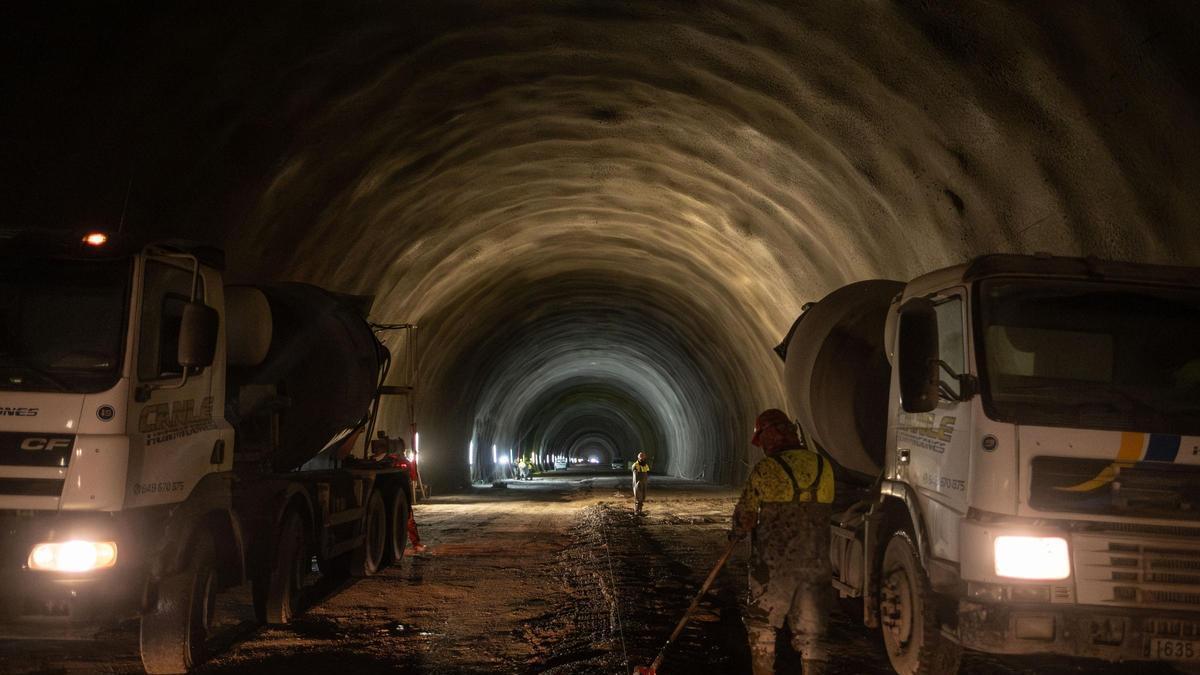
The Cabildo de Tenerife has given its backing to the future Tigaiga tunnel, the underground connection between La Guancha and Los Realejos with which the Canary Islands Government aims to complete the closure of the Insular Ring on the northern side. The project, being developed by the Vice-Ministry of Infrastructure, involves a twin-tube passage of seven kilometres and an investment of more than €600 million. If it materialises, it would become the longest tunnel in Spain, beating the Erjos tunnel by almost two kilometres, with the latter due to enter service next year.
“Novel solution” for complex stretch
The Cabildo’s Councillor for Roads, Dámaso Arteaga, considers the work to be a “novel” solution to resolve “one of the most complicated stretches” of the island’s road network, “as it crosses an area of high environmental sensitivity.” Specifically, the route would run beneath the Protected Landscape of Campeches, Barranco Ruiz and Tigaiga — hence its name — a space of nearly 700 hectares shared by the municipalities of Los Realejos and San Juan de la Rambla. For this reason, Arteaga understands that “the project offers an answer to one of the most complex points of the island’s road network,” and he gives a first “fairly positive” assessment of the initiative.
Route details and preliminary studies
Although the alternative is still at an early stage of development, the future Tigaiga tunnel would start from the area around the PIRS housing estate in La Guancha and link up with the TF-5 motorway at Los Realejos, passing beneath San Juan de la Rambla. The route has been defined following two preliminary studies, which conclude that a fully underground route is the most suitable option from a technical, economic and environmental point of view, avoiding a surface crossing through the northern natural corridor and definitively ruling out the open-air exit at Las Aguas, proposed during the previous legislature and rejected by local neighbourhood groups.
Complementary to Erjos tunnel
The infrastructure is now conceived as the continuation of the route that will link El Tanque and Santiago del Teide via the Erjos tunnel, which is expected to open next year. The Canary Islands Government maintains that both infrastructures are complementary and that this new link will absorb the expected increase in traffic on that corridor, improve safety on a stretch of the TF-5 affected by frequent rockfalls and carrying around 35,000 vehicles a day, as well as strengthening connections with the Isla Baja region and redistributing journeys between the north and west of Tenerife.
Funding challenges ahead
The main obstacle for the Tigaiga tunnel moving from paper to construction is, for now, securing the funding for the more than €600 million the project will require. “We need to secure financing to commission the drafting of the final route and construction project,” admits the Canary Islands Government’s Vice-Minister for Infrastructure, Francis González. Until then, the department is focusing its efforts on “clarifying technical and environmental issues” so the project can progress “with as much information as possible and without unnecessary delays” once it has financial backing.
For that reason, the regional government hopes funding can come through a new Roads Agreement between the Canary Islands and the Spanish State, the instrument through which both administrations finance and carry out the Archipelago’s main road infrastructures, or through an increase in funds from the current agreement, extended until 2027 and allocated more than €1.2 billion for strategic actions such as completing the Insular Ring, the BUS-VAO lane on the TF-5 or the undergrounding of the TF-1.
“There is a framework of uncertainty regarding available resources. We need a greater contribution and mechanisms that allow us to use surpluses or leftover funds,” says González. At the same time, the Councillor for Public Works, Pablo Rodríguez, has raised the possibility of resorting to an extraordinary credit, a budgetary tool that allows additional funding to be incorporated for priority investments without waiting for a new annual budget, with the aim of boosting the allocation for this and other strategic actions on the Canary Islands’ road network. Once resources are guaranteed, the Government plans to tender the drafting of the construction project and continue with the administrative process.
“Perfectly viable” project
Despite the high cost of the project, Dámaso Arteaga argues that the investment effort is justified by the impact it would have on island mobility. “If the Canary Islands Government finds the necessary financing and puts the required resources on the table in the future, I believe it is a magnificent proposal to improve the flow of traffic on the north-south axis,” he says. In this regard, he considers the project “perfectly viable” and stresses that the resources “must be sought,” whether through the Roads Agreement with the State or any other funding formula promoted by the regional government. With that premise, the Cabildo reaffirms its support for an infrastructure it considers strategic for mobility in the north of Tenerife.
What’s happening in the Canaries – straight to your phone
News, weather alerts and practical updates – direct from the islands, in English. We live here and know what’s going on – before the international media catch up. Everything lands on our WhatsApp channel – no middlemen, no algorithm. Curated for families, expats and travelers.

Canary Islands international air arrivals fall 1.3% in September

Helicopter evacuates US cruise passenger near Tenerife

El Hierro airport sees 3.6% rise in September passengers

Gran Canaria approves €509k works to shore up GC-200 slope

Canary Islands gets €47.5m for free public transport in 2026

Canary Islands airports see 0.9% fall in September passengers
El Rejo road in La Gomera to close for six hours on Tuesday

Man, 65, seriously injured in GC-1 crash in Agüimes

Las Palmas traffic changes for emergency sewer works