
Sustainability language used 129 times – but not in the rules
References to sustainability appear throughout the tourism plans for the Canary Islands’ coastal areas – known as the Plans for Modernisation, Improvement and Increased Tourism Competitiveness (PMMs). But they only feature in the documents’ explanatory notes and supporting paperwork. In the binding regulations themselves? Not a single mention. This disconnect between rhetoric and real obligations is what a recent study describes as a “sustainability paradox”.
The article, recently published in the academic journal Cuadernos de Turismo, reveals that the terms “sustainable”, “sustainability” and “sustainable development” appear 129 times in the planning reports for the 13 PMMs approved in the archipelago between 2011 and 2015. However, they do not feature once in the regulatory provisions, which set out the management rules and criteria.
The study’s authors have exposed what was already an open secret, albeit one that until now lacked empirical backing: that the language of sustainability is used as a justifying principle, as a symbolic resource for coining ever more concepts (sustainable tourism, sustainable renovation, sustainable mobility, among others), but not as a regulatory requirement that conditions urban planning policies or specific actions.
‘This is all green marketing’
“This is all green marketing, as the English speakers call it. That is, including the word ‘sustainable’ in any document or title, even when applying for subsidies,” reflects Moisés Simancas, one of the study’s authors and a professor of Human Geography at the University of La Laguna (ULL).
“In the documentation we analysed, there is a declaration of intent, a diagnosis. But when the time comes to set out the determinations, the term ‘sustainable’ disappears,” he adds.
The study argues that the inclusion of sustainability in the PMMs responds more to adapting to regulatory or technical pressures than to a genuine desire to transform the “unsustainable” tourism model. The authors speak of a “performative process”: seeking to project an image of commitment to sustainability through a certain “terminological saturation”, but without altering existing structures owing to the lack of “legally binding commitments”.
Legal ambiguity and the risk of litigation
But that is not all. The term “sustainable” has a notable legal ambiguity, Simancas argues, because it is difficult to determine exactly what it implies in the absence of indicators and data, especially at a local level. The geographer believes that its exclusion from binding regulations may stem from a desire to avoid that legal problem and the risk of facing challenges, blockages or litigation, particularly concerning the acquired rights of property owners.
In his view, “sustainability, by definition, is about setting limits”. And that can translate into measures such as requiring green spaces, pedestrianising streets, or reducing – that is, shrinking – the area designated for tourism uses to prevent the establishment of new accommodation.
Plans that could transform tourism – but are being wasted
Simancas and David González, also a geographer at the ULL, chose the PMMs for their innovative and exceptional character within Canary Islands planning. These instruments were born during the tourism moratorium, from 2009 onwards, to facilitate tourism renovation processes that general municipal plans could not carry out, as they take precedence over them and allow urban planning agreements to be signed to modernise the accommodation stock.
“They are extremely powerful, but they are being wasted,” summarises Simancas.
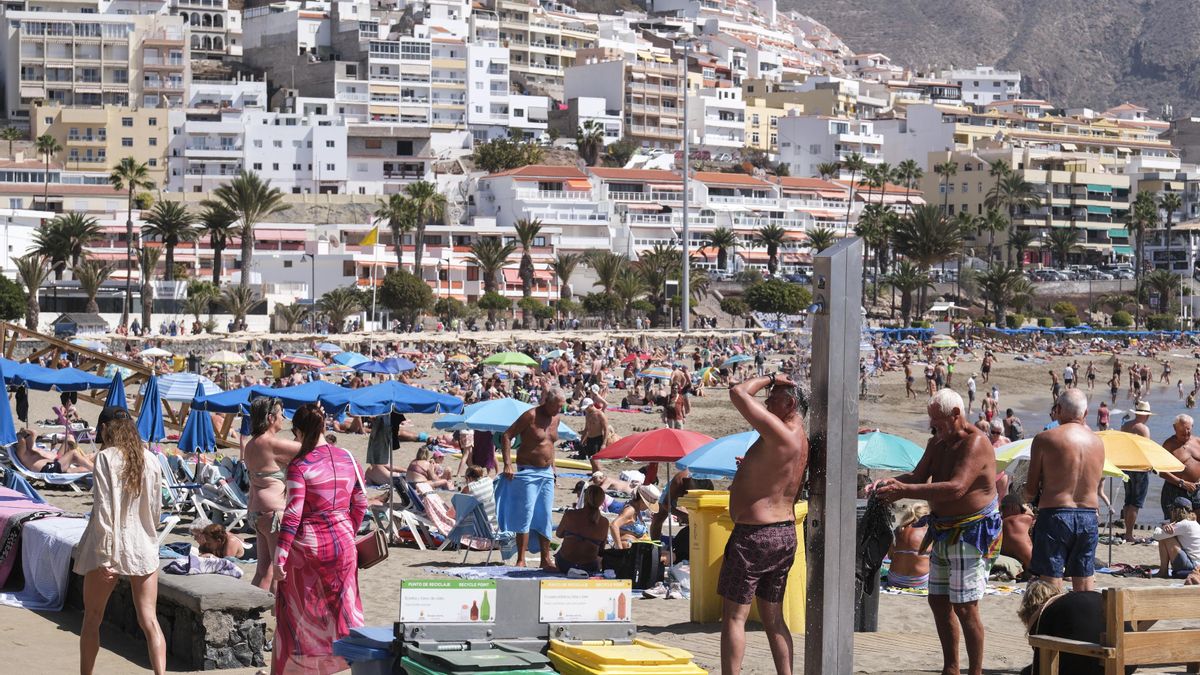
The authors extracted from the Official Gazette of the Canary Islands (BOC) the 13 PMMs already approved (the first and second generation, between 2011 and 2015) corresponding to the coastal tourism areas of Lanzarote, Tenerife, Fuerteventura and Gran Canaria. The study notes that these spaces, despite occupying barely 1.8% of the archipelago’s surface area, in 2023 concentrated 89.4% of accommodated travellers, 93.2% of overnight stays and 91.1% of tourism bed spaces.
How the study was conducted
The researchers then segmented the documentation manually, focusing on the narrative and regulatory texts: the reports (information, planning and justification), the urban planning regulations (the binding rules) and the environmental sustainability reports. Purely technical or numerical documents, such as maps, building catalogues or economic-financial studies, were left out.
They then used Perplexity, an artificial intelligence tool, to count the exact number of times three key words or concepts appeared: “sustainable” (as an adjective), “sustainability” (as a noun) and “sustainable development” (as a conceptual framework). The analysis yielded the 129 mentions. The first term appeared 59 times; the second, 45; and the third, 25.
By island, the PMMs for Lanzarote concentrated 52 references to the language of sustainability, followed by Tenerife with 42, Fuerteventura with 22, and Gran Canaria with 13.
According to the study, these terms are used to grant institutional legitimacy and project an image of modernity, but also to deliberately avoid concepts such as “limit”, “carrying capacity”, “maximum quota” or “sanction”.
A 445% increase after the 2013 law
Another significant finding was the turning point represented by Law 2/2013 on the renovation and modernisation of tourism in the Canary Islands. Article 30 of that law “expressly requires the justification of sustainability in actions”. The four PMMs approved before it came into force accumulated 20 mentions of sustainability, compared to 109 recorded in the nine subsequent ones. That is an increase of 445%.
The authors also cross-referenced these figures with real indicators of tourism saturation to check whether the plans that were more sustainable on paper corresponded to areas under less pressure from tourism activity. The analysis identified three distinct patterns. Firstly, areas such as Adeje, with extremely high saturation (150 tourism bed spaces per hectare), also concentrate the highest number of references to sustainability in their PMMs. Secondly, equally saturated destinations whose plans completely omit that discourse, such as Costa San Miguel, Puerto Santiago or Costa de Mogán. And finally, a third, more coherent group, represented by Corralejo and Morro Jable, which the authors describe as having “low discursive sophistication with moderate densities”.
‘Sustainability as a symbol, not a paradigm’
The authors conclude that the PMMs constitute a “paradigmatic case of how a critical language linked to sustainability can be adopted, making it function as a sophisticated tool for legitimising certain decisions and interests”. This demonstrates, they continue, that “sustainability functions more as a symbol than as a transformative paradigm for the regeneration of such urban-tourism spaces”.
What’s happening in the Canaries – straight to your phone
News, weather alerts and practical updates – direct from the islands, in English. We live here and know what’s going on – before the international media catch up. Everything lands on our WhatsApp channel – no middlemen, no algorithm. Curated for families, expats and travelers.

Canary Islands sea hits second-hottest year on record

Legal bid to halt tree felling in Santa Cruz’s La Salud

Fiesta del Charco: A journey through La Aldea’s past

Corralejo dunes power line set for removal

ULPGC launches 14 research projects at Las Canteras

TMT will never be built, says Canary Islands astrophysics chief

Pedro Duque: Canarias is the “ultimate dream” for rockets

Court blow to Tenerife motor circuit project
La Palma faces new volcanic risk planning deadline
