Canary Islands sends clear message to Aena over airport management
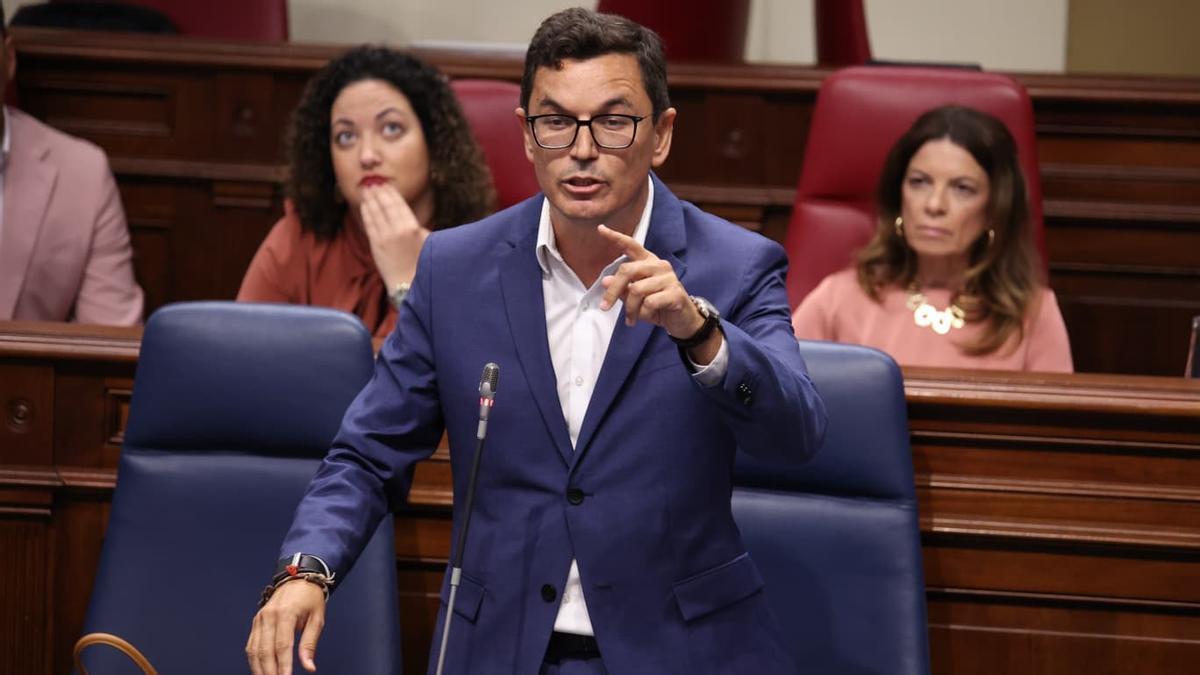
The Canary Islands government has issued a blunt warning to the semi-public airport operator Aena, stating it “has no say” in the political negotiation over participation in airport management. The message, delivered this Wednesday in the regional parliament by the Minister for Public Works and Mobility, Pablo Rodríguez, amounts to a clear declaration of intent and comes exactly one week after President Fernando Clavijo accepted the state’s proposal to negotiate a role in airport management similar to the deal Pedro Sánchez struck with the Basque lehendakari Imanol Pradales in March.
“We are not asking for a seat on Aena’s board of directors, but to participate actively in decisions and even in setting fees, based on what our Statute of Autonomy says. So Aena has no say in this discussion; it is merely an operator that will have to comply with the state and Canarian legislative framework that both governments decide,” insisted the minister.
Criticism directed at Aena’s CEO
These remarks from the minister show that, at least for now, criticism is aimed more at Aena’s chairman and CEO, Maurici Lucena – who has been highly combative regarding the Canarian request – than at the state itself. This is especially the case given that on 20 May, the Ministry of Territorial Policy and Democratic Memory, led by Ángel Víctor Torres, made a move after four months of confrontation by sending the Canary Islands government a formula “in the same terms” as the one reached two months ago with the Basque Country.
Clavijo has accepted this model, which opens the door for the autonomous community to have a voice in decisions on airport infrastructure, investment and connectivity – though without executive capacity or binding power over Aena. In other words, it will have a voice, but not a vote.
What the state proposal entails
According to the ministry, Torres’s proposal involves opening a round of document exchanges to finalise an agreement that could be raised at a forthcoming bilateral transfer commission between both administrations in June. The formula includes the creation of a bilateral body for airports of general interest located in the archipelago, to participate in airport planning, connectivity, service quality, environmental policies and planned infrastructure investments. It also allows for contributions to the DORA (Airport Regulation Document), which sets Aena’s multi-year investment framework.
Pressure maintained on Lucena
Indeed, Clavijo’s government sent a letter on 25 May asking the relevant state authorities to clarify in detail the terms of the proposal, which is why Rodríguez did not attack the central government in parliament as he has on previous occasions. Pressure remains on Lucena, whom both Clavijo and Rodríguez have accused of prioritising the interests of the 49 per cent represented by private shareholders over the 51 per cent representing the general public interest – to the extent that the regional president called for his dismissal in April, saying: “Maybe it’s time for the Spanish government to change him.”
Despite everything, the minister aimed a barb at Torres when he announced he was initiating the transfer process for aerodromes, something already included in the Statute prior to 2018. “We have been negotiating with AESA (the State Aviation Safety Agency) for over a year on a collaboration agreement for the management of airports that are not of general interest,” he concluded.
What’s happening in the Canaries – straight to your phone
News, weather alerts and practical updates – direct from the islands, in English. We live here and know what’s going on – before the international media catch up. Everything lands on our WhatsApp channel – no middlemen, no algorithm. Curated for families, expats and travelers.

Tenerife faces huge tourism expansion despite moratorium calls
El Bejeque in Las Canteras adds sea to its fire

Siam Park Gran Canaria must build its own desalination plant
Fuerteventura’s biggest resort to open on 1 November
Gran Canaria to teach tourism history in schools
Canary Islands see 0.3% rise in foreign tourists in August

Row over 368-bed hotel project in La Gomera
Spanish astronaut trains in Lanzarote for Moon mission

Tivoli La Caleta hosts first red tuna Kaitai in Canarias