
American rootstocks trialled in phylloxera battle
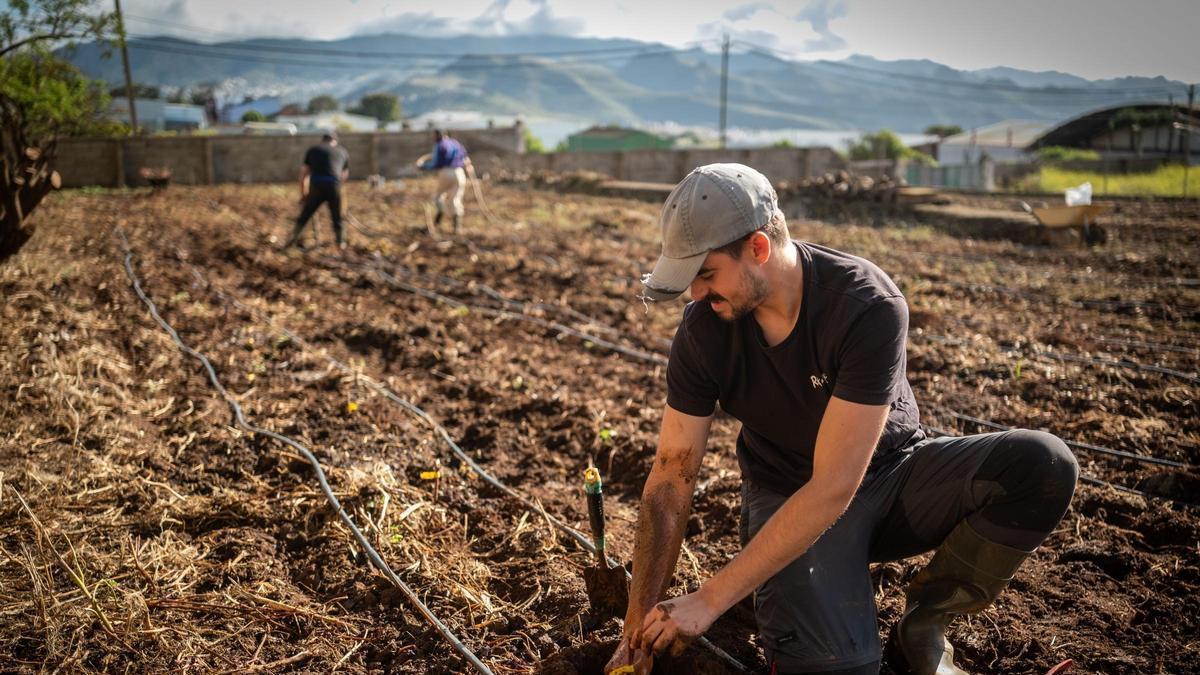
A project using American vine rootstocks is offering a potential solution should phylloxera spread across the Canary Islands. The initiative, led by the regional government, has one of its first test sites at Finca Morales in Los Baldíos, La Laguna.
Grafting traditional varieties for resilience
The goal is to identify the most suitable rootstocks onto which traditional grape varieties can be grafted. This would serve as a possible response if the insect were to become widespread, and as a tool to improve crop yields amid water shortages and the deterioration of plant material.
Narvay Quintero, the regional Minister for Agriculture, Livestock, Fisheries and Food Sovereignty, visited the La Laguna farm on Tuesday and explained that the work is taking place on plots that had lain fallow for years. “We are only talking about new plots, at different altitudes and on different islands,” said the minister. He also stated that no new phylloxera-infected plants have been found since November 2025. “All cases have been located and all infected plants have been eliminated,” he stressed.
From fallow land to experimental vineyard
The plot in Los Baldíos was once used for vines but more recently had no specific crops, with only a few fruit trees and some roaming animals. Gabriel Morales, co-owner of Vinos En Tándem, explained that they decided to return the land to viticulture, adding it to their other production sites elsewhere in Tenerife.
“The aim of this initiative is to evaluate, in real growing conditions, the performance of different vine rootstocks when combined with varieties adapted to each area. The goal is to create plants that are more resistant to the insect while also improving crop yield and production under the climatic, soil and biological conditions of the archipelago,” a regional government spokesman said.
Five-year trials across the islands
The action was approved by the scientific-technical committee set up in September last year as an advisory body for the control and eradication of phylloxera. In more detail, the trials will take place on voluntary farms linked to all the protected designations of origin for Canary Islands wines, located in Tenerife, La Palma, La Gomera, Gran Canaria, Lanzarote and Fuerteventura.
The ministry is covering the cost of the work, carrying out the grafting with specialised staff, and will provide technical monitoring throughout the initiative, which is expected to last five years. This is “the period necessary to obtain rigorous, consistent results that can be applied across the sector,” the statement added.
Financial support for participating growers
According to figures from the regional government, participating farmers will receive financial compensation: a grant of €4,000 during the first year, corresponding to the planting phase, and an additional €1,000 for each of the following four years for the maintenance of each trial plot.
Quintero stressed that this work is part of “a broader line of action that the Canary Islands Government has been developing since phylloxera was detected, in order to guarantee its control, prevent its spread and move towards its eradication.” In this regard, he said that this year a total investment of €1.1 million has been allocated to measures against the insect.
What’s happening in the Canaries – straight to your phone
News, weather alerts and practical updates – direct from the islands, in English. We live here and know what’s going on – before the international media catch up. Everything lands on our WhatsApp channel – no middlemen, no algorithm. Curated for families, expats and travelers.

Canary Islands sea hits second-hottest year on record

Legal bid to halt tree felling in Santa Cruz’s La Salud

Fiesta del Charco: A journey through La Aldea’s past

Corralejo dunes power line set for removal

ULPGC launches 14 research projects at Las Canteras

TMT will never be built, says Canary Islands astrophysics chief

Pedro Duque: Canarias is the “ultimate dream” for rockets

Court blow to Tenerife motor circuit project
La Palma faces new volcanic risk planning deadline
