Moroccan delegation arrives in Canaries to build on January agreements
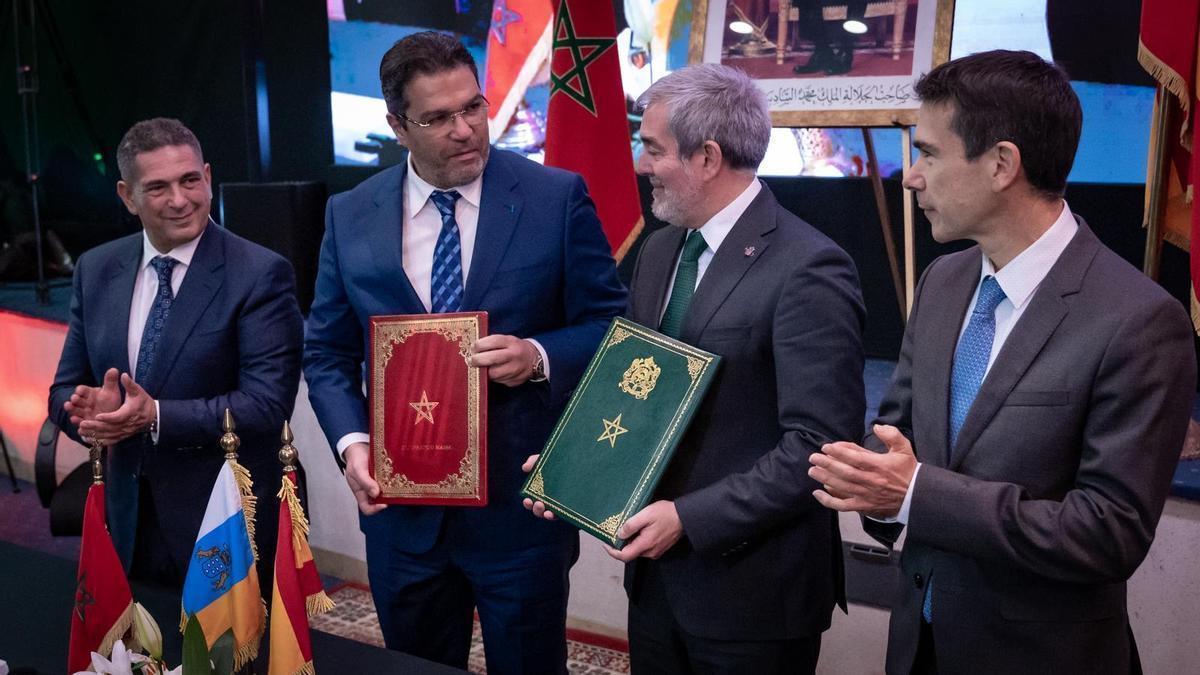
Three months after a Canary Islands institutional and business delegation wrapped up an intensive working agenda in Agadir—signing more than a dozen agreements and pledging a new era of cooperation with Morocco—the conversations begun there are now returning to the archipelago with the aim of turning projects into reality. The official visit beginning this Monday with institutional meetings in the Canary Islands, led by the president of the Souss Massa Regional Council, Karim Achengli, represents a direct continuation of that mission and an attempt to transform the commitments made into concrete results.
From pledges to projects
The January trip to Agadir—the largest institutional and business mission ever organised by the Canary Islands in that Moroccan region—closed with a clear message from regional president Fernando Clavijo: the archipelago must seize the economic growth of its neighbouring country and avoid what he described as “absurd isolationism”. That visit enabled the signing of ten collaboration agreements and a memorandum of understanding covering tourism, agriculture, industry, logistics and ship repair, while also opening contacts in sectors considered strategic for both sides.
Over three days, and until 29 April, more than fifty institutional, business, academic and sports representatives from the Moroccan region are returning the visit to the Canary Islands with an agenda focused on giving continuity to the work carried out in January. The proceedings will formally begin this Monday with a bilateral meeting between Clavijo and Achengli, followed by a plenary session to discuss the development of the agreements signed and new lines of cooperation.
Strategic relations with Atlantic Africa
The visit is part of the Canary Islands government’s strategy to consolidate a stable, long-term relationship with neighbouring territories in Atlantic Africa, based on institutional cooperation, economic development and the generation of shared opportunities. During the January trip, both the regional government and Canarian business leaders argued the need to view Morocco’s economic growth as an opportunity rather than a threat. The president of the Canarian Confederation of Business Owners, Pedro Ortega, insisted at the time that the islands could not turn their backs on a nearby and expanding market, and stressed that getting to know the competition and establishing direct relationships was essential for identifying real business opportunities.
That approach now guides the working agenda planned in the Canary Islands, where B2B business meetings between companies from both territories will play a prominent role. These meetings are designed as a tool to identify concrete investment projects and consolidate a stable space for economic cooperation between the two sides of the Atlantic.
Key infrastructure and blue economy
The Moroccan delegation will also visit infrastructure considered strategic for the archipelago’s economic model, including the Port of Las Palmas, the Canary Islands Institute of Technology and various facilities linked to water management, innovation, tourism, the primary sector and universities. The aim of these tours is to exchange experiences and advance joint projects in the blue economy, sustainability, digitalisation and training. The Canary Islands’ public universities will once again play a relevant role in this process, in line with the drive for academic and scientific cooperation as one of the pillars of the Canary Islands-Africa strategy. Collaboration in research, talent mobility and knowledge transfer are among the shared priorities, alongside common challenges such as the energy transition and water resource management.
World Cup 2030 and tourism opportunities
The agenda also includes meetings linked to preparations for the 2030 FIFA World Cup, which will be jointly organised by Spain, Morocco and Portugal, opening up new opportunities for collaboration in sport and the international projection of both territories, with potential investments and talent attraction. In tourism—one of the main focuses of the January mission—the possibility of generating investment projects linked to recovering hotel establishments left inactive after the pandemic in the Moroccan region was raised, as well as developing new complexes in areas with available land. The creation of combined tourism products between the Canary Islands and Souss Massa was also proposed, a formula that would allow the diversification of offerings and the attraction of new international markets.
Boosting air and sea links
In the transport sector, the contacts made opened the door to projects for improving maritime and air connectivity between the Canary Islands and Agadir, with the aim of facilitating trade, boosting tourism and supporting business activity between the two territories.

Tenerife’s Char Fuego y Brasas named 13th best steak restaurant in Europe

Gran Hotel Taoro: a foodie destination in Puerto de la Cruz

Canary Islands hotel prices rise 4.11% in September

Icod de los Vinos launches twelve self-guided routes
Four new openings shaking up Las Palmas dining scene

Tenerife faces huge tourism expansion despite moratorium calls
El Bejeque in Las Canteras adds sea to its fire
Siam Park Gran Canaria must build its own desalination plant
Fuerteventura’s biggest resort to open on 1 November