
Storm Therese Disrupts Canary Islands Air Traffic
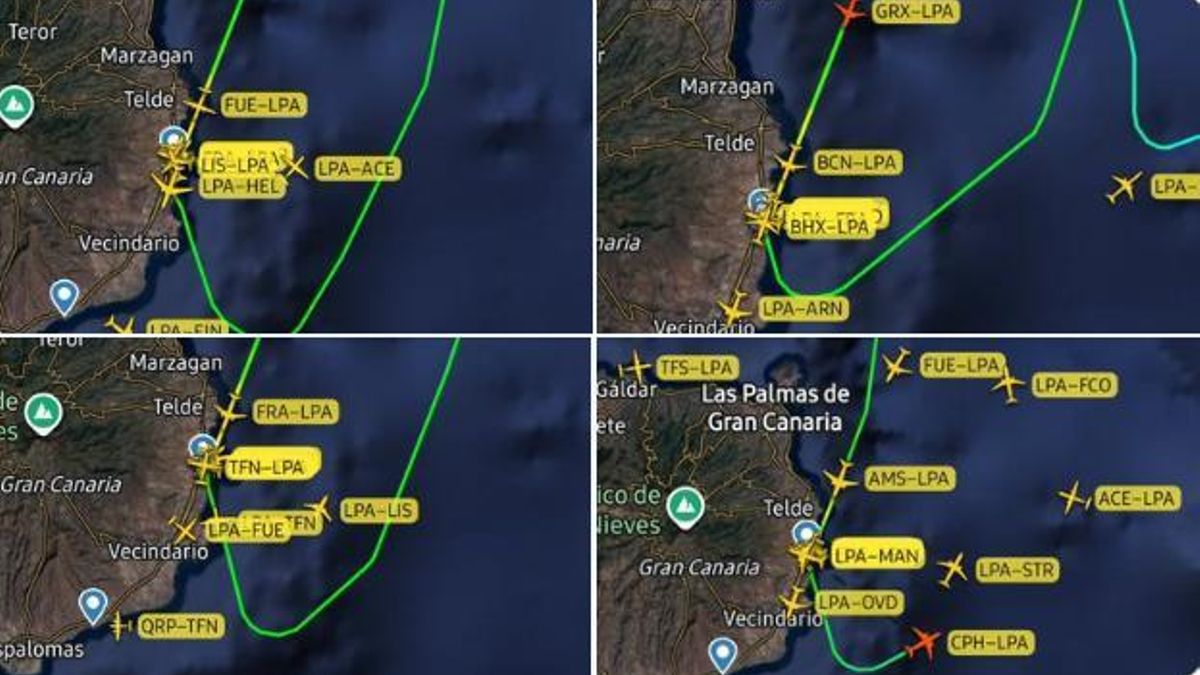
The storm named Therese continues to cause disruptions to air traffic across the archipelago. As of this Friday, a total of 25 flight cancellations and five diversions have been recorded at Canary Islands airports. Furthermore, several flights have experienced aborted landings, known as go-arounds, at Gran Canaria due to strong, gusty winds and wind shear.
Understanding the Dangers of Wind Shear
As explained by Air Traffic Controllers on their X profile, these sudden changes in wind intensity or direction during descent are considered critical. “When an aircraft is in landing configuration, it flies at a relatively low and stable speed,” they stated. “Wind shear breaks that equilibrium in two ways.”
“On one hand, a loss of lift can occur. If a headwind suddenly disappears or turns into a tailwind, the air flowing over the wings decreases dramatically, and the aircraft can drop abruptly. It can also cause a deviation in trajectory, meaning sudden lateral shifts that can pull the aircraft off the runway centreline at the last moment, making the landing unsafe,” emphasised Air Traffic Controllers in their tweet.
The Go-Around: A Standard Safety Manoeuvre
Despite the stress this meteorological phenomenon may cause for passengers, who feel a sudden increase in engine power and a sharp climb, Air Traffic Controllers clarify that this is in fact the standard safety procedure when a landing is not 100% secure.
Jet Stream Propels Departing Flights to Extreme Speeds
Among other effects of Storm Therese’s passage over the Canaries is that, thanks to the powerful winds, flights departing the islands and heading north are being propelled to reach dizzying speeds within the island’s airspace. Air Traffic Controllers, also via social media, indicated that ground speeds of over 1,100 km/h have been recorded.
“What’s happening?” the account asked, before offering an explanation for these unusual speeds. They stressed that safety remains paramount and, despite the impressive figure, this does not pose a risk. “It does not mean dangerously approaching the speed of sound (Mach 1) and presents no structural problem for the aircraft. Simply put, we are travelling within an air mass that is moving very fast,” they concluded.

Storm Therese Floods Homes in Adeje, Forces Evacuations

Storm Therese Isolates 200 in Gran Canaria as River Bursts Banks

Storm Therese Batters Canaries with Snow on Teide

Storm Therese Hits Tenerife: Essential Driving Safety Tips

Storm Therese Approaches Canary Islands with Severe Weather Alert

Storm Therese to Batter Canaries for Five Days with Wind and Rain

Storm Samuel Set to Batter Canary Islands with Unusual Force

Storm Set to Bring Rain, Wind and Snow to Canary Islands

A Chilly, Wet Start to Spring Forecast for the Canary Islands
