Canary Islands ETS: flights could cost up to 20 euros more
Flying between the Canary Islands could cost an extra two or three euros, while a ticket to mainland Spain could rise by between 15 and 20 euros. That is the scale of the price hike that the application of the Emissions Trading System (ETS) to air connectivity in the Canary Islands would bring, according to an executive report analysing the impact of this regulation on the archipelago.
Clavijo calls for firm defence of exemptions
The President of the Canary Islands, Fernando Clavijo, has called on the Spanish government to defend “firmly and decisively” before the European Union the “pressing need” to maintain the exemptions provided for the outermost regions in EU climate legislation. In a letter addressed to the Prime Minister, Pedro Sánchez, Clavijo urges the Spanish executive to fight in Brussels to ensure that air and sea connections between the islands, as well as those linking the archipelago with the Spanish mainland, remain exempt from ETS payments beyond 2030.
Current rules penalise Canary Islands ports
The current legislation only accounts for 50% of emissions on maritime connections with third countries, while applying 100% to routes with the Canary Islands. The regional government aims to correct this disparity by taking advantage of the regulatory review being prepared by Ursula von der Leyen’s team, with the aim of preventing the archipelago’s ports from continuing to be penalised by the diversion of maritime traffic to facilities in North Africa. In this vein, a report commissioned by the Canary Islands Executive warns of the competitive distortions that ETS is generating in the islands’ ports, since only air and sea routes with the Spanish mainland are exempt, but not maritime connections with other European countries.
Bruselas review could determine future of exemptions
The request comes at a pivotal moment, coinciding with Brussels’ evaluation of the directives for the European Union Emissions Trading System for air and maritime transport. The conclusions of this evaluation will be known before the summer and will determine whether the exemption for the outermost regions is maintained and whether the rates applied to ports in third countries are modified. The head of the Canary Islands Executive warns that the full application of this system in the archipelago would mean an increase in transport costs and could cause the diversion of maritime traffic to alternative routes. In his view, these consequences would have a direct impact on key sectors such as tourism and trade, in addition to affecting the socio-economic development of the archipelago.
“Fundamental” to maintain exemptions beyond 2030
“It is fundamentally important that the Spanish government communicates to the European Commission, firmly and decisively, the pressing need to maintain these exemptions beyond 2030,” Clavijo demands of Sánchez. “Otherwise,” he adds, “the negative impact that this could bring for our archipelago would be disastrous, given the inherent constraints of the Canary Islands as an outermost region and the lack of alternative land connectivity.” Faced with this danger, the president highlights that France and Portugal have already taken action in defence of their respective outermost regions, and therefore considers it essential that Spain “join this common position to convey a message of unity before the European institutions.”
Common front of three EU states considered key
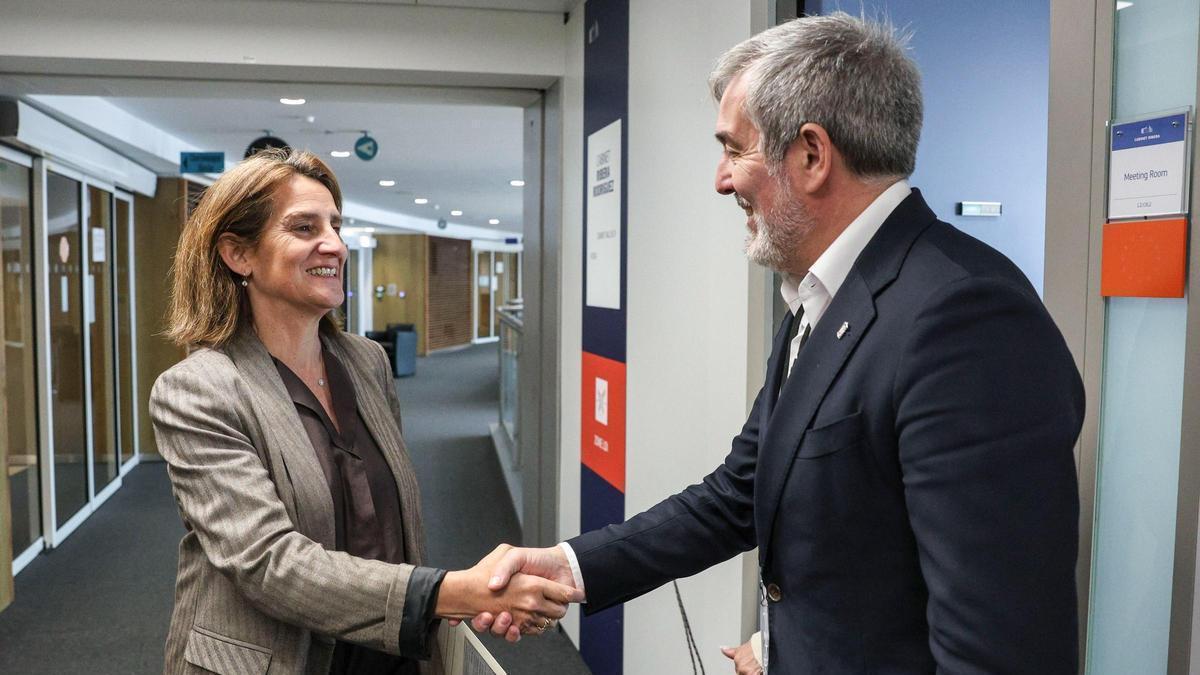
This united front of the three states with territories covered by Article 349 of the EU Treaty is considered key by the Canary Islands government at a time when the European Executive is finalising its report on the effect of ETS during its first two years of application. The letter to Pedro Sánchez follows the intensive work agenda on this issue that President Fernando Clavijo held in Brussels a few weeks ago. He then met with the Executive Vice-President of the European Commission for a Clean, Just and Competitive Transition, Teresa Ribera; the European Commissioner for Transport and Tourism, Apostolos Tzitzikostas; and the team from the cabinet of the European Commissioner for Climate, Wopke Hoekstra. Clavijo secured clear backing from Commissioner Tzitzikostas for protecting the outermost region exemptions in ETS, while Vice-President Ribera confirmed that Brussels is currently immersed in a “listening process,” which is why the Canary Islands is calling on the State to step up pressure now, together with France and Portugal, on the European Commission.
What’s happening in the Canaries – straight to your phone
News, weather alerts and practical updates – direct from the islands, in English. We live here and know what’s going on – before the international media catch up. Everything lands on our WhatsApp channel – no middlemen, no algorithm. Curated for families, expats and travelers.

Tenerife faces huge tourism expansion despite moratorium calls
El Bejeque in Las Canteras adds sea to its fire

Siam Park Gran Canaria must build its own desalination plant

Fuerteventura’s biggest resort to open on 1 November
Gran Canaria to teach tourism history in schools
Canary Islands see 0.3% rise in foreign tourists in August

Row over 368-bed hotel project in La Gomera
Spanish astronaut trains in Lanzarote for Moon mission

Tivoli La Caleta hosts first red tuna Kaitai in Canarias