
Allow two hours for the visit, of which the underground route itself takes exactly sixty minutes. Living on Tenerife day to day, I am quite wary of heavily commercialised natural wonders. Back home, the volcanic Cueva del Viento means raw rock, helmets on heads, narrow passages and complete, almost ear-ringing natural silence. So when we planned a trip to the Balearics and I typed Drach Caves Majorca into the search bar, I expected a big tourist machine. It turned out to be a powerful, almost operatic show that you should treat as a precisely staged performance. Our sons were initially very sceptical about the idea of walking through dark holes in the ground, but in the end the Majorcan underground left a strong impression on them.
If you are wondering what to see while building your detailed family trip plan for Spain, the island’s east coast and its karst formations almost always end up at the top of the recommendations. You should know what you are signing up for, though. These are huge paved halls where you will feel a peculiar, piercing chill, hear the constant echo of hundreds of footsteps and experience cold drops of water falling straight onto the back of your neck. In this guide I break down all the caves in Majorca – I will tell you what to avoid, where you cannot go with a pushchair and why you should skip one particular boat trip. Also check: Majorca with children guide.
- Is Drach Cave worth visiting with children?
- Coves del Drach (Dragon Caves) – Majorca's top attraction
- Coves dels Hams – the second big cave
- Coves d'Artà – for those who want to avoid the crowds
- Drach vs Hams vs Artà compared
- Getting there and when to go
- What to bring when visiting the caves
- Frequently asked questions
- Is Drach Cave in Majorca worth visiting with children?
Is Drach Cave worth visiting with children?

Yes, if your children are at least three years old, can walk on their own for a good while, and you prepare them for the specific conditions underground. Many people think the dragon caves in Majorca are an ordinary, relaxing stroll you can fit in straight from the beach. Far from it. You go down deep into the earth, where the temperature drops to 21 degrees Celsius and humidity hovers around eighty per cent. Your T-shirt quickly becomes sticky, and a strong smell of wet earth, fungi and settling minerals hits your nostrils.
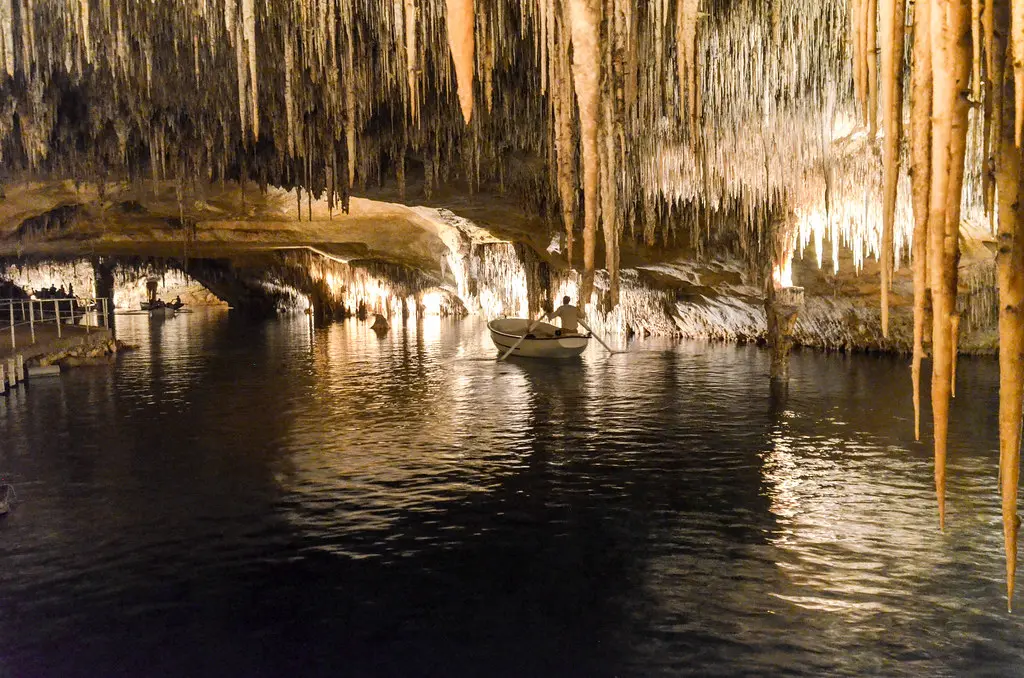
What will surprise younger children most? Above all the darkness, which at some points is total, and the echo, which amplifies every sound and rustle. With a small baby it is much harder. You will not get a pushchair in there for love nor money, because the route is full of slippery stone steps and changes in level. The only sensible option is an ergonomic carrier, which means an hour of walking for the parent with extra weight in a fairly stuffy, humid environment. Despite these physical inconveniences, the play of light on the stalactites, the huge rock formations hanging overhead and the reflections of limestone stalactites in perfectly smooth sheets of water engage children’s attention very strongly. Going down into the Drach caves was like stepping into the set of a treasure-hunter film.
Coves del Drach (Dragon Caves) – Majorca’s top attraction

This is the absolute number one in tour operator catalogues and the most visited place on the east coast. Coves del Drach is located in a small tourist town, which is why the term Porto Cristo caves is very often used to point to the exact destination. The system consists of four huge interconnected chambers: the Black Cave (Cova Negra), the White Cave (Cova Blanca), the Cave of Luis Salvador (Cova de Lluís Salvador) and the Cave of the French (Cova dels Francesos). The whole route is about 1,200 metres long and is covered in a group of several hundred people, step by step, walking along a paved path protected by metal railings.
The descent and problems in the tunnel

From the very first metres you will feel the impact of the specific microclimate. The chill wraps around your shoulders, and the sound of dripping water carries in a loud echo through halls several metres high. The lower we went, the dimmer the light became. In one of the narrower, taller corridors in Cova Negra we hit our first small crisis. The older one suddenly stopped halfway down the steps and flatly refused to go any further. The enclosed space, the loud, thundering echo of hundreds of other tourists’ footsteps and the overwhelming awareness of millions of tonnes of rock overhead triggered sudden anxiety in him. We had to let several dozen people pass, stand right by the railing under a damp wall and give him a good five minutes to steady his breathing. What helped was explaining how the acoustics of the rock work and treating it as a physics lesson.
Martel Lake and the concert in the dark

The main event, the reason thousands of people visit every day, is one of the largest underground lakes in the world – Martel Lake, stretching 177 metres. This is where the famous concert in the Drach cave takes place. Long wooden benches are set along the shore, forming a huge, dark amphitheatre. When the whole group sits down, absolutely all the lights go out. The darkness is literal, physically palpable, which makes many younger children cry and reach for their parents’ hands.
Our younger son bore the hardships of the walk very bravely, but when we sat down on the cold, damp bench and total darkness fell, his body shut down. From the tiredness of walking and the monotony of the gloom, he simply rested his head on my shoulder and fell asleep sitting up. He woke up disoriented a good few minutes later, when three slowly moving boats emerged from the darkness, lit only by a faint glow styled to look like candles, and the sounds of a string quartet spread through the cave. The musicians play a classical repertoire live, and the resonance boxes of the cellos and violins combined with the rock vault produce an incredibly powerful, vibrating sound that you can feel in your chest. You should keep your expectations realistic, though: the performance lasts exactly 10 minutes, it is not an hour-long opera.
The boat trip after the concert
When the last notes fade, the lights come on and the crowd heads for the jetty. Every ticket entitles you to a short boat trip to the exit. It is a hundred-metre stretch, and a gigantic, slow-moving queue forms for it. Tired tourists, crying toddlers, stuffy air and general weariness. We made a quick decision. Instead of standing and waiting in the crush, we simply skipped the boat trip and walked along a special bridge built along the shore. It turned out to be a brilliant move. The bridge was almost empty, and we could calmly look down at the crystal-clear, illuminated water without stress and without elbowing our way along in a wooden boat.
Practical information and tickets
The basic facts you need to know before you go:
- 🕐 Opening hours: Open all year. In season (from 11 March to 31 October) entry times are at regular intervals: 10:00, 11:00, 12:00, 14:00, 15:00, 16:00, 17:00. In winter there are fewer entry times: 10:30, 12:00, 14:00, 15:30.
- 💰 Ticket prices: Drach cave tickets cost 18.50 € per adult online (19.50 € at the ticket office). Children aged 3 to 12 pay 11.50 € online (12.50 € at the ticket office). Children aged 0-2 go free, but you need to get a ticket for them.
- 🚇 Getting there: By car to Porto Cristo or by TIB bus. There are large free car parks on site.
- ⏱️ Visit duration: Exactly 60 minutes, set by the pace of the group in front of you. The distance is 1.2 km.
- https://www.cuevasdeldrach.com/pl/index.php
The golden rule that will save you stress: buy tickets online a few days before your visit to reserve a specific entry time and skip the huge queues at the ticket office.
Coves dels Hams – the second big cave

Just a few minutes’ drive further on are the Hams caves, often treated as an alternative or an add-on for those hungry for geological sights. Coves dels Hams offers a completely different aesthetic and character. They are slightly more expensive (an adult pays around 24 € and a child 12 €), the visit is shorter (about 45 minutes), but the plus is noticeably smaller groups of tourists, which matters a lot with children.
This place is known worldwide for its very specific speleothem formations, called helictites by geologists. In local slang people call them “rock anemones” or simply the Majorcan “hams”, meaning fishing hooks. These strange structures, most numerous in the “Angel’s Dream” hall, grow in completely chaotic directions that seem to defy gravity. They look like fragile branches of underwater coral taken straight from the ocean floor.
Paradoxically, it was not the limestone hooks that stole our boys’ hearts. The Coves dels Hams visit starts in the Cueva Redonda (Round Cave), an open space filled in centuries ago, where a rich botanical garden with a specific microclimate now operates. Loudly screeching peacocks walk freely among the ferns and trees. To my slight disappointment, watching a huge bird at close range was incomparably more interesting for the boys than the million-year-old speleothem formations deep underground.

Underground, on the Venetian Sea (a small lake), a musical show has also been prepared, titled “Magical Mozart”. It is shorter, though, more dominated by visual projections and does not have the same scale as the competition a few kilometres away. If peace and quiet matter a lot to you and your children get bored quickly in large crowds, the smaller groups at Hams may make up for the higher ticket price. Golden tip: choose a visit to Hams as your first attraction in the morning, to enjoy the open garden with the peacocks without the tiring afternoon heat.
Coves d’Artà – for those who want to avoid the crowds
If you want to avoid the commercial crowds entirely, Coves d’Artà is in Capdepera, on the north-east corner of the island. It is a much less popular option, though many cave enthusiasts consider it the most geologically interesting of the island’s show caves. The underground chambers here are the tallest and most spacious, which reduces any feeling of claustrophobia.
Ticket prices are very close to Drach (17 € adults, 9 € children aged 7-12, younger children free). What you will not find here: there is no underground lake with an orchestra playing in boats, and no boat trip for visitors. Instead, the organisers have put together dramatic light shows that sit well with the rawness of the place. The highlight is a giant stalagmite over twenty metres tall in a chamber known as the “Queen of Pillars”. Because visitor numbers are lower, groups with a multilingual guide are smaller, and the whole route takes just 35 to 40 minutes. It is an excellent alternative if you want to show your children the scale of the caves but worry about panic in a dense crowd in the dark.
Drach vs Hams vs Artà compared
Comparing the key features of these three sites will help you decide which one best suits your family’s temperament.
| Feature | Coves del Drach | Coves dels Hams | Coves d’Artà |
|---|---|---|---|
| Location | Porto Cristo | Porto Cristo | Capdepera |
| Advantages with children | Concert on the lake, lighting | Open gardens, free-roaming peacocks | Smaller groups, shorter route (40 min) |
| Tickets (adults) | ~17.50 € | ~24.00 € | ~17.00 € |
| Drawbacks | Huge crowds, total darkness, long distances | More expensive tickets, shorter concert | No boats, no live music |
| Concert / Show | Yes (live classical music) | Yes (Mozart multimedia show) | Light effects only |
Getting there and when to go
Getting there takes a bit of planning, especially if you are staying at the opposite end of the island. The fastest option is a hire car. Roads in Majorca are excellent quality. From the popular family resort of Alcudia in the north, the drive takes about 45 minutes at a relaxed pace. If you set off from the capital, Palma, the journey takes an hour and ten minutes. On arrival there are large free parking areas among the trees, where you will also find dedicated picnic zones. In peak summer season, aim to be at the car park at least half an hour before the entry time printed on your ticket.
But what if you are travelling by public transport? There is a trap here. Many online guides recommend the TIB 412 line. Watch out for that. The 412 bus does serve the east coast, but it goes through Sant Llorenç and Manacor straight to Cala Millor, skipping the main destination. To get from Palma straight to the entrance of the caves without any trouble, take the 401 bus. The stop is practically next to the entrance gates. The cheapest way to pay for tickets on TIB buses is to tap a normal bank card on the reader as you get on and off.
What to bring when visiting the caves
Packing the right things in your backpack will decide how comfortable the visit is, so tick off a few important points before you set off.
- Sturdy footwear: Ordinary flip-flops or sandals on a slippery limestone floor wet from dripping water are asking for a painful fall. Wear comfortable trainers or sports shoes with rubber soles.
- A warm layer: Outside it may be a hot Spanish summer at 35 degrees, but down below it stays at a constant 21°C. A light zip-up hoodie thrown over your shoulders sorts out goosebumps, especially when sitting still during the concert.
- A baby carrier: Do not even try to bring a pushchair. The number of stairs, narrow spots and uneven surfaces rules out anything on wheels completely. Parents with pushchairs are usually turned back by staff just before the gates.
- A bottle of water: With 80 per cent humidity it will simply feel very stuffy. A sip of clean water halfway round really helps settle tired kids.
Frequently asked questions
Yes, as long as the child is over 3 and walks well. The lighting, the huge chambers and the short light shows hold their attention effectively. Just remember to warn them about the high humidity, the drop in temperature and the moments of complete darkness, which can cause brief unease.
From birth, there are no age restrictions. Children from 0 to 2 go in completely free, but when booking online you must add their 0 € ticket to the basket. Bear in mind that the terrain rules out pushchairs, so a baby has to be carried in an ergonomic carrier.
Yes, it is the main 10-minute point of the route, taking place on Lake Martel. A string quartet floats across the water on lit boats, playing classical pieces live, and the rock acoustics amplify the sound. The audience sits on wooden benches in complete darkness broken only by the glow of candles on the boats.
A family of four (two adults and two children aged 3-12) will pay around 56 € when buying tickets online. The exact rates are around 17.50 € for an adult and 10.50 € for a child when bought online. At the on-site ticket office commissions are added, so each person pays on average two euros more.
The drive straight from Alcudia along the east coast takes around 45 minutes. From the capital, Palma, the route takes a little over an hour. If you plan to get there by public transport from Palma, avoid the 412 line and choose the red TIB number 401 instead, which stops right by the ticket office entrance.
Drach is huge, has a lake 177 metres long and a live string quartet, while Hams is known for its unique helicktites and an open garden with peacocks. Hams offers a shorter visit, clearly smaller tourist crowds and a more multimedia show on the underground Venetian Sea. On price, entry to Hams is noticeably more expensive.
No, staff strictly forbid it at the entrance gates. The underground structure is 1,200 metres of distance packed with stairs up and down, narrow passages and a constantly damp, slippery surface. You are on your own, or rely on a proper carrier for smaller children.
Exactly an hour from passing through the gates. You go round in a group of other tourists moving at a steady pace set by the staff directing traffic. The distance includes the walk, a short concert in the amphitheatre and an optional boat trip, after which everyone slowly makes their way outside.
Yes, in July and August it is absolutely essential to avoid long disappointment on the day. The online booking system lets you pick a specific time and also lowers the price of each ticket by almost two euros, saving you from queueing at the ticket office at the entrance.
Coves d’Artà, in the north-east corner of the island near Capdepera, is the quietest route of all the big limestone systems in the Balearics. That means much more comfortable walking up and down the stairs without being pushed by other people, but in exchange it has no boats on a lake and no live concerts.
Is Drach Cave in Majorca worth visiting with children?
From my perspective the trip was a considerable logistical challenge, especially when it came to keeping the youngest motivated and patient in the crowd, but it is an experience people talk about long after they get back. Coves del Drach impresses with its massive paved infrastructure, the size of the lake itself and the flawless acoustics during the performance. Our personal top 3 definitely includes the light show on the stalactites, the cool air that gives relief after the heat outside and, which turned out to be an absolute hit with our sons, the chance to see huge peacock feathers up close on the birds walking right by the ticket offices of the nearby Hams caves.
This is not a quiet stroll for loners, as I explain while building a wider picture in the text Majorca – pros and cons, is it worth going? You have to go there knowing what you are signing up for, let go of frustration at people pushing past and enjoy this particular limestone-and-music spectacle under thousands of tonnes of rock. Because seeing Lake Martel lit up in turquoise in the very middle of the earth, with violins playing on it, really does make a big impression on both the big and small members of the family.