Compiled with the help of artificial intelligence, based on Spanish-language information. Source below the article.
Tenerife approves €5bn sustainable mobility plan
The Cabildo de Tenerife has given definitive approval to the island’s Sustainable Mobility Plan (PIMSIT), a roadmap containing 92 specific measures designed to transform transport on the island over the next two decades.
In a statement issued this Wednesday, the island authority said the strategy involves an investment of €5.097 billion up to 2035 — the largest sum ever earmarked for mobility on Tenerife, according to the island government.
Nine programmes spanning every level of government
The document, which received the green light from the island’s Governing Council this Wednesday, sets out a strategic plan for mobility in Tenerife through nine programmes involving every level of government. These cover areas including boosting public transport, road infrastructure, electric mobility, a commitment to intermodality, digitalisation and the management of private vehicles.
The Cabildo says the plan has a favourable Strategic Environmental Declaration from Tenerife’s Environmental Assessment Commission (CEAT), approved unanimously on 11 August. In its ruling, the commission highlighted the positive effects of the plan on citizens’ wellbeing and the environment, praising factors such as reduced CO2 emissions, lower noise levels, the fight against climate change and the protection of natural areas.
‘A historic document’
The president of the Cabildo, Rosa Dávila, described it at a press conference as a historic document that aims to transform mobility in the coming decades through 92 measures organised into nine programmes involving all branches of government.
For her part, the Cabildo’s minister for mobility, Eulalia García, recalled that one of the main objectives is to offer ever more alternatives to the private car and to make getting around Tenerife “more accessible, inclusive, clean and efficient”. She added, however, that the plan includes no measure to limit the number of hire cars on the island, as already happens in the Balearic Islands, for example.
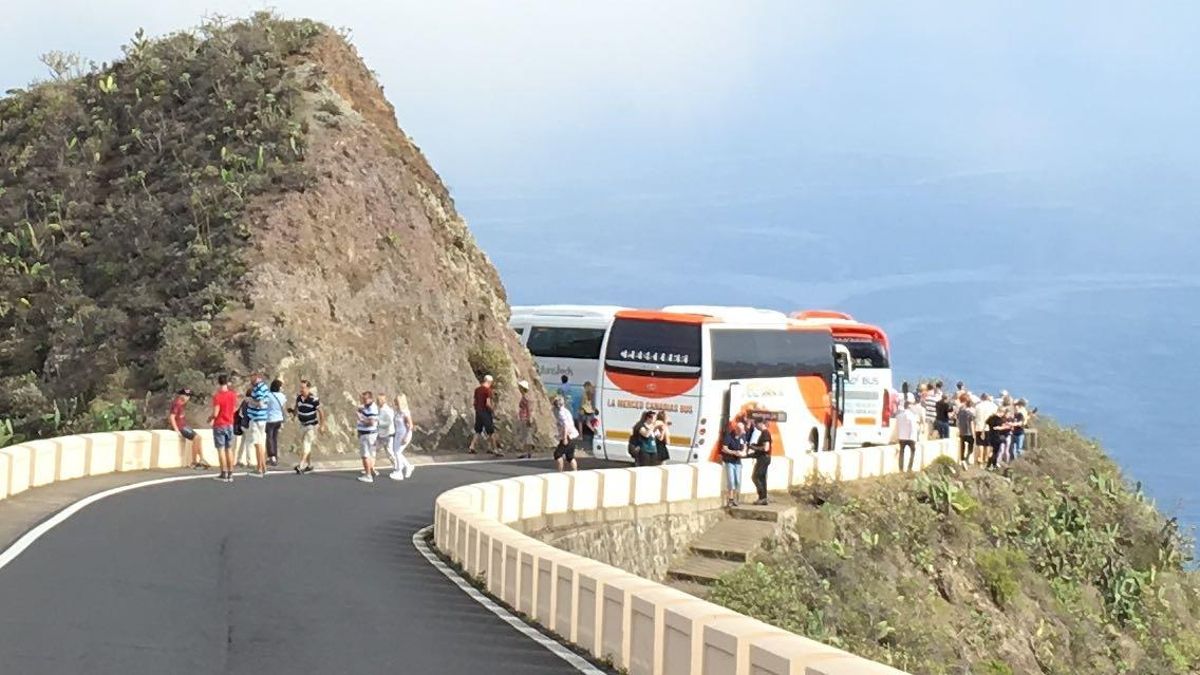
Places such as the Teide National Park, Teno, Masca and Anaga are overwhelmed by vehicles, most of them hire cars, without the Cabildo having so far adopted any measures on this type of mobility. It is worth recalling that residents and representatives of several groups demonstrated last March in Anaga to denounce the daily gridlock and influx of visitors in this protected natural area, declared a UNESCO Biosphere Reserve for its rich biodiversity.
Two time horizons and a multi-billion-euro budget
The plan is projected over two time horizons, 2035 and 2045. The first sets an interim deadline for responding to the mobility challenges Tenerife will face in the coming years, while the second sets out a long-term vision aimed at anticipating the island’s future needs.
It also provides for a total investment of €5.097 billion up to 2035 to carry out the planned measures, of which the Cabildo de Tenerife will assume €1.222 billion, to which will be added the funding expected from the Government of the Canary Islands, the Spanish central government and the island’s town halls.
Following its approval this Wednesday by the Governing Council, the PIMSIT will be presented on 25 September to the Plenary Committee and will subsequently be put before the ordinary plenary session of the island authority.
Third lanes, trams and park-and-ride sites
Among the key sections of the sustainable mobility plan are infrastructure and facilities for the public transport system, roads, intermodality — including trains — the control and regulation of private vehicles, a commitment to green corridors and the electrification of collective transport.
The project seeks to improve traffic flow and reduce congestion on the most heavily pressured stretches of road, through standout actions such as creating a third lane on the southern motorway between San Isidro and Las Américas and between Gúímar and San Isidro. It also backs a third lane on the northern motorway between Los Rodeos airport and La Orotava.
The measures also include modernising and strengthening the public and collective transport network to match supply to users’ needs, and expanding the tram network. Optimising and expanding school transport is also envisaged.
Likewise, among its programmes the PIMSIT promotes infrastructure that encourages the use of public transport, with the Cabildo citing as examples the creation of an island-wide network of park-and-ride sites and the promotion of bus and high-occupancy vehicle (BUS-VAO) lanes on the main TF-1 and TF-5 corridors.
Developing car-sharing and lift-sharing platforms and apps, establishing urban green corridors, supporting the creation of low-emission zones and promoting an island-wide network of charging infrastructure for electric vehicles also form part of the measures planned under the PIMSIT.
These actions build on work carried out over the past three years through the extraordinary reinforcement of public transport, the decarbonisation of the TITSA fleet, the increase in charging points, interchange renovation projects and the promotion of smart BUS-VAO lanes.
What’s happening in the Canaries – straight to your phone
News, weather alerts and practical updates – direct from the islands, in English. We live here and know what’s going on – before the international media catch up. Everything lands on our WhatsApp channel – no middlemen, no algorithm. Curated for families, expats and travelers.
Bus lane to Las Teresitas beach returns this weekend

Sumar Canarias rejects €1.8bn airport expansion plan

Tenerife South airport revamp tender left empty

Canary Islands August arrivals up 0.9% as Spain hits 12.3m

Imserso website crash sparks anger among Canary travel agencies

Binter unveils revamped BinterMás loyalty programme

Canary Islands airports to receive €1.8bn investment

Canary Islands airports to receive €1.8bn investment

Family stranded at Lanzarote airport after flight cancelled