
Compiled with the help of artificial intelligence, based on Spanish-language information. Source below the article.
Canary Islands forests store far more carbon than previously thought
Amid a scorching summer marked by devastating wildfires on an unprecedented scale and a record number of heat-related deaths in Spain, some good news in the fight against climate change has arrived from the Canary Islands: the archipelago’s forests capture more carbon than was previously believed, according to a study recently published in the journal Carbon Balance and Management.
The research estimates that the islands’ woodlands, which cover some 112,735 hectares of land, store 10.26 million tonnes of carbon — 25% more than the figure calculated by the Ministry for Ecological Transition (MITECO) in the fourth national forest inventory, published in 2020. The finding matters because forests represent one of the main defences against the advance of global warming. Through photosynthesis, they absorb carbon dioxide (the principal greenhouse gas) from the atmosphere, release oxygen and retain the carbon, which remains stored in the wood, branches, bark and roots for decades or even centuries.
A pioneering methodology with unprecedented detail
The key to this new publication, which involved scientists from the University of La Laguna (ULL), Goethe University Frankfurt in Germany and the Spanish National Research Council (CSIC), lies in the methodology used. The authors have succeeded in generating maps of extremely high spatial resolution, using a grid of 50 by 50 metres, which make it possible to determine the amount of carbon stored in any type of forest and at any point in the Canary Islands. It is a more advanced methodology than that employed by MITECO and, for the first time, provides this level of detail, which constitutes the great achievement of the work, in the words of Rüdiger Otto, professor in the ULL’s Department of Botany, Ecology and Plant Physiology and lead author of the study.
“This tool could be very useful for sustainable forest management, ecosystem services, biodiversity conservation and regional climate policy,” notes Otto.
La Palma leads the way, followed by Tenerife and La Gomera
The results show that La Palma holds the largest carbon reserve in the archipelago, with 4.14 million tonnes (almost 40% of the total). It is followed by Tenerife, which accounts for 37.5% (3.77 million tonnes), and La Gomera, with 12.4% (1.28 million tonnes). Gran Canaria and El Hierro, which represent 11.8% and 4.9% of the forested area respectively, each hold around 5% of the islands’ total carbon (some 0.5 million tonnes apiece). The research excludes Lanzarote and Fuerteventura owing to the absence of woodland on both islands.
Canary Island pine forests store the most carbon: 57.1% of the total, of which 44.8% corresponds to natural stands and 12.3% to replanting. Evergreen forests, such as laurel forest and monteverde, contain 37% of the reserve. Plantations of exotic species, such as radiata pine or eucalyptus, account for around 5% of the carbon stored. Meanwhile, thermophilous woodlands accumulate barely 1.1% owing to their degraded state as a result of human activity.
Garajonay’s laurel forest rivals tropical rainforests
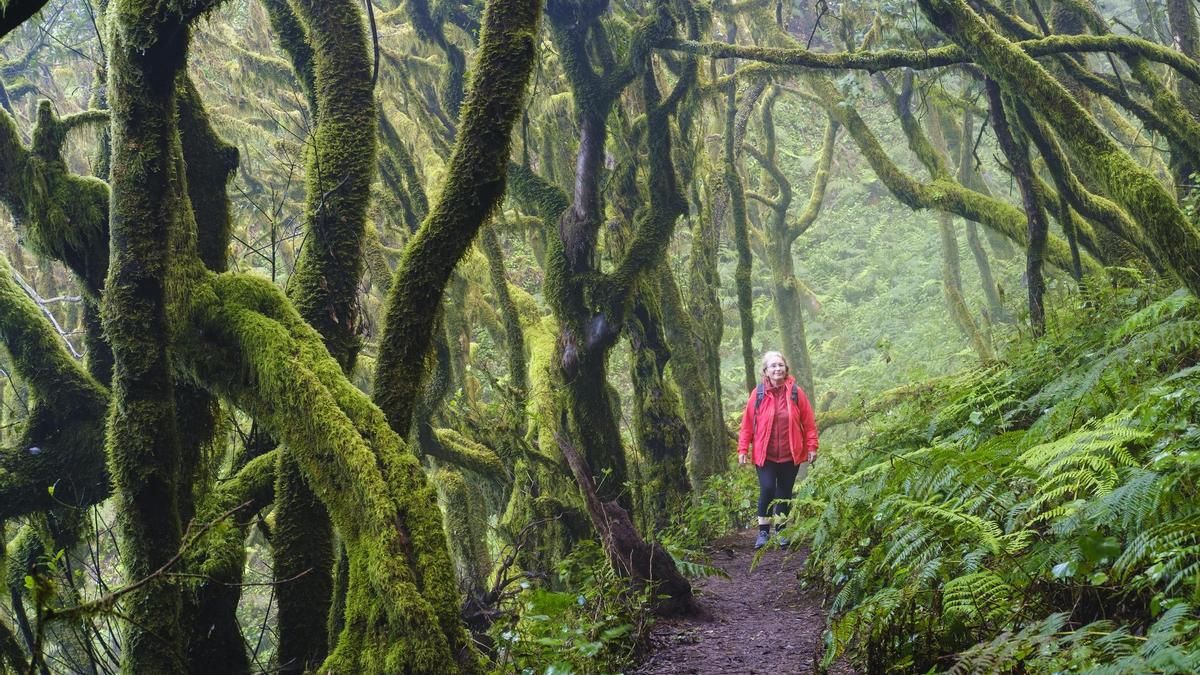
Another relevant finding is that laurel forest is the ecosystem that stores the most carbon in the Canary Islands. The highest values are found in Garajonay National Park on La Gomera, where averages of up to 413.2 tonnes of carbon per hectare are recorded, with peaks of 730 tonnes. “This is an exceptional figure,” the publication concludes, surpassing previous estimates and placing La Gomera’s laurel forest at carbon storage levels similar to those observed in tropical and subtropical rainforests or the wet forests of Hawaii. The key, explains researcher Otto, lies in the favourable humidity conditions provided by the influence of the trade winds and the sea of clouds.
Forests under threat from extreme heat
The study provides a snapshot of the carbon stored in the archipelago’s woodlands. However, it does not specify whether a particular forest is acting as a carbon sink — that is, sequestering more carbon than it releases into the atmosphere. Under normal conditions, it does. Forests offset our emissions by capturing carbon dioxide (CO2) and help to cool the planet. But that capacity is being diminished on a global scale by extreme heat and high humidity, according to another recent study published in the journal Nature Communications. This cocktail accelerates the respiration of plants and microorganisms, which increases the decomposition of organic matter and releases large quantities of CO2 into the atmosphere, turning entire forests — originally allies in the fight against the climate crisis — into sources of emissions.
Otto notes that younger forests have a greater capacity to capture carbon than mature ones, even though the latter have accumulated more over their lifetimes. He adds that this difference is related to tree growth, which tends to be faster during the early stages of development and slows with age.
“An important task for future research projects will be to evaluate the evolution of these carbon stocks in recent decades, which of our forests captures carbon fastest and what the structural and abiotic factors influencing this process are,” reasons the expert.
Water, the limiting factor for the forests of the future
The lead author of the study explains that water is the main limiting resource for plant growth and carbon accumulation, and warns that the rise in temperatures associated with climate change may increase evapotranspiration — in other words, the atmosphere’s demand for moisture. This would reduce the availability of water in the soil and affect the growth of vegetation and its capacity to capture carbon.
“Woodlands containing the largest trees within each of the three main types of forest in the Canary Islands — laurel forest, pine forest and thermophilous woodland — should be identified and protected,” stresses Otto.
The researcher also considers it important to quantify the carbon stored in vegetation in order to estimate possible losses linked to changes in land use, such as the construction of roads, housing developments or other infrastructure. In addition, he believes that knowing this data makes it possible to identify the potential for carbon sequestration in areas at different stages of ecological succession. “It could be especially useful for guiding ecological restoration projects on abandoned agricultural land, providing an additional reason to promote their recovery given their potential contribution to mitigating climate change,” concludes Otto.
What’s happening in the Canaries – straight to your phone
News, weather alerts and practical updates – direct from the islands, in English. We live here and know what’s going on – before the international media catch up. Everything lands on our WhatsApp channel – no middlemen, no algorithm. Curated for families, expats and travelers.
New map reveals 60+ closed beaches in Canary Islands
Tenerife strikes deep geothermal milestone
La Gomera named among world’s quietest islands

Geothermal energy breakthrough in Tenerife

Tenerife strikes geothermal energy in Vilaflor

Canary whales face ship strike risk warns new study

The underwater ‘grandmothers’ of the Canary Islands

Galaxy M74’s hidden star disc discovered by IAC

Canary banana prices hit year low in August
