A sweet industry under threat
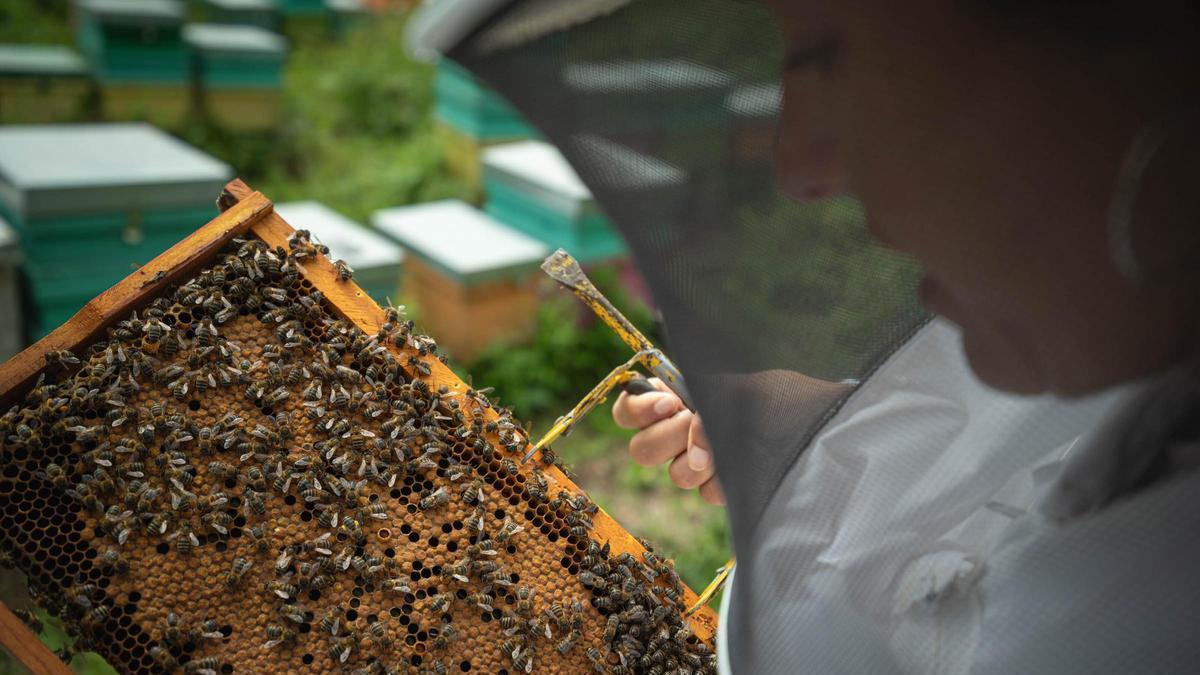
Where there is buzzing and beehives, there is also a future. Beekeeping in Tenerife is, according to sector experts, ‘a background task, little seen, spread across the whole island and completely dependent on environmental conditions: if the countryside changes, the bees notice it’. Yet, while the sector tries to recover from droughts, fires and habitat loss, beekeepers are also denouncing another growing threat: the marketing of foreign honeys under local labels, due to the prestige and quality of Canary Islands production. The bees obtain the liquid gold after collecting nectar from flowers. Those endemic and exclusive flowers of our ecosystem, such as the tajinaste or Teide broom, give rise to honeys unique in the world.
Unique varieties, unfair competition
Tenerife leverages its geographical diversity and microclimates to certify a unique heritage of 14 honey varieties protected by the Protected Designation of Origin (PDO), 13 monofloral and one multifloral. However, production is heavily threatened by cycles of severe drought and by competition from foreign honeys packaged under the ambiguous name ‘Canarias’, which lack the stringent local PDO conditions. The average price of the so-called golden nectar in the archipelago is €15 per kilo. By contrast, on the mainland, the average price is around €3 per kilo. This places Canarian labelling at a more exclusive value. ‘Some brands,’ denounces Florencio Gutiérrez, a beekeeper with over 57 years of experience, ‘take advantage of our image to sell product that doesn’t always come from here; they package it in Tenerife and stick the label on.’ The beekeeper thus sums up unfair competition which, in his view, harms those who work with traceability and under the PDO: ‘they buy at €3, put the islands’ flag on it and sell it for €15.’
The beating heart of Canarian beekeeping
In this context, Tenerife has the reputation of being the main engine and refuge for bees in the Canary Islands. With its particular terrain, it consistently concentrates 50% of the archipelago’s active beekeeping operations — between 600 and 630, depending on the year. Because the vast majority are family-run or supplementary, the sector brings together around 620 professionals, organised into 13 associations that, collectively, manage more than 16,000 hives. These have also experienced notable growth in recent decades: they have increased by 62% in the last 25 years and currently represent 48% of the total Canarian census. This ancestral work, dating back to Guanche times, has for decades been a supplementary activity for many farmers. ‘Those who work the land use bees to support the agricultural process. Now, especially with the pollination of tropical fruits — such as avocado or papaya, whose production has tripled in recent years — beekeeping has acquired enormous importance within Canarian agricultural consumption,’ explains Gutiérrez, who has been involved in the sector since the age of eight.
So great is the importance of beekeeping, illustrates the Councillor for the Primary Sector, Valentín González, that ‘the value of the pollinating action of bees on our crops and wild flora is estimated to be between 10 and 20 times higher than the economic value of the direct production of honey’. Gutiérrez, for his part, speaks of the current situation and places beekeepers as one of ‘the greatest conservators of nature’.
Hard years and a slow recovery
‘They have been hard years. We are coming off high seasons of drought and the 2023 fire was one of the hardest blows I can remember. A large part of the bees’ habitat was burned. However, little by little, the livestock is recovering,’ details the beekeeper again. In 2016, the Casa de la Miel registered almost 49,000 kilos packaged — the highest figure in its history — in 2020, however, barely 9,700 kilos were exceeded, the lowest recorded to date. A difference of almost 80% that evidences the impact of droughts and altered flowering patterns on island beekeeping. Now, so far in 2026, the season barely totals 351 kilos and is progressing with a delay due to a spring marked by low temperatures, far from the 30,000 kilos packaged in 2025, a year that marked a slight recovery.
Traditional heartlands and new restrictions
The current and traditional nerve centre for beekeepers, where most production is concentrated and structured, covers the northern area, between the Valle de La Orotava and the municipality of Icod de los Vinos. In addition to these, areas with a strong presence in Guía de Isora, Santiago del Teide and the eastern midlands (Güímar, Arico, Granadilla) stand out. ‘The best area for the bees’ work is the north coast of Tenerife,’ emphasises Florencio, due to the aridity of the southern zone. That said, the beekeeper continues, ‘unfortunately, with the construction boom, space has been limited for us; the same happens in the midlands, and now we are increasingly restricted from going up to the National Park’ due to the Teide Management and Use Plan (PRUG), which limits their participation. The relationship of beekeeping with the slopes of the volcano is historic and stems from the traditional use of the broom’s flowering.
Tighter rules for Teide beekeeping
The new PRUG, approved by Decree 182/2025, subjects the beekeeping sector to a more restrictive framework: it sets an annual cap of 2,000 hives, with a progressive reduction from the 2,600 that were authorisable, and establishes a territorial rotation to leave one of the park’s three zones empty each year. Furthermore, the document itself provides for new studies to adjust the management of this use and measure its effects on pollination and natural resources. The revision is based on scientific evidence incorporated for Teide, which already points to negative impacts from the competition of Apis mellifera on the reproductive success and nutritional quality of native species, as well as on wild bees and indigenous flora. In this context, the Primary Sector Councillor defends a position of balance: ‘Our work must focus on providing the necessary tools for transition, mediation and technical support so that the traditional use of Teide broom honey continues to be compatible with the care of the National Park.’
Support schemes and calls for reform
The sector rests on three main lines of public support: POSEICAN aid, the National Beekeeping Plan and contributions from the Cabildo. The first, linked to the number of hives, has been criticised for encouraging volume without directly addressing productivity or the health of operations. ‘Aid should come per kilo of honey produced and certified in the Canary Islands. Then, if that is the case, you stimulate production and future generations. What happens now is that if I, with my own capital, invest in hundreds of hives I can already get a benefit, even if I don’t produce,’ states Gutiérrez. The National Plan, for its part, focuses on technical assistance, treatments and improving marketing. At the island level, the Cabildo has strengthened its commitment to the sector following episodes such as the 2023 fire, allocating aid for supplementary feeding (€167,000), honey production (€50,000) and equipment for the Casa de la Miel (€42,000).
A future that depends on the bees
‘Supporting beekeepers means betting on the maintenance of a livestock activity of great tradition on the island,’ maintains Valentín González, who highlights ‘the importance of the sector for the productive and environmental fabric of Tenerife’. In this scenario and ‘from the point of view of public management,’ concludes the councillor, ‘the main challenges revolve around the location of the apiaries — due to Tenerife’s terrain, habitat loss and restrictions — and generational renewal.’ Even so, he recalls, the sector ‘shows its enormous desire to work, with a production census that has tripled since the 1990s’. And so, in Tenerife, caring for the bees, despite the difficulties, remains a way of caring for the land and the future of the countryside.
What’s happening in the Canaries – straight to your phone
News, weather alerts and practical updates – direct from the islands, in English. We live here and know what’s going on – before the international media catch up. Everything lands on our WhatsApp channel – no middlemen, no algorithm. Curated for families, expats and travelers.

Two tonnes of illegal tropical fruit seized at Tenerife port

Canary Islands approves new €1.6bn development fund

Mogán mayor says her €65,000 salary is too low

Abandoned cars in Canary Islands: hundreds left to rot

Work resumes on 27 affordable rental homes in Las Palmas
Los Realejos residents fight on against propane gas plant

Canarias among Spain’s poorest regions as 36.2% live on low incomes

Canary Islands bananas lose ground to imported bananas
Canary Islands bottom of Spain’s social housing table