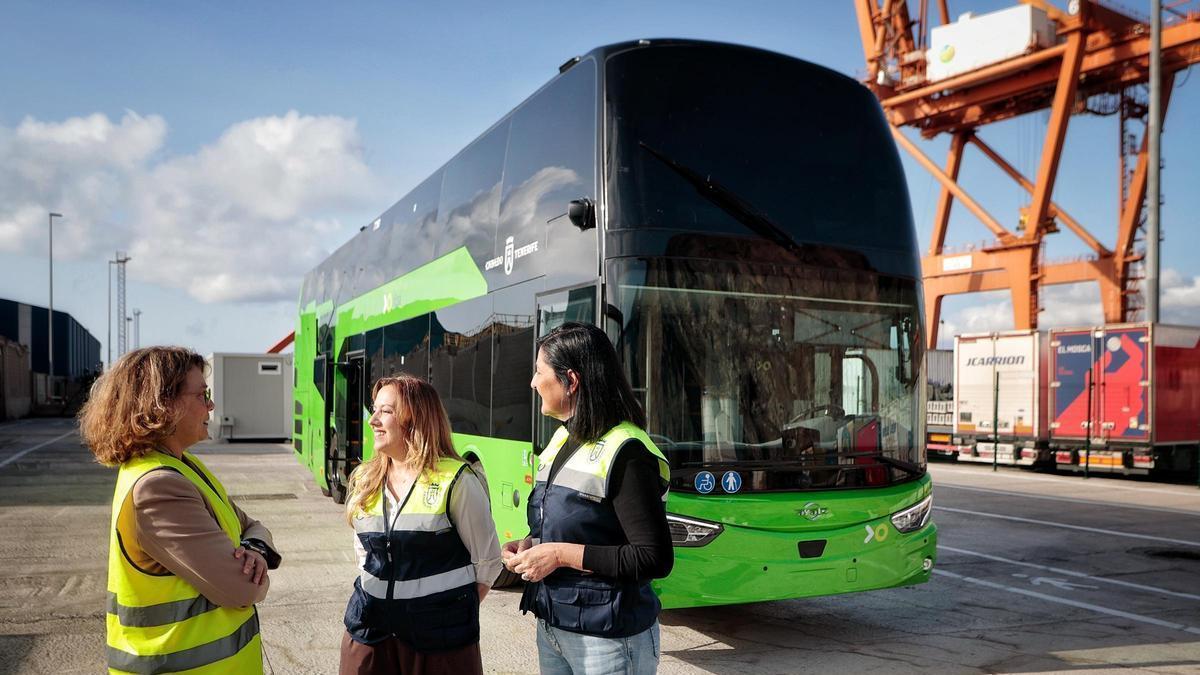
Pioneering fleet arrives in Santa Cruz
Thirteen double-decker buses, the first of their kind for public transport in Spain, will be travelling on Tenerife’s roads before the end of next summer. The first vehicle, destined for long-distance routes to the North and South of the Island, arrived last Sunday at the port of Santa Cruz. The President of the Island Council (Cabildo), Rosa Dávila, presented the gleaming new bus at the Dique del Este, alongside the Councillor for Mobility, Eulalia García, and the Managing Director of Titsa (the public transport company), Victoria Padilla.
Dávila toured the vehicle, highlighting its modern features. For instance, it has no wing mirrors; this crucial function for the driver is handled by state-of-the-art cameras. The interior still smells new, having left the specialised Ayats factory in Girona just three days prior, on Friday. It travelled to the Island from Huelva with a stopover in Gran Canaria.
A bespoke Spanish build
Dávila praised “the only Spanish company that builds double-decker buses, and with a very artisanal technology at that.” She emphasised that “we were able to be at the factory seeing the entire process, for this one and the rest, which are practically finished already.” The President noted they tracked its journey “from when it embarked in Huelva until it arrived here on Sunday afternoon,” and that “it attracted a lot of attention during the crossing and when docking; they have been sending us videos, including some from the crew. They were delighted, as was the passenger complement.”
She stressed that “there are no double-decker buses in Spain for public transport; this will be the first.” She hopes it will be in circulation within a month to a month and a half.
Boosting capacity on key routes
It will be assigned to reinforce the high-demand 110 line between the Santa Cruz Transport Interchange and Costa Adeje, which runs every 15 minutes and mobilised 1.2 million passengers in 2025 (a 14% increase on 2024). The expectation is to increase passenger capacity by 44%, moving from the current 59 seats to a total of 85.
Four buses will arrive each month, with the first of these new batches arriving in just a week, before the end of March. The plan is therefore for all thirteen to be on the Island by June and operational throughout the summer. Besides the 110, they will reinforce another southern route (TF-1 motorway), the 112 (Santa Cruz Interchange-Los Cristianos), and in the North (TF-5 motorway), the 108 between Santa Cruz and Icod de los Vinos. These are essentially direct lines with very few stops and high passenger numbers.
A push for public transport
Dávila, García, and Padilla highlighted the commitment to public transport over private vehicles. They noted the next step is to install all the electrical systems, fleet tracking technology, and other elements to make this enormous 14-metre-long bus fully operational. The offering will expand from four to six million passengers on the double-decker buses.
The President valued the fleet modernisation, together with free transport (introduced on 1 January 2023), as a key measure to improve mobility. She emphasised that “we are incorporating new buses to further improve the average fleet age of 3 years, the lowest in Spain, and to continue adding passengers.” In this regard, she underlined that “with the efforts of the last two years and following the introduction of free travel, we have practically doubled the number of bus passengers.”
Rosa Dávila reflected: “We are putting the best of ourselves into this, with very significant investments, and now the step must be taken by the citizens.” She linked this to a cultural and mindset change, “where we park our private vehicle and opt for public bus transport” as the best way to end road traffic saturation.
Final fitting and accessibility features
Eulalia García indicated that work on the new bus “will take place in our workshops and depots to install all the technology over approximately one month.” In this final phase, the bus will be fitted with security cameras, interior information panels, the ticketing and payment system, and driver assistance systems, among other things, to integrate it into Titsa’s modern fleet.
Besides increasing passenger capacity, work is also being done to increase frequencies and commercial speed on lines with few stops, which, García points out, “makes them more competitive than others.”
The Managing Director of Titsa, Victoria Padilla, highlighted that this bus includes all accessibility measures. It features, she detailed, two spacious spaces for people with reduced mobility on the first deck, a double access ramp (electric and manual), accessible stop buttons, and a visual information and aid system for people with reduced visibility, among other elements. Furthermore, safety and passenger comfort were prioritised in the design. All seats include seat belts and various ports to charge mobile phones during the journey, aimed at improving the travel experience.
A modern and growing fleet
In three years of management, the Tenerife Island Council has acquired a total of 351 new buses, giving the island one of the most modern fleets in Spain, with an average age of just over three years. The next vehicles to join the Titsa fleet will be these 13 double-decker units. Another 57 new buses will also arrive this year and could enter service within 2026. Then in 2027, 25 more vehicles will be added to the service for interurban journeys. Five of these will be double-deckers, meaning the Island will have a total of 18 double-height buses circulating on its main roads. This new fleet has already led to a reduction of over 7% in Titsa’s emissions, promoting cleaner and more sustainable mobility.
What’s happening in the Canaries – straight to your phone
News, weather alerts and practical updates – direct from the islands, in English. We live here and know what’s going on – before the international media catch up. Everything lands on our WhatsApp channel – no middlemen, no algorithm. Curated for families, expats and travelers.