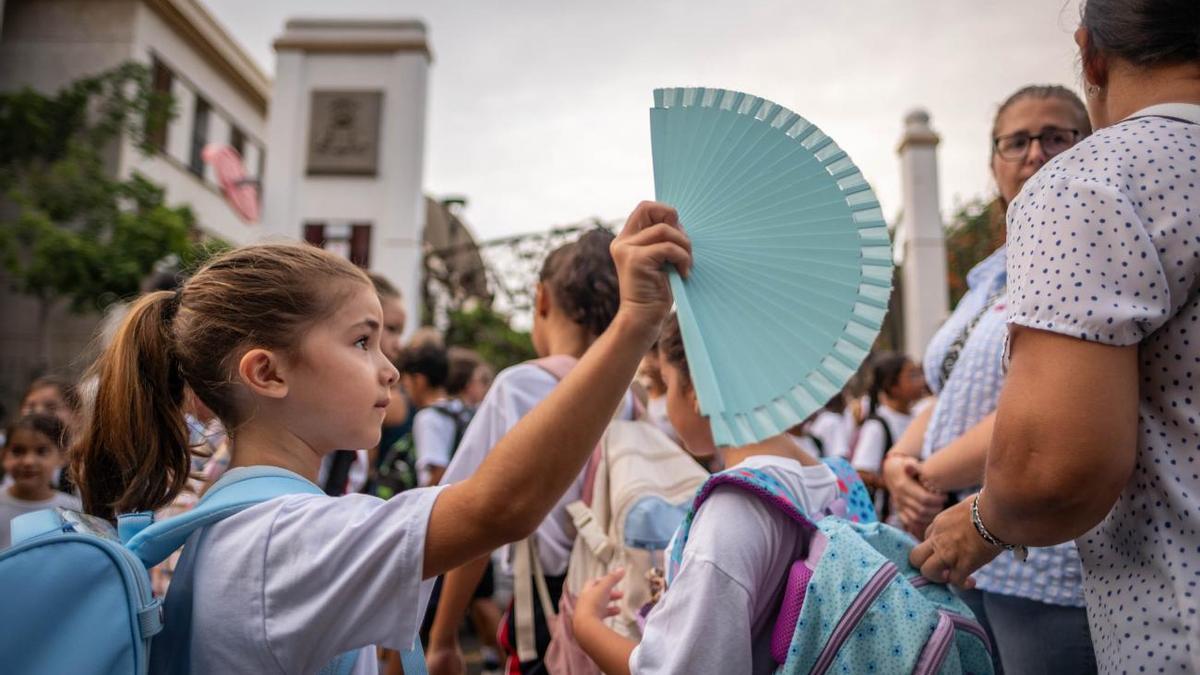
Schools prepare for rising temperatures
Although it may feel as though summer is taking its time to arrive in the Canary Islands, and the dreaded heatwaves associated with this time of year have yet to materialise, schools in Tenerife are already preparing for the effects of climate change. Specifically, 51 schools in the south of the island will be adapted to combat high temperatures, becoming veritable climate oases from the next academic year onwards.
Meeting yields key decisions
This was one of the main conclusions to emerge from a working meeting held this morning between Poli Suárez, the regional minister for Education, Vocational Training, Physical Activity and Sports, and Rosa Dávila, president of the Tenerife Cabildo (island council). The meeting was scheduled to discuss, among other matters, the follow-up to a collaboration agreement signed between both institutions, which specifically envisages the creation of shaded areas in educational centres.
Progress on shade projects
Last October, the Tenerife Cabildo and the regional education department agreed to install shaded areas in schools and secondary schools across the island to prevent classes being suspended when temperatures rise, as has happened on several occasions. Of the 50-odd centres earmarked for these climate refuges, five have now completed works and six are under construction. The remaining 40 projects have already been contracted and are at the administrative stage, awaiting execution. The department intends to take advantage of the summer break, when teaching activity pauses, to carry out the work.
Ready by September
Minister Suárez hopes the shaded areas will begin to be operational from September. “If all goes well, by the start of the 2026-2027 academic year, around 51 schools in southern Tenerife will have completed their works,” he said. The main actions include the installation of pergolas, lightweight roofs, tensioned sails and other structures, depending on the conditions and needs of each school.
Investment and future expansion
The agreement involves an investment of nearly £1.8 million from the island institution, which the department will implement under the Plan for Adapting Schools to High Temperatures — a scheme designed to promote safer, more sustainable school environments adapted to the current climate reality. If this total funding were distributed equally, each school would receive around £34,000. Although the project is currently limited to 51 of the island’s 277 schools — meaning only two in ten facilities (18.4 per cent) are covered — Suárez raised the possibility of extending it to the metropolitan area and the north of the island. “Collaboration between administrations is proving key to continuing progress in improving Tenerife’s educational infrastructure,” he said. The Cabildo agrees and is already considering extending the initiative.
Among the completed projects are the early years and primary schools (CEIP) Igueste, in Candelaria; Llano de las Naciones and Juan Bethencourt Alfonso, in San Miguel de Abona; and San Isidro, in El Rosario, as well as the compulsory education centre (CEO) in Arona. Works currently under way correspond to the following schools: Agache, in Güímar; Carmen Álvarez de la Rosa and Príncipe Felipe, in Candelaria; Tijoco Bajo, in Adeje; La Pasada, in Granadilla de Abona; and the secondary school (IES) San Miguel, in San Miguel de Abona.
Other islands join the initiative
This pioneering initiative has been joined by the island councils of La Gomera and Lanzarote, which have also signed their own agreements with the regional education department, as part of the archipelago-wide strategy to advance the climate adaptation of educational infrastructure.
During the meeting, the Cabildo president also announced that Tenerife will host the next National Vocational Training Congress. The event, to be held on 8 and 9 April 2027, will bring together more than 1,500 people, including students and staff from training centres across Spain. “We are the institution with the highest investment and scholarship policy in the country right now, which is why we have secured this important congress for our island,” she said. In her view, vocational training in Tenerife is “exemplary” and hosting this event will be an opportunity to highlight its importance.