
Playa del Inglés is the most famous and most visited beach on Gran Canaria. Nearly three kilometres of golden sand on the island’s southern coast, full tourist infrastructure, and a direct connection to the legendary Maspalomas dunes make this spot a magnet for millions of tourists every year. Is it worth it? Absolutely — as long as you know what to expect.
Three kilometres of golden sand
Playa del Inglés stretches for about 2.7 km — from the border with the quieter Playa de San Agustín to the east all the way to the Maspalomas dunes to the west. The beach is wide (over 100 metres in places) and covered in fine golden sand. The ocean can be somewhat unpredictable here — waves can be sizeable, which delights surfers but calls for caution from families with small children.
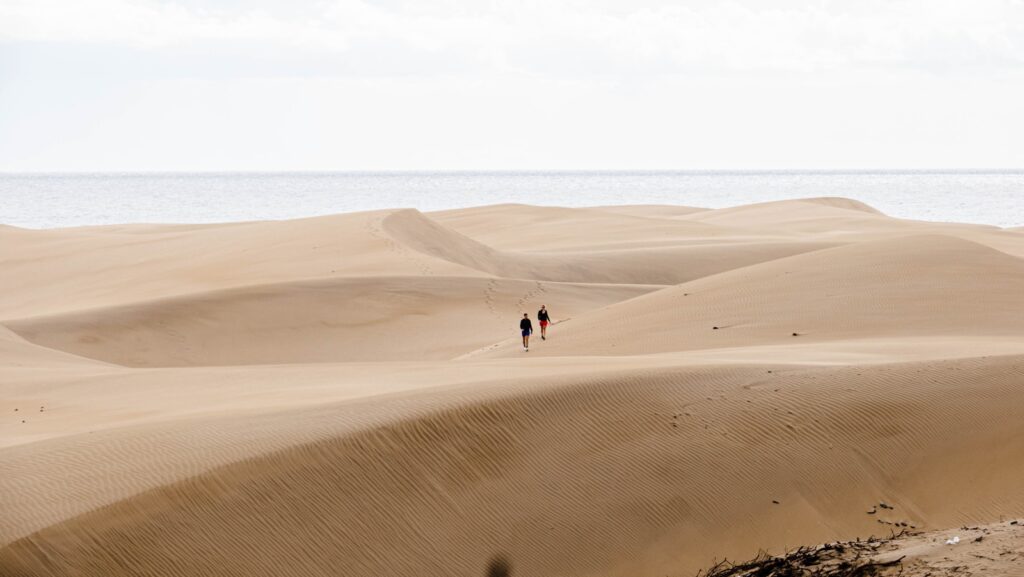
The further west you go, towards the dunes and the Maspalomas lighthouse, the wilder and less crowded the beach becomes. This section includes nudist areas, and the landscape transitions into the spectacular dunes — Reserva Natural Especial de las Dunas de Maspalomas, spanning over 400 hectares. It’s a real mini-Sahara on a European beach.
What to do at Playa del Inglés
The eastern part of the beach is the full-comfort zone: sun loungers and parasols for hire, lifeguards on duty, beach bars and restaurants within walking distance. The paseo marítimo (seaside promenade) connects the beach to the resort centre, hotels, and shopping centres.
Sports enthusiasts will find surf schools, bodyboard rental shops, and jet ski tour operators. In the evening, the action moves to Yumbo Centre — a massive entertainment complex with over 200 venues: restaurants, bars, clubs, shops, and pharmacies. Yumbo is also the heart of Gran Canaria’s LGBTQ+ scene — this is where most of the island’s gay bars, clubs, and events are concentrated.
Maspalomas dunes
The western edge of Playa del Inglés blends seamlessly into the Dunas de Maspalomas — a nature reserve with towering sand dunes that stretch all the way to the Faro de Maspalomas lighthouse. A walk through the dunes is an essential experience — a surreal landscape that looks like a slice of the African desert transplanted onto an island.
Between the dunes and the beach lies the picturesque Charca de Maspalomas — a saltwater lagoon that serves as a haven for migratory birds. It’s well worth visiting at sunrise or sunset, when the light paints the dunes in shades of gold and orange.
Practical information
- Beach length: approx. 2.7 km
- Sand: golden, fine, natural
- Facilities: full — sun loungers, lifeguards, bars, showers
- Waves: moderate to large — caution with small children
- Getting there: Global buses (lines 1, 5, 30, 66 from Las Palmas), taxi, parking
- Nightlife: Yumbo Centre — over 200 venues
Who is Playa del Inglés for?
This is a beach for anyone who wants sun, entertainment, and convenience in one package. Couples, groups of friends, party-goers — boredom is not an option here. Families with small children might prefer the calmer Playa de San Agustín on the eastern side, or the completely wave-free Playa de Amadores. But if you want to feel the full energy of southern Gran Canaria — Playa del Inglés is the best choice.
Nearby beaches
Right next to Playa del Inglés, to the east, lies the tranquil Playa de San Agustín — far less crowded and popular with families. To the west, beyond the dunes, stretches Playa de Maspalomas — wilder, with a scenic view of the lighthouse. A few kilometres further west you’ll find Playa de Amadores — an artificial, wave-free beach perfect for families with small children.
Weather at Playa del Inglés
Playa del Inglés is one of the largest beaches on Gran Canaria, stretching all the way to the Maspalomas dunes. The island’s south coast is a sunshine guarantee – rainy days are rare and mostly occur in winter. Check the weather in Playa del Inglés or in Maspalomas.