
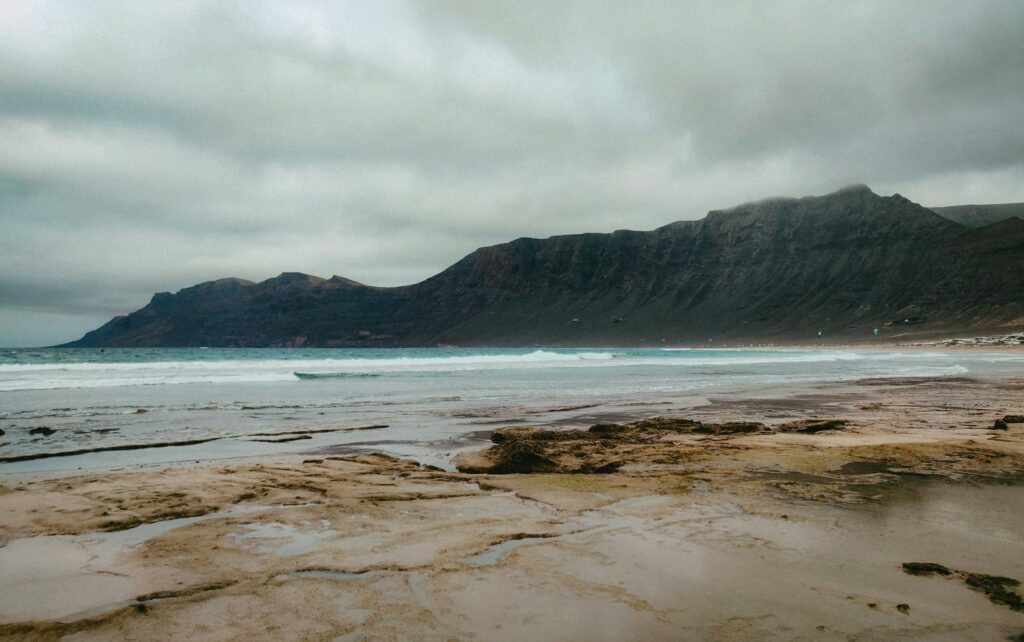
Playa de Famara is 6 kilometres of raw, windswept beauty on the north-west coast of Lanzarote. Towering above the beach are the monumental Risco de Famara cliffs — the tallest rock formation on the island, reaching 671 metres. At their feet, on sand sculpted by relentless wind, surfers from across Europe catch their first waves. This is not a beach for sunbathing — it’s a beach for experiencing.
Famara Cliffs — A Wall Above the Ocean
Risco de Famara is the remnant of an enormous volcanic caldera roughly 10 kilometres in diameter, whose centre lay south of the island of La Graciosa. The cliffs stretch for several kilometres and reach a maximum height of 671 m at Peñas del Chache — the highest point on Lanzarote. The view from the beach up at this rock wall is one of the most iconic landscapes in the Canary Islands.
It’s worth driving up to the clifftop (via the LZ-202 road) and looking down at the beach from above. The panorama takes in the whole of Famara, the island of La Graciosa and the Chinijo Archipelago. At sunset it’s simply otherworldly.
Surfing — The Capital of Lanzarote
Famara is the heart of surfing on Lanzarote. The beach offers over 7 kilometres of beach break — waves break over a sandy bottom, making them relatively safe even for beginners. In the village of Caleta de Famara there are a dozen or so surf schools, and group lesson prices start from around €35–40 per session including board and wetsuit hire.
Conditions are best from autumn through spring, when the Atlantic swell delivers consistent waves. Summer can be too calm for surfing, but perfect for bodyboarding. Kitesurfing, windsurfing and bodyboarding are also popular here.
Swimming? Think twice
Playa de Famara is not suitable for regular sea swimming. Strong rip currents pose a real danger, and waves can be large even when conditions look calm. Lifeguards are on duty in season on a designated stretch, but most of the beach is unguarded. If you’re looking for calm water for swimming, head to Playa Flamingo in Playa Blanca or Playa del Reducto in Arrecife.
Caleta de Famara — A Village with Soul
At the southern end of the beach lies Caleta de Famara — a small settlement divided into two parts: the old fishing port and a newer district of bungalows right beneath the cliffs. The village lives and breathes surfing — board shops, surf schools, vegetarian cafes and hostels define its landscape. Despite growing popularity, it has retained an authentic, slightly bohemian vibe, a world away from mass tourism.
Caleta de Famara is well worth a meal at one of its local restaurants — fresh fish and seafood served with views of the ocean and cliffs is an experience in itself. Recommended spots: Sol Famara, El Risco and Restaurante Famara.
Practical Information
- Getting there: by car from Arrecife via the LZ-401, about 25 minutes. Car park at the end of the road, near the village entrance.
- Public transport: bus line 20 from Arrecife to Caleta de Famara (approx. 30 min, several services daily).
- Wind: blows almost constantly. Bring a windproof jacket and sunglasses — the sand can be relentless.
- Tides: at low tide the beach is enormous and flat — perfect for walks and longboarding on the wet sand. At high tide it shrinks dramatically.
- Facilities: restaurants and shops in the village. No amenities on the beach itself. Public toilets by the car park.
- Sunsets: Famara faces west — sunsets are spectacular, especially with La Graciosa on the horizon.
Nearby Beaches
- Playa de San Juan — a tiny cove north of Famara, right beneath the cliffs, accessible only at low tide.
- La Graciosa beaches — ferry from Órzola (30 min drive from Famara), pristine beaches on the eighth Canary Island.
- Playa de la Garita (Arrieta) — 30 minutes’ drive east, a peaceful beach with a natural pool, popular with locals.
Weather and conditions at Playa de Famara
Famara is a long beach on Lanzarote’s northwest coast, beneath the dramatic Risco de Famara cliffs. It’s a surfer’s paradise, but the wind can be very strong. Before your trip, check the weather in Costa Teguise – the forecast includes wind conditions.