
Ajuy is a beach where you literally stand on the oldest piece of land in the Canary Islands. The dark rocks exposed by the waves are over 70 million years old — they formed on the ocean floor during the Cretaceous period, when dinosaurs still roamed the Earth. Today this geological curiosity creates one of the most extraordinary settings on Fuerteventura: a black beach with massive sea caves carved by the Atlantic into rock older than the islands themselves.
Cuevas de Ajuy — caves millions of years old
The main attraction at Ajuy is not the beach itself, but the Cuevas de Ajuy — a system of sea caves hollowed out of dark basalt and turbidites. The path to the caves leads from the beach northward along the cliffs (about a 10-minute walk). The route is straightforward but in a few places runs close to the edge — take care, especially in strong wind.
The caves themselves are impressive — the entrance to the largest is several metres high, and inside you can hear the thunder of waves crashing against the rock walls. Light streaming in from the ocean creates dramatic effects. This is a Natural Monument (Monumento Natural de Ajuy) protected by law — collecting rocks or disturbing the environment is forbidden. Information panels along the path explain the geology of this remarkable place.
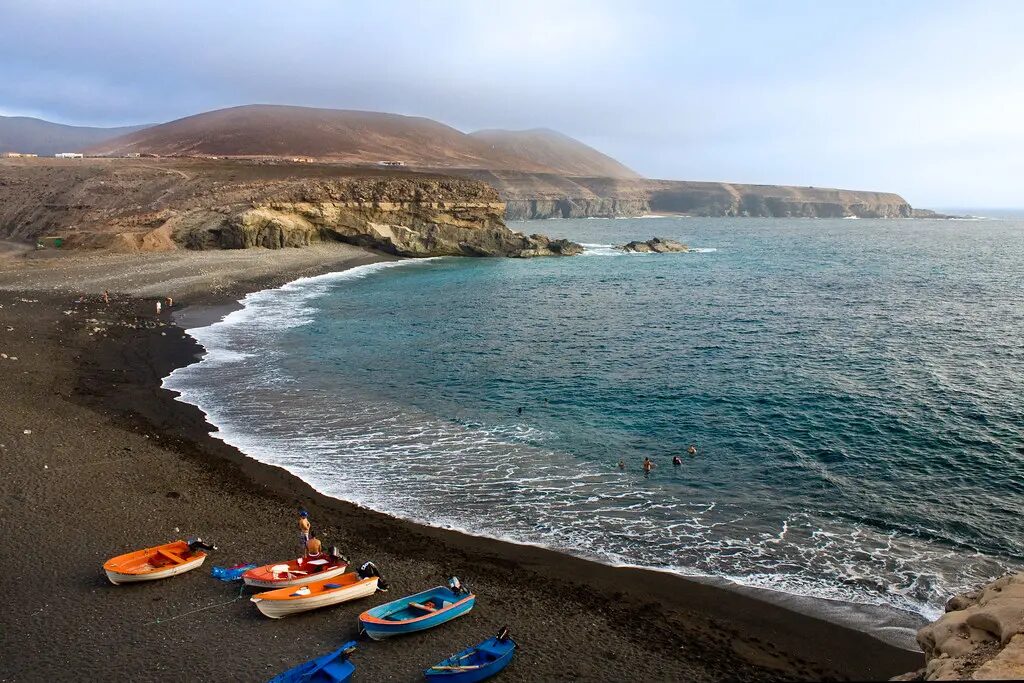
The beach
Playa de Ajuy is a small cove (about 200 m) with dark, coarse-grained sand mixed with volcanic fragments. The beach is open to the ocean and often sees powerful waves — swimming is possible but dangerous. Currents can be strong and the seabed drops away quickly. This is definitely not a beach for a relaxing day out with children.
Above the beach, in the tiny village of Ajuy, two or three fish restaurants operate. Fish straight from the ocean, grilled in traditional Canarian style — one of Fuerteventura’s best-kept gastronomic secrets, known mainly to locals. Prices are moderate and portions generous.
Getting there
Ajuy lies on the western coast of Fuerteventura, in the municipality of Pájara. Drive from Betancuria or Pájara along the FV-621 — the last few kilometres are a narrow road winding down to the coast. Parking in the village is free and usually sufficient. Public transport is limited — buses run infrequently, so a car is virtually essential.
Practical information
- Beach length: approx. 200 m
- Sand: dark, coarse-grained, volcanic
- Waves: powerful — open ocean
- Swimming: dangerous — strong currents and waves
- Caves: Cuevas de Ajuy — Natural Monument (~10-min walk)
- Geology: oldest rock in the Canary Islands (70+ million years)
- Restaurants: local fish restaurants in the village
- Parking: free
Nearby beaches
Ajuy lies on the remote western coast of Fuerteventura, where beaches are few and far between. The nearest bathing spots are the beaches in Pájara or La Pared — about 20 minutes’ drive to the south. La Pared is a surf spot with black sand and powerful waves. To the east, on the other side of the island, lie the tourist beaches of Costa Calma and Sotavento — a completely different atmosphere, but well worth comparing both faces of Fuerteventura.