New hope for the La Palma goat
The future of the La Palma goat—one of the crown jewels of the Canary Islands’ native livestock—looks brighter than ever. The selection of ten breeding sires as part of a programme on the “Beautiful Island” represents a major boost for the preservation of an indigenous breed whose presence has been documented since before the Castilian conquest at the end of the 15th century.
The announcement was made by the Association of La Palma Goat Breeders during the presentation in Puntallana of the 12th Catalogue of Breeding Stock for the Palmera Goat Breed. This new edition reflects the collective work of farmers, technicians, and partner organisations to safeguard, improve, and secure the future of this 100% Canarian breed.
Consolidating the breeding programme
The catalogue highlights the consolidation of the La Palma goat’s breeding programme, underpinned by tools such as the management of the Herd Book, the Official Milk Recording Scheme, DNA parentage verification, morphological assessment, genetic evaluations, inbreeding studies, and marker-assisted selection. According to the breeders’ association, all these measures are providing “increasingly precise” information to guide the selection of breeding stock and facilitate decision-making on farms.
One of the most significant recent advances has been the push for genetic conservation of the breed and the future implementation of artificial insemination. Based on the analysis of available genetic evaluations, the mothers with the best genetic scores have been selected to produce a new generation of high-genetic-merit sires.
Ten selected sires
As a result of this work, according to the Association of La Palma Goat Breeders, ten young males have finally been selected to join the genetic conservation programme. They are now housed at the El Pico farm in Tejina (Tenerife), run by the Canary Islands Institute for Agricultural Research (ICIA), where technicians will extract their seminal material for storage in the Germplasm Banks.
This step represents a highly important breakthrough for the breed, as it will preserve its genetic variability and provide future doses of semen for artificial insemination programmes. This tool will help accelerate genetic progress, strengthen the sustainability of farms, and open up new possibilities for the conservation of the La Palma goat.
Thanks to committed farmers
The association emphasises that this achievement has been possible “thanks to the commitment of the farmers who actively participate in the improvement programme, providing data, collaborating in the controls, and betting on a rigorous selection of their animals.” The organisation also acknowledges the support of public administrations and technical partner bodies, which make it possible “to keep advancing towards increasingly ambitious goals.”
Prized for its high-quality milk
The La Palma goat is bred for milk production and is recognised for the exceptional quality of its milk. It is highly prized for its high fat and protein content, making it ideal for cheese production. Specifically, this breed produces the Palmero cheese with Protected Designation of Origin (PDO). It is one of the breeds worldwide with the greatest potential for making artisanal cheeses.
Currently, the breed’s Herd Book contains 7,004 active registered breeding animals, of which 6,620 are females and 384 males. Furthermore, 6,273 animals have both father and mother registered, representing 89.6% of active breeding stock with known parentage. These figures demonstrate the significant progress made in genealogical recording and in improving the information available on the population.
Progress in parentage testing and milk recording
During the 2025 campaign, work also continued on parentage testing using molecular markers. In total, genetic profiles were obtained for 317 animals from seven different herds, and 233 animals were parent-verified. The breed now has 704 active animals with confirmed parentage via DNA for both sire and dam, representing 10% of the total active population.
Another pillar of the selection scheme is the official milk recording programme. In the 2025 campaign, all goats from the farms in the so-called selection nucleus were recorded, with a total of 1,034 animals controlled, 5,086 recording entries, and 834 completed and valid lactations. The aim is to increase animal productivity through high-quality milk production. To this end, an annual genetic evaluation of breeding stock is carried out, identifying the best goats and sires for replacement based on milk production and quality criteria.
Challenges ahead
The Association of La Palma Goat Breeders acknowledges that significant challenges remain: improving production quality, increasing the breed’s recognition and reach, strengthening selection tools, and creating opportunities to encourage generational renewal and the continued presence of livestock farms in the area.
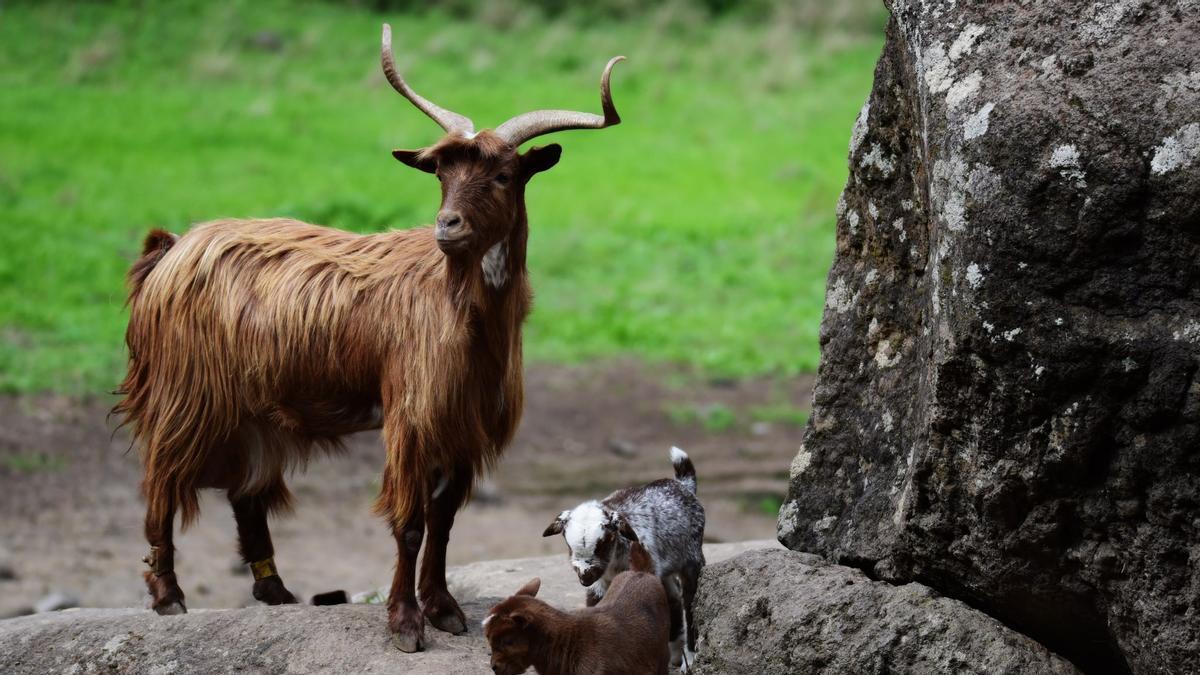
The La Palma goat is distinguished by its predominantly red coat, in various shades and combinations, which often intensifies on the legs. Its head is usually small with lively eyes, triangular in shape, with a more or less developed tuft on almost all specimens. The horns are spiral-shaped, widening from the base, and take on spectacular characteristics in males. A beard is common in males, though it can also appear in most females. Its ears are medium-sized and horizontal, normally extending beyond the level of the eyes.
Beyond its physical traits, another defining characteristic of this species is its remarkable capacity for adaptation—to both the climatic conditions of the island and its geography—enabling it to move with great agility over rugged terrain.