
Canary Islands Forge Their Path into Space with Magec
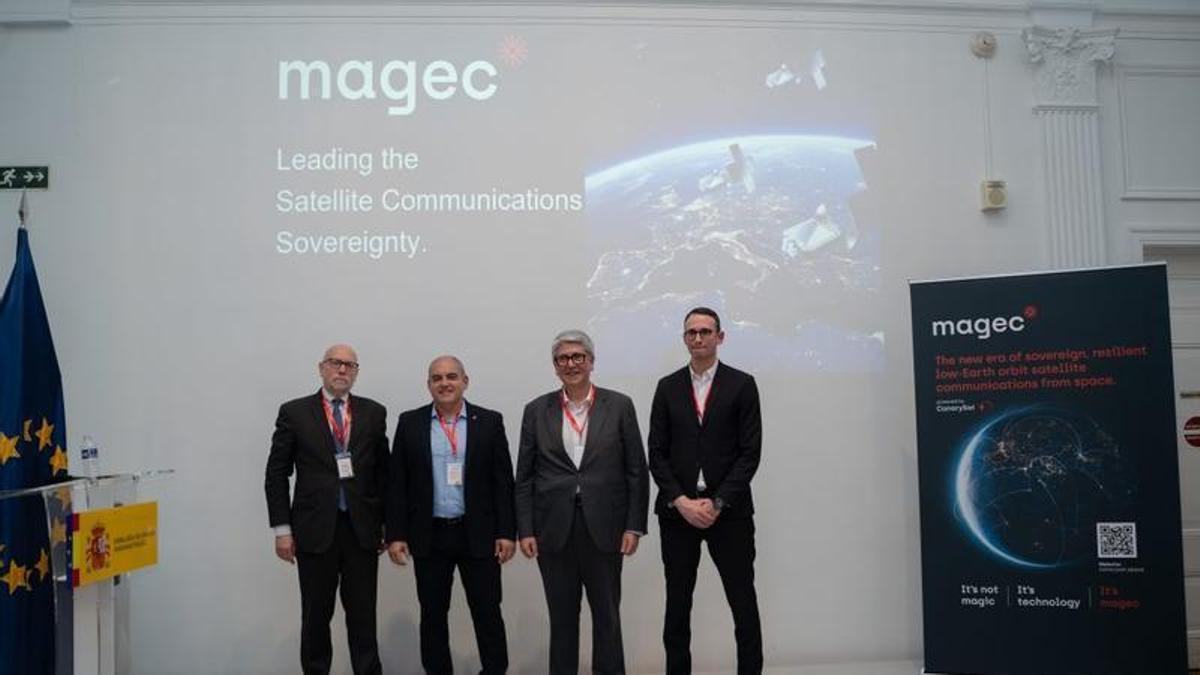
In just four years, the Canary Islands plan to launch their very own Starlink-like communications constellation into space. However, this network, to be named ‘Magec’ after the Guanche sun god, will feature far fewer satellites and a more ambitious objective. A total of 264 small communications nodes will carry the Canary Islands’ name into orbit.
A Secure Network for Critical Services
Unlike Elon Musk’s global internet venture, this communications network will focus primarily on achieving secure connectivity. This is the core purpose of the project by CanarySat, the company based in the Canary Islands Special Zone (ZEC) that will operate the constellation. “Our goal is to create a secure, resilient space-based communications network designed for critical services,” stated Antonio Abad, CEO of CanarySat. This means it will not only provide internet coverage and connectivity but also guarantee that “governments, critical infrastructure, or emergency services can operate even in complex situations.”
Strategic Announcement at Global Satellite Show
“This launch represents a decisive step towards a secure and sovereign communications infrastructure in space, capable of addressing current and future challenges in critical connectivity,” declared Abad during the international Satellite Show 2026, held this week in Washington, USA.
Medium-Sized Satellites in Low Earth Orbit
The satellites will be launched into low Earth orbit (LEO) and are not small; they will be of a “medium size.” Each will weigh approximately 300 kilograms—about the same as a large motorbike or a piano. “They will be optimised to offer real capacity while being deployable efficiently,” Abad emphasised. The satellites will operate across 12 orbital planes at an altitude of 900 kilometres, providing global coverage with high availability. Each satellite in the constellation will be equipped with an active communications antenna and inter-satellite links, creating a secure and robust network.
Addressing Space Debris and Light Pollution
Given their orbital altitude, one of the company’s primary concerns is sky pollution. “We are in low orbit, which allows for the controlled decommissioning of satellites at the end of their operational life,” the CEO stated. However, to maximise capacity per satellite and require fewer units, they will also incorporate “control and operation systems that minimise collision risk, complying with international space debris mitigation standards.”
Resilient Connectivity for Demanding Scenarios
The Magec constellation will offer a wide range of secure communication services. These include resilient connectivity during disasters, secure 5G backhaul links, high-speed point-to-point communications for all types of mobile platforms, and protected connectivity that guarantees operational capability in critical, high-demand environments.
Project Timeline and Strategic Ambition
The Magec constellation is currently in the design phase. The first demonstration missions could launch around 2028, with a progressive deployment of the network sought between 2029 and 2030, “when the system will be fully operational.” With this launch, the Canary Islands will become a strategic communications “node” between Europe, Africa, and the Americas. “It will not only improve connectivity but also attract investment, talent, and industrial activity, generating high-quality employment.”
Ground Infrastructure on Tenerife
To support this purpose, ground station infrastructure for satellite communications is being developed by the Tenerife Island Council, through the Technological and Renewable Energies Institute (ITER), and the company Arquimea. “It’s not just a support infrastructure; it’s a central piece of the system,” insists Abad. He affirms that this facility will allow them to “operate satellites, process data, and offer services from the Canary Islands to the rest of the world, both for our Magec constellation and for those of other operators.” As he stresses, this will position the archipelago “not just as a user, but as an active part of the global communications infrastructure.”

Canary Islands a Top Easter Getaway as Airlines Add Flights

Canary Islands Water Accidents Rise 30% in 2025

Spanish Navy Tracks Russian Vessel in Canary Waters

Tourist Arrested at Gran Canaria Airport for Attempted Homicide

Cruise Lines Seek Safe Harbours in the Canary Islands

Iran War to Impact Canary Islands Tourism, Warns Minister

The Must-Visit Rice Restaurant in Tenerife’s Capital
Farewell to Anteo: A Wave of Restaurant Closures Hits Gran Canaria

Tenerife’s Guachinche La Maestra Serves Up XXL Portions
