
The New Face of Canarian Farming
Explaining varieties of lettuce, learning to tell a courgette from a traditional Canarian squash, listing what Palmeran goats eat, or showing the mating process of the Majorera goat breed. This is the content of the Canary Islands’ agroinfluencers, and it is trending. A growing number of young islanders are combining their passion for the Canarian countryside with social media and the promotion of a profession hampered by a lack of generational succession. They amass thousands of followers on their Instagram, Facebook, and TikTok profiles, using their videos to sell their products and to showcase all the work behind the primary sector.
More Than Fame: A Mission to Educate
Unlike influencers in other sectors, these farmers and livestock breeders are not seeking fame. They enjoy life in the countryside and want to show it to the world, and in doing so, hope people will appreciate everything behind it and willingly pay a price for local products that allows island producers to make a profit. “I want people to be aware of what is behind what they eat,” explains Majorero livestock breeder Rayco Ramos. The 35-year-old started his Caprarius cheesery in Pájara, Fuerteventura, in 2019, and social media has allowed him to position his product despite fierce competition. He now narrates his daily tasks in short videos, defends the sector against injustices, and explains the entire production process. His shyness did not stop him from getting in front of the camera, and he now looks to the future eager to achieve many more goals. “We want to develop projects linked to tourism, workshops, and are working on expanding our product range,” he says. He admits that making a living from this requires “putting in a huge number of hours” and asserts that authenticity is the key to success. “For now, I manage my social media myself, but my idea is to get someone to help me in the short term,” he explains. With 10,000 followers between Instagram and Facebook, he argues that the goal of such exposure is to make people understand that when they buy his products, they are also buying “tradition, place, breed, culture, and designation of origin.”
From Direct Sales to National Recognition
With the same idea, Sergio Rodríguez, better known as Nito, started twelve years ago. Raised in Tenerife watching his family lose money because of middlemen, he designed a business model focused on direct sales to consumers, allowing him to champion Canarian and zero-kilometre products. His spontaneity, authenticity, and generosity have built a community of nearly 500,000 followers on his social networks and led him to win two AgroInfluye Awards. Social media have enabled Nito’s company to grow very quickly, going from a staff of ten workers to 45 in the last year. He uses videos as a shop window for his products but also to help those behind the screen learn about the sector. He gives advice, shares tricks, and practically teaches working techniques in the Canarian countryside. “I wanted people to see where things come from and know that cultivating isn’t just throwing a seed and harvesting, but that there is quite hard and risky work behind it because success depends on many factors,” Nito explains about his beginnings. He is passionate about the land and wants to end the “bad reputation” of primary sector work. To this end, he has started an educational project based on workshops with children on his farms so that the youngest can learn about agriculture and the value of local produce.
A New Generation Finds Its Voice
The path Nito has travelled serves as an example for other agroinfluencers just starting out. Benjamín Farrais, 29, has always felt connected to the Canarian countryside. After trying other sectors, he decided to rent a farm and start planting different crops. Despite his embarrassment, he took the plunge last year to explain his tasks on social media after working for a long time on his personal development. The success of his videos has allowed him to set medium-term goals. “People ask me where they can buy my products, and for the moment I sell to wholesalers, but I’m considering opening an infrastructure, a physical sales point,” he states. His main goal is to raise awareness about the importance of healthy eating and betting on local production. “I was embarrassed to start with the videos, but then I thought that I cultivate health and people should know that,” he explains about his beginnings. And in the future? He does not rule out growing on social media and monetising it, as long as it is for good. “What is clear to me is that whatever I do has to respect my values,” he points out.
Overcoming Challenges for a Sustainable Future
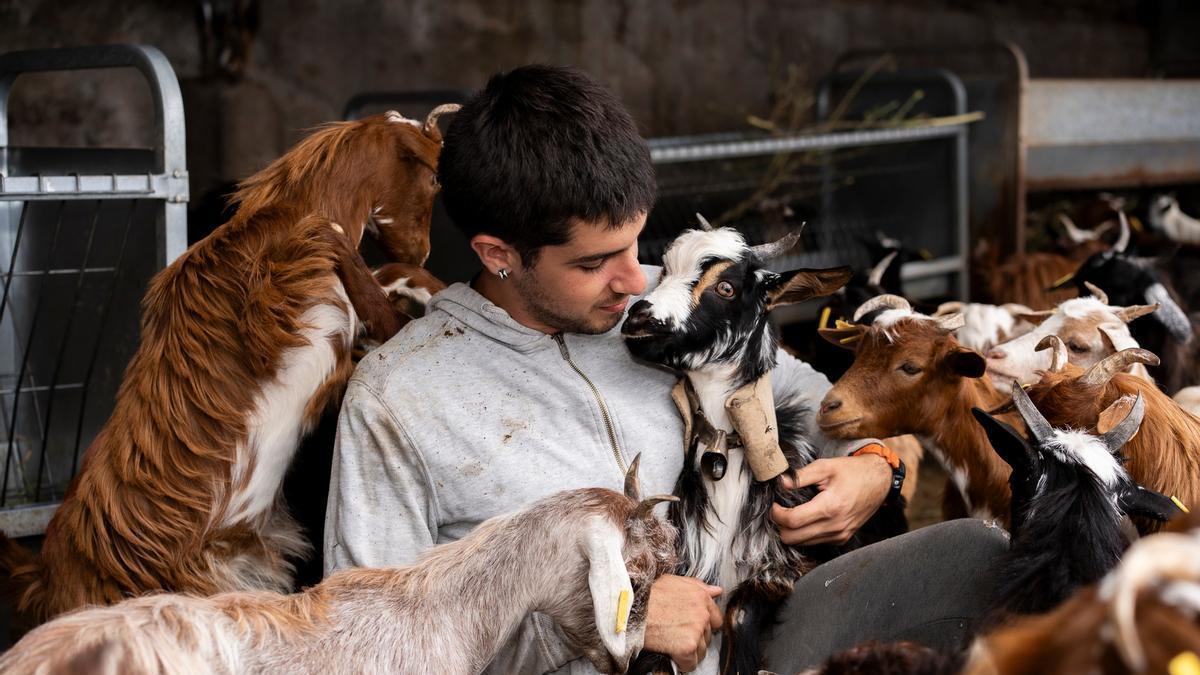
Jorge San Gil approaches his project with the same energy. At just 21, he already has his own company, Granja El Guisio in Breña Alta (La Palma)—a livestock farm with 130 Palmeran goats that includes the creation and sale of artisanal cheese. During the pandemic, he discovered that what made him happy was spending hours on the farm, and he trained in Pamplona to launch a solid project in La Palma. Now social media serves as a sales window, but he also uses it to tell the reality behind the sector, which helps educate the public about the value of local products. “If you’re not on social media nowadays, you don’t exist,” says the young man. He admits he doesn’t post as much as he should because he doesn’t have the time. “I have to push harder because it’s true that whenever I post, I notice a spike in interest,” he assures. For now, the earnings are limited and only cover expenses. “It’s a very tough sector; it doesn’t even give me a good salary,” he states. San Gil plans to expand his business and acquire his own farm, but finding one has become an impossible mission. “I only encounter obstacles,” he laments.
Inspiring the Next Generation
All the Canarian agroinfluencers hope their social media content will encourage new generations to dedicate themselves to the land, thus uniting tradition and modernity. They are aware that the lack of generational succession is one of the sector’s main problems and want to remedy it. “In the new generations, I see a lot of interest in the countryside, but there is still much to do for them to see it as a future option,” affirms Farrais. The leap to social media has not been a bed of roses. They all agree that to face criticism and expose oneself in front of thousands of people, you must be mentally prepared. Some have had to seek psychological help to move forward. That said, the haters are in the minority. Most comments encourage these young people to continue uploading content.
No post found!