
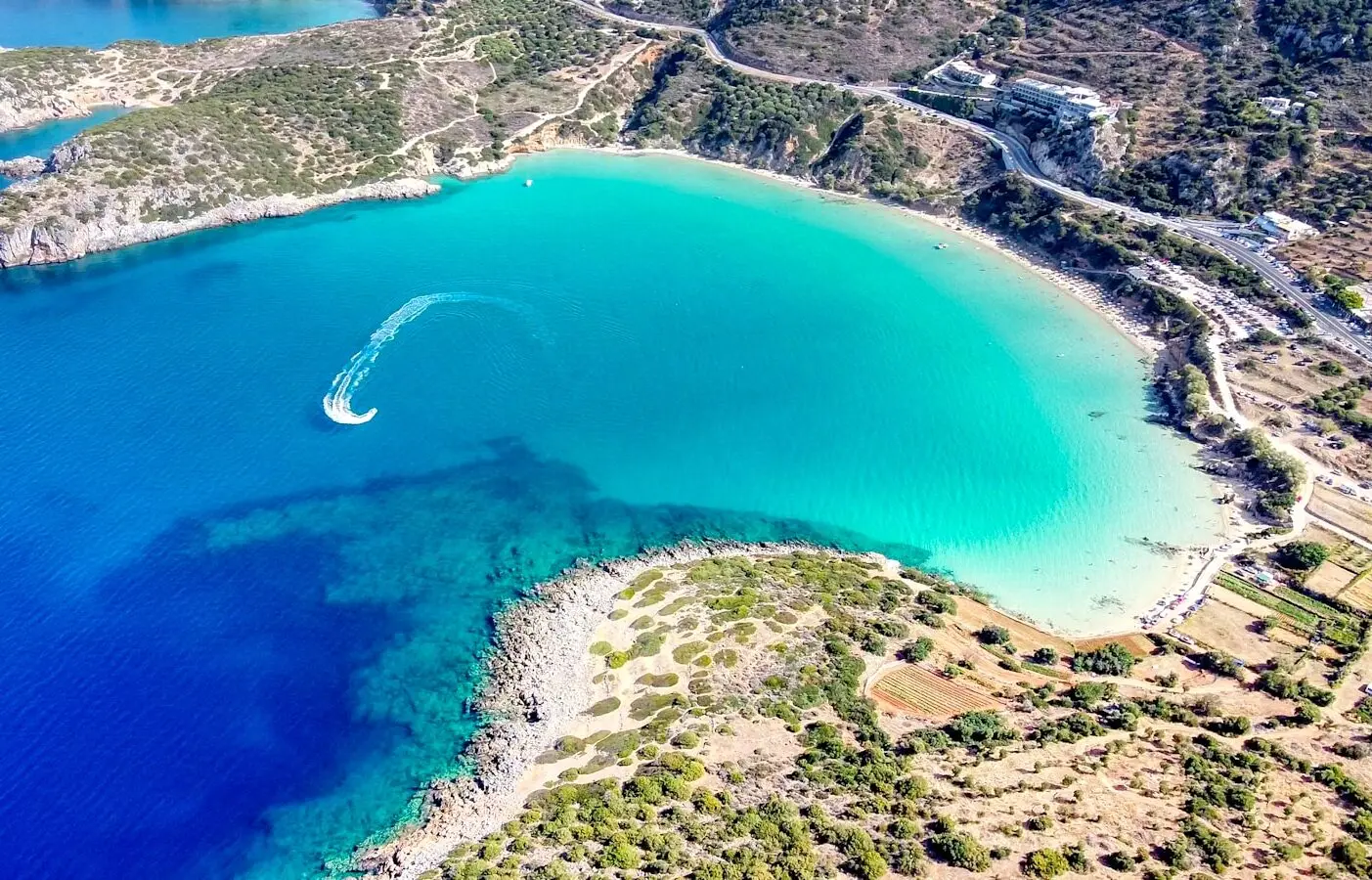
Crete’s coastline runs to over 1,066 kilometres – that much coast means choosing a specific beach for a family with two small children can be paralysing. The Aegean Sea around Greece is different from the sea parents familiar with Atlantic islands are used to: different water temperature, different sand structure, different wave patterns. We gathered hard, reliable data from accounts by families travelling to Crete, blogs and themed groups to build a practical ranking around one thing: the best beaches in Crete for families are the ones that offer the right depth, safe entry into the water and sensible facilities for children aged 0-12.
Before we get to the ranking, a word about who it is for. The model family of 2+2: an older child of preschool age, a younger one crawling or a two-year-old just taking their first steps in the water. These two needs are completely different. The older child wants movement, waves, sand forts and entertainment on dry land, so they quickly get bored with a shallow lagoon that offers no stimulation. The toddler needs ankle-deep water for tens of metres, soft ground, shade and no strong current. Every beach in our ranking has been assigned to one of these two profiles, and sometimes – like Elafonisi – it covers both groups in one place. The rest is logistics: parking, distance by car, availability of equipment.
Most of the conclusions are based on accounts from families after the season, travel blogs and long discussions in themed groups for parents travelling with children. Crete’s most beautiful beaches are not only sandy coves from Caribbean postcards, but also difficult pebble beaches and sharp, rocky descents that can genuinely threaten a toddler’s delicate feet. All of this requires the right approach, checking access routes, parking distances and the prices of parasols that protect against heatstroke. If you are just starting your logistical analysis and want to understand the whole process of organising such a trip to the island, be sure to read the comprehensive guide to Crete, which is an excellent starting point. For parents looking for a broader perspective on other destinations in the country, the section covering trips to regions such as Greece with children will be very helpful. Let’s move on to a detailed discussion of the key factors that decide the choice of the ideal place to rest.
- How to choose a beach by your child's age
- Western Crete – top 7 beaches
- Eastern Crete – top 5 beaches
- Premium beaches – for families on a longer stay
- Best beaches for babies 0-2 years
- Best beaches for children 6-12 years
- Practical info – what to know before the beach
- What to pack for a Cretan beach with children
- FAQs about Crete beaches with children
How to choose a beach by your child’s age
The basic mistake many parents make is treating all beaches in Crete the same way. After reviewing maps, satellite photos and video accounts from across the island, it is clear that a child’s age and physical development are the only markers of where it is worth going on a given day. The segmentation we use in the ranking divides beaches into three age brackets: youngest children 0-3, preschoolers 4-6, and older children who can swim, 7 and over. Understanding the differences between the needs of these age groups is the absolute basis of any calm trip. The table below sets out the hard criteria assigned to each bracket.
| Age | Beach feature | Examples |
|---|---|---|
| 0-3 | Shallow entry, no waves, sandy, shade (parasol) | Elafonisi lagoon, Voulisma, Marathi, Stalos |
| 4-6 | Waist-deep water, soft sand/pebble, equipment, restaurant | Agia Marina, Ammoudara, Kalathas, Amnissos |
| 7+ | Adventure beaches, snorkelling, caves, waves OK | Vai, Falassarna, Balos boat trip, Chrissi boat trip |
The most important criterion from the point of view of physical safety and preventing stress in a child is simply the depth of the water where it meets the land. For babies, the entry must be extremely flat and long. Any sudden drop in the seabed, sudden hollows in the sand or waves coming in from the very windy open Aegean Sea completely rule out a given area. The water in the Aegean can have completely different current characteristics from the Libyan Sea, which calls for great caution. Waves, even those that look like small ripples, can knock over an unsteady two-year-old. That is why all beaches with open access to strong winds are out of the ranking.
An equally important issue is the structure of the ground. Sand means our little ones will run about comfortably without fear of sharp stings, while pebbles mean they must wear special, very hard water shoes, which are often a sensory discomfort for a small child.
The third factor is natural shade. Most of the most famous Greek beaches have no trees near the water at all, which means full dependence on a system of paid, private parasols – an extra holiday cost of around 8 to 15 EUR per set per day. On top of that, the presence of lifeguards on the island is by no means common. You will only find lifeguard services in the most built-up areas, while trips to nature reserves require parents to be absolutely, one hundred per cent vigilant at all times.
Western Crete – top 7 beaches
The western regions are the area with the most online recommendations, but also the most purely logistical doubts. The subject needs a cautious, systematic approach: distances, the length of walks from car parks, typical water temperatures – only hard data tells you what really awaits a family after landing with a grumpy two-year-old in a car seat. For parents planning a base on the left flank of the island, we recommend the practical material Chania with children, which gathers the key aspects of getting around this region day to day.
| Beach | Region | Age | Entry | Parking | From Chania |
|---|---|---|---|---|---|
| Elafonisi | south-west | any | 30 cm lagoon | 5 EUR | 1.5h by car |
| Balos | north-west | 5+ | Shallow lagoon | 1 km on foot / catamaran | 1.5h + walk |
| Falassarna | west | 6+ | Long beach, waves | Free | 1h by car |
| Kalathas | Akrotiri | 4+ | Calm bay | Free | 30 min |
| Stalos | near Chania | 0-8 | Flat, long | Free | 15 min |
| Agia Marina | near Chania | any | Restaurants nearby | Free | 15 min |
| Chrissi | southern island | 6+ | Boat trip from Ierapetra | From the port | 3h from Chania |
The ranking opens with Elafonisi. The place is famous in the media for its completely pink sand, but that famous colouring is heavily enhanced in photo-editing software. The pink tint is in fact very fine, fragile sediment from washed-up shells, visible only where the wet sand meets the small waves. The rest of the flat is in shades of grey and light cream. The real asset of the reserve is the shallow lagoon – a stable depth of around 30 centimetres for many metres. This arrangement of water is a dream come true for the parent of a two-year-old: the child goes in and does not want to come back out for a snack, because there is nothing to fall over. From the 2024 season the parking policy changed: the current ban on driving close to the reserve means leaving the car in a distant paid area for around 5 EUR. So a short walk of around 15 minutes awaits you. The area has no shade, so renting a strong parasol or setting up a tent needs to be sorted right after arrival, around 9 in the morning.

The next entry is the well-known Balos lagoon. It requires hard, firm logistical decisions before you even leave the hotel. The drive along an uneven gravel road ends at a car park, from which you have to walk about a kilometre over hard stones, and on the way back there is a steep uphill stretch. Carrying a heavy pushchair with a child and all a preschooler’s kit, who will signal exhaustion after five minutes, is a scenario not to be accepted. The only rational logistical option for a family with small children becomes a trip on a tourist catamaran from Kissamos. In 2026 a ticket costs from 40 to 45 EUR per adult passenger. The water itself is fantastic, but the strong sun and the nature of the boat suggest this trip mainly for children over 5.

Falassarna is completely different. Located a safe hour’s drive away, it offers five kilometres of light sand. It is known online for its spectacular sunsets and a large free parking area. However, its openness to the sea breeze means that very large waves form here very regularly, which is an excellent form of energetic fun for older children who love jumping in the water with a parent’s help, but ultimately rules the place out as a rest destination for babies who cannot stand on their own two feet on the wet shore.

For families looking for maximum calm near the main cities, a very good choice is Kalathas bay, lying quietly on the Akrotiri peninsula. This small sandy horseshoe offers fully free parking, completely cuts out the problem of big sea waves and creates safe conditions for any child, including especially small preschoolers just taking their first, uncoordinated steps in learning to swim in shallow water.

Families aiming instead for a base of large closed resort complexes will find full satisfaction on the wide sands around Stalos and right next to it, in the well-known tourist area of Agia Marina. They lie just a quarter of an hour’s smooth drive along a wide road from the largest western city. They offer a flat expanse of light land, plenty of good Greek restaurants right by the promenade and the guarantee of finding showers. This is an extremely good choice when you simply want to leave the logistics and big mountain trips to others and enjoy a very simple model of rest with a sun lounger in the background.

Although the tiny island of Chrissi sits firmly in the south, it makes this list as a premium trip. The journey is tiring: three hours in a stuffy car to the port at Ierapetra, then a very bumpy boat crossing for around 30 EUR. Natura 2000 protection has left the area without any infrastructure. Chrissi is a wild adventure strictly for older children, with a backpack stuffed with drinking water, strong UV sunscreen and a first-aid kit.

Eastern Crete – top 5 beaches
The east side of the island poses very similar, though often slightly gentler, driving challenges. The tourist base there is huge, and the large number of hotel pools and all-inclusive resorts attracts crowds of multi-generational travellers. Parents planning a holiday in the eastern parts of the island should read our guide Heraklion with children – it gives you a full picture of the city port, where you set off for the nearby coasts.
| Beach | Region | Age | Key feature | From Heraklion |
|---|---|---|---|---|
| Vai | north-east | 6+ | Palm grove. Waves and stones underfoot | 1.5h by car |
| Voulisma | east-central | 0-6 | Shallow turquoise lagoon | 1h by car |
| Ammoudara | near Heraklion | any | Long, facilities, town base | 10 min |
| Ammos | Hersonissos | any | Hotel beach, facilities | 30 min |
| Malia beach | east-central | 6+ | Long, but nightlife next door | 35 min |
In travel groups, a beach with the short name Vai comes up again and again. It lies in the north-east corner of the map. It has an extraordinary natural grove of almost 5,000 thick date palms – the sight alone makes a huge visual impression and draws families who like photogenic places. What will keep an older child busy counting palms for an hour is a trap for a two-year-old. Getting into the cool water brings a completely different practical problem: the seabed is gravel and a collection of small, rough pebbles, and the area gets waves. For a toddler just taking their first steps in the water, the first step ends in tears because “the stones hurt” their feet. The place demands hard rubber shoes and suits children over 6 rather than younger ones.

The perfect opposite of difficult Vai is the very well-known Voulisma bay. The name “Blue Beach” fits perfectly here thanks to the wonderful turquoise shade of the shallow water. The entry is exceptionally gentle, very flat, and lets you walk almost a hundred metres into the sea without an adult losing stable ground underfoot. That makes it a top pool-style option for babies. The organisational downside is having to carry a pushchair in your hands up steep concrete steps straight from the paid car park.

If your measure of safety is full tourist facilities and a quick, smooth bus ride, the strip called Ammoudara below the big city is close to perfect. It is a spacious town base with plenty of sunbed stands, good toilets and qualified lifeguards. The proximity of local restaurants takes a big weight off a parent’s shoulders – no more hauling kilos of cooked food in bags for fussy children, which for many is the key criterion for a relaxing holiday. The hotel beach Ammos on the edge of the Hersonissos resorts looks very similar. You reach for a cold drink right from under your big umbrella in the hotel row of sunbeds, handing the whole logistics over to the resort staff.

The last recommendation from the east is Malia beach. It has wonderful, very clean sand and a long, safe stretch of land, but it has a very obvious organisational catch in the form of neighbouring nightclubs. The area is full of the nightlife of noisy British tourists, which can be a huge problem for small children who are tired of noise and loud music, especially if they want to sleep in the early afternoon in pushchairs parked next to the beach sunbeds.

Premium beaches – for families on a longer stay
For parents looking for a change after two intense weeks in crowded big resorts, there is a set of options for really long road trips around the island. The south coast hides a quiet, small settlement with the short name Lentas. It is a place for a wild break with a strong emphasis on escaping the big, almost aggressive bustle. There are no stalls, no loud club music, but there are also no qualified doctors or medical equipment nearby – an important compromise you have to accept knowingly when travelling with a small child.

A real geographical phenomenon is the area called Triopetra, which literally means “Three Rocks”. It consists of a spacious, two-part system of bays. The huge boulders protect the water, so the area is very calm, with no wind and no dangerous deep waves. Triopetra seems an excellent alternative for a few hours away from mass tourist infrastructure, listening to the sound of the water.

The premium list also includes a trip towards a mighty river gorge, where the cool Preveli stream flows into the sea. It promises phenomenal visual experiences in a rare palm forest – on Crete this is a powerful and intriguing sight. Parents should be warned about the transport trap, though. Preveli is known for an extremely difficult entry over stone cliffs and very steep concrete descents from the car park, which with a pushchair and a heavy backpack turns relaxation into a fight for survival.

The last of the long routes described here is the area with caves known from their hippie heyday in the 1960s, called Matala. It offers a very nice combination of contact with the historic legacy of free travellers and a great beach, but the deeper sand and strong winds make this settlement better suited to a trip reserved for much older children who want to learn about history and culture.

Best beaches for babies 0-2 years
For families with children aged 0-2 the criteria are strict: a lagoon with a stable depth of a few dozen centimetres, no waves, soft ground and access to shade. After filtering the hard facts about Greek shores from hundreds of tourist options, three excellent candidates remain for little ones just taking their first steps.
Elafonisi lagoon – With an extreme lack of any significant breaking waves from the open sea and a superb, completely even depth of a few dozen centimetres, this place is as safe as it gets. The water warms up well above 28 degrees Celsius in June, which reduces the problem of a small body getting cold.

Voulisma – Offers a beautiful, fully soft, light and very safe shore with a shallow hundred-step transition to the proper, steeper part of the sea on the east of Crete.

Marathi – A tiny area on a smooth, quiet stretch of the peninsula, with no wind hitting the shore, no stress and a completely reliable, very close, literally beachside option of free parking with a pushchair.

Best beaches for children 6-12 years
For school-age children looking for tougher challenges in the water, with basic swimming skills and able to handle cooler waves or pebbles without tears, the list looks completely different. Older children quickly get bored of a gentle puddle in the open sun, so the criteria shift towards adventure and activity. The options recommended for ages 6-12 are as follows:
- Falassarna – The huge area and the strong winds that return every few moments produce superb bouncy, dynamic waves for wild, sporty and acrobatic fun on the water for any ten-year-old.
- Chrissi – The need to board a bumpy boat from the port and the wild, survival-style lack of built-up commercial facilities produce a fantastic, demanding adventure format for a day trip that gets young people active without phones in their hands.
- Balos – A full, time-consuming trip on a heavily commercial boat packed with big tour attractions. The three-hour combo of rocking across the western waters on a tour boat, plus a cool entry from the deck, delivers a very powerful dose of positive sporting excitement for all the younger and older school-age siblings.
Practical info – what to know before the beach
Beach days with children on Crete need preparation – and a few euros in your pocket. Before you head onto the beaches around Chania, check the availability of shade, public showers for rinsing off salt and parking fees, especially near nature reserves. Because of Greek seasonal rules, the number of branded sunbeds is heavily limited. A full set for a family on town beaches costs from 8 to as much as 15-20 EUR a day. You will only avoid this cost as a guest of a hotel resort with its own pool.
Safety in the water is a priority. Beaches near towns such as Ammoudara have lifeguards and a clear flag system (green, yellow). But on wild beaches in the west or in the palm grove you are on your own. The lack of natural shade on the east coast means a real risk of sunburn – from 11:00 until the afternoon cool-down, keep children under an umbrella or a thick towel. On Falassarna and similar beaches the sun only lets up at sunset.
Rubber footwear (strappy sandals or water shoes) is essential on stony ground – for example in Vai or on the smaller eastern beaches. They cost around 5-8 EUR in a shop. Parking in Stalos can be free (the machines zero out the ticket), but entry to protected reserves with turquoise coves costs a few EUR at the booth.
What to pack for a Cretan beach with children
The packing list for a summer road trip around Crete in a hire car with two children is surprisingly long – and you cannot shorten it without risk. Below is the set of absolutely critical items for any beach, whatever the region of the island.
- A reliable, thick sunscreen with a minimum SPF 50 and proper paediatric certification, plus a wide-brimmed hat with good neck coverage and a thin full-body swim shirt with a strong UV block to prevent sunburn in the water.
- Firm pool shoes from local shops for around 5 EUR, giving sure footing on rocky stretches with sea urchins along the southern shores, with good protection for little toes and no painful complaints.
- Water wings that fasten around a small child’s chest, or firmly inflated armbands, which genuinely help a two-year-old who cannot swim stay steady in the water, with a parent keeping hands under their arms at all times.
- A small first-aid kit kept in its own waterproof pouch, with cream for nappy rash, plasters with fun stickers and remedies for earache or toothache for sudden bad days with doctors and assistants outside the big hospital centres south of the main city.
- Plastic bottles and hard water cups with a dense, strong carbon filter at the top to catch tap microbes, ensuring plenty of hydration for thirsty children.
- Cloth or microfibre towels that roll up into a minimal column for easy packing in a tight small vehicle, plus a large thin cotton cover-up to shield a small child from the hot sun on an exposed beach with fine sand during the shadeless afternoon hours.
- Rubber and firm moulds for building moats to head off loud complaints from a son, along with firmly sealed packets of dried crisps without chocolate coating that give plenty of energy before reaching cool town cafes far from the water. Do bear in mind: wide wheels and huge tourist inflatables are banned at many lifeguarded reserve entrances in summer for crowd safety along the bay waters.
FAQs about Crete beaches with children
When considering the absolutely critical requirement of a flat shoreline for small children, the outstanding choice is the famous, spacious Elafonisi, with an incredibly calm and shallow stretch of water away from land, often warmed to a very pleasant 28 degrees Celsius in full summer water in June, right on the western corner of the coast with no strong currents to pull at a baby who suddenly falls over for lack of good body mass.
The fame of heavily colour-enhanced posters creates a form of photographic distortion about the huge nature reserve, when in reality up close you will only see a very thin layer of finely crushed natural shell remains along a narrow strip washed by small waves by the sandy shoal right by the large water bay; the rest of the wide area has light greyish tones all the way to the horizon in the views.
Walking the hugely taxing stretch of gravel and stones for about a kilometre from the upper car park, free in theory or cheap for a car, straight into the open heat down to the small bay is sheer horror for anyone with a tired child in a pushchair, whereas a trip on the large multi-deck boat from Kissamos, with a ticket to buy for the parent heading the family, guarantees relaxation and no complaints on the return in the sun with no trees and light kit.
The overwhelming abundance of several thousand huge palm leaves creates absolute magic for souvenir photos in the tourist reserve grove in the east for parents from far-off European countries, from the cold early hours, for challenge-seeking fathers with rubber water shoes on the sharply stinging remains among boulders and rough pebbles at some depth for wading through wind-blown waves, for a reluctant preschooler going barefoot.
The location known as a long, flat, sandy and spacious stretch built for comfort near the city base, under the name of the huge Ammoudara area, earns great praise for the quick, short drive of about a quarter of an hour to the city land from the wide corner of planes, full of public play equipment, coin-operated sun loungers by the tavernas, and a fully, calmly lifeguarded crowd of relaxation on Crete beaches by the eastern towns.
Trained lifeguards watching from a mast tower on Crete beaches are found only at the large urbanised and heavily funded spots for hundreds of hotel outdoor pools located around Agia Marina or the strongly eastern Stalos outline and the town-side Ammoudara, with yellow warnings from signal lights on a board, leaving the smaller reserves completely, utterly free of outside help and fully the parents’ responsibility from morning on, protecting the water on Crete beaches for families.
A very small, windless area with a much reduced effect of waves and sea swells rushing over the land, tucked away on Akrotiri near the lovely area by Kalathas, gives a great spot for snorkelling and watching calm, very shallow pebbles for a beginner six-year-old with assistance in pool noodles, while teenagers can confidently try the big and ancient cave-cut drops from the sandy hills of Matala on the far sea with great historical shores full of old knowledge and darkness for dips by the shore under a clean, crystal-clear surface.
The south-western absolute winner of any pool-style measurement of water for crawling small travellers earns great praise for its lagoon areas with spacious, stress-free dimensions away from waves, known by the tourist name Elafonisi, in the powerful reserves of Crete beaches, guaranteeing thirty measured degrees Celsius and, unchanged, thirty very small units per metre at the edge of level land with no holes towards the salty cut-off water on the sands of Crete beaches for children on the western edge on the road map.
A budget can suffer with a summer hire car in season for tourist rentals and ticketing along the Elafonisi reserves or the high prices at Balos along shores full of the protected eastern town beach of Stalos, safe Crete beaches around the large town of Agia Marina with sunset, having large asphalt parking areas by the sun loungers, offering an absolute guarantee of no coin-operated fees from your wallet before relaxing by the pools and water with tourist beach assistants.
From the eastern sandy tip to the very wild, windy area, it is praised for its beautiful water over firm shingle beneath a gigantic, magnificent, powerful collection of five thousand lush green, splendid palm trees in groves widely and proudly known as Vai, hugely beautiful for tourists, while at the meeting point of western opinion on the island, the winner is the abundantly smooth, safety-filled, long, sandy and light Crete beach with flat ground at the bottom in the lagoon-like great Elafonisi, in the clean water of Crete beaches with flat shores of the western area, from trips along plentiful land roads and cruise ports of Greek towns to tourist transfers to the shores, for tourists and relaxing views from Crete beaches in plentiful trips in the sun to waters with no depth for landing cars for a trip in the western sea area.