
Compiled with the help of artificial intelligence, based on Spanish-language information. Source below the article.
DGT updates its winter road status system
The Directorate-General for Traffic (DGT) has updated the road status categories applied when roads are affected by snow, dense fog or wind. One of the main changes is that the colour codes and terminology are now linked to those used by the State Meteorological Agency (AEMET), with the aim of “giving citizens a clearer message”. The update arrives with the start of the 2026-2027 Winter Road Campaign, which sets out a new series of measures to guarantee traffic flow and safety during snowy spells.
Four colours aligned with AEMET warnings
The DGT explains that “the possible road statuses, valid for snow, fog and wind alike, are from now on defined in line with AEMET’s generic warning levels, based on a single four-colour code that is distinct from the generic categorisation, with the aim of making it as intuitive as possible”.
Yellow (Affected) corresponds to the lowest-impact level and is activated when weather conditions begin to affect traffic. In this case, the body recommends that drivers take extra care. Orange (Hampered) is established when the weather is already influencing traffic, and restrictions and limitations are imposed on road users. Red (Adverse) appears when the weather affects traffic to a greater degree, leaving it heavily conditioned and applying tougher restrictions than at the previous level. Black (Impassable) announces the total closure of the road when weather conditions make it impossible to guarantee users’ safety. Alongside these colours, white status will apply “when there is no adverse weather incident of any kind or the minimum thresholds are not met”.
New overtaking rules in adverse weather
On 1 October, the reform of the General Traffic Regulations came into force, and one of its obligations concerns driving in adverse weather conditions. When there is snow on the road and drivers find it difficult to continue, overtaking is completely prohibited on motorways and dual carriageways. Vehicles must also drive in the right-hand lane, leaving the left lane free to ease the passage of emergency vehicles and snowploughs.
What each colour means for drivers
The 2026-2027 Winter Road Campaign sets out a series of guidelines depending on how much snow has built up on the road. The DGT has established a new road status categorisation together with a series of measures drivers must adopt.
In the case of yellow, when it begins to snow or there is a light layer that does not hinder traffic, drivers must reduce their speed to 100 km/h on motorways and dual carriageways, and to 80 km/h on other roads. Vehicles over 7.5 tonnes must drive in the right-hand lane and are banned from overtaking, with movement also restricted for very large vehicles and special transports. The DGT advises avoiding mountain passes.
Orange applies when the road is partially covered in snow. In this case, all vehicles must drive in the right-hand lane and overtaking is prohibited on motorways and dual carriageways. Traffic is also banned for very large vehicles, vehicles over 7.5 tonnes and vehicle combinations. The speed of cars and coaches is limited to 80 km/h, and the DGT stresses the importance of taking extra care and avoiding sudden manoeuvres that could endanger road safety.
If a driver encounters red, it means the road is completely covered in snow. Consequently, all vehicles must drive in the right-hand lane and overtaking is prohibited on motorways and dual carriageways. Very large vehicles, those over 7.5 tonnes, vehicle combinations and coaches are also banned. In addition, only cars equipped with chains or winter tyres may circulate, and the maximum speed is limited to 30 km/h.
Black is the most serious level. It is activated when there is a very thick layer of snow or highly adverse weather conditions. In such a scenario, all vehicles are completely banned from circulating, in order to avoid risky situations or vehicles becoming trapped.
Winter tyre exceptions on high-capacity routes
The DGT explains that “the instruction also includes the list of various stretches of high-capacity roads where only vehicles equipped with winter tyres are allowed to circulate, and the use of chains is prohibited in red road status, as these are areas with successive tunnels”. These exceptions are located on the A-23 (Huesca), the A-67 (Cantabria) and the A-6 (Lugo).
What’s happening in the Canaries – straight to your phone
News, weather alerts and practical updates – direct from the islands, in English. We live here and know what’s going on – before the international media catch up. Everything lands on our WhatsApp channel – no middlemen, no algorithm. Curated for families, expats and travelers.


Tenerife weather: sunshine and 26C for Sunday 22 November
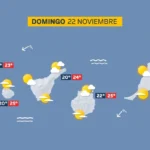
Sunday: sunshine, scattered cloud and a light calima

Tenerife weather: Stable skies and a slight lift in temperatures

Saturday: sunshine and a calm Atlantic

Friday: calm skies and a building Atlantic swell
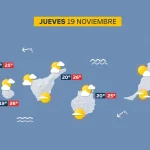
Thursday: scattered cloud and a building Atlantic swell

British man, 23, dies after being pulled from Tenerife sea

Tenerife weather: Sunshine and 27C forecast for Wednesday

Wednesday: sunshine, light winds and a warmer day
