
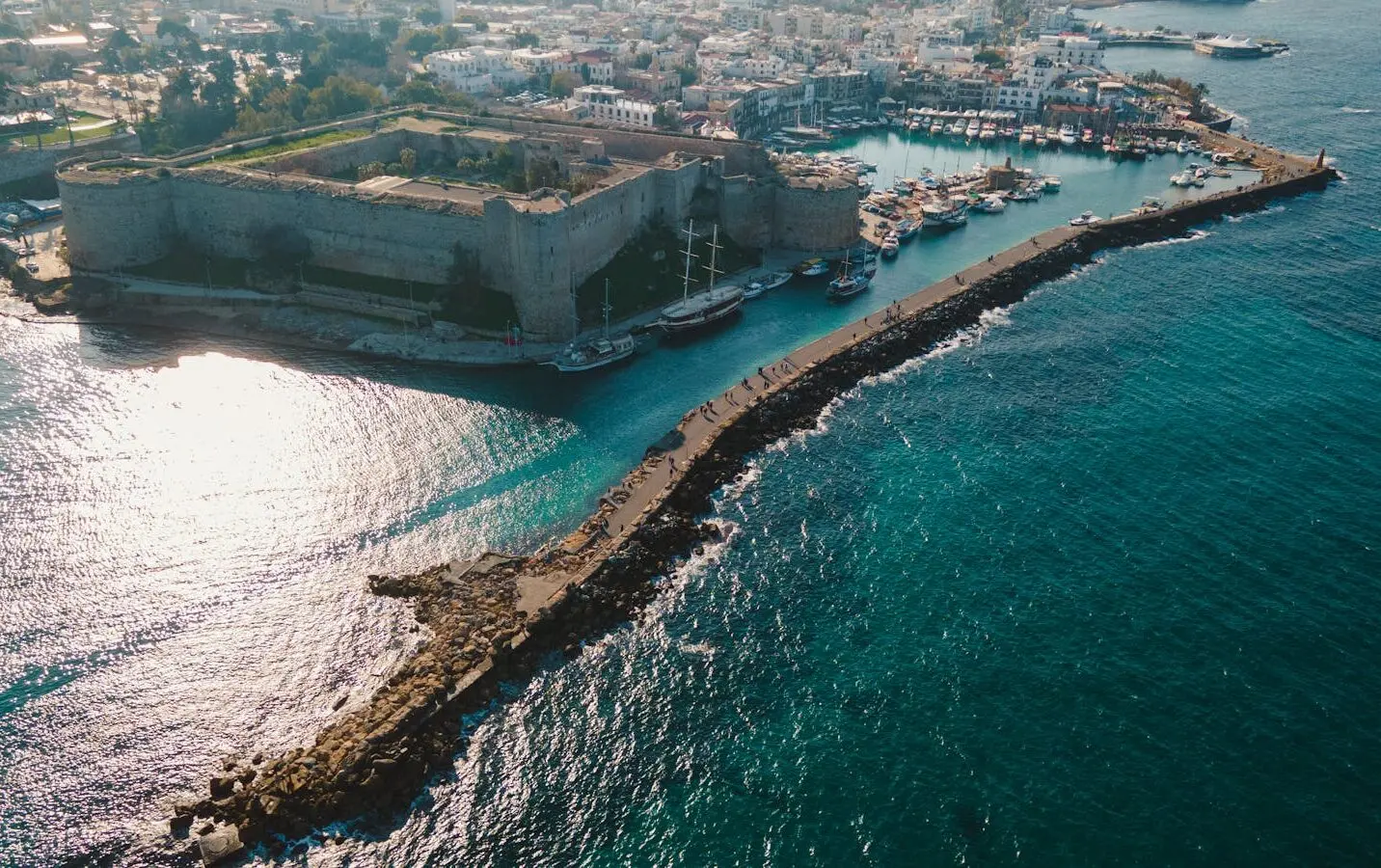
Rhodes is one of the Greek destinations best suited to families – the east of the island is sheltered from the Meltemi wind, the largest water park in Greece is here, and there is a strong base of all-inclusive hotels. In the main Greece with kids guide, Rhodes comes out #1 for families with children aged 4-12 who value convenient and safe AI options above all. This guide walks you step by step through the decisions you need to make before you travel – choosing where to stay, planning visits to the UNESCO monuments, picking a beach to suit your child’s age, and organising the logistics for a family of 2+2.
The east coast has three strong cards for families with younger children: Faliraki Water Park (with its 147-metre Kamikaze) spread over 100,000 square metres, whitewashed Lindos with its ancient Acropolis towering above the bay, and the mighty, remarkably well-preserved walls of the UNESCO-listed Old Town. On top of that there are excellent, safe beaches sheltered from the strong, characteristic Meltemi wind – a key factor when planning a holiday with a toddler. With a very active, curious two-year-old and a preschooler who gets bored quickly, a flight of around 3 hours is a huge logistical argument.
For families looking for full convenience, predictability and safety, the island offers a large, varied base of accommodation aimed squarely at the youngest guests. Rhodes doles out its attractions in moderation – there are water parks, ancient monuments, medieval castles and natural wonders. This guide will show you how to get the most out of this Greek destination, what to see with little ones, how to avoid the crowds, what to watch out for in terms of safety, and where to find time in all of it for an ordinary parent’s break over a frappe.
- Why Rhodes with kids – 5 reasons
- Rhodes Town – the UNESCO Old Town with kids
- Lindos with kids – the Acropolis and Pallas beach
- Faliraki – the number one family resort in Rhodes
- Faliraki Water Park – the largest in Greece
- Rhodes beaches – top 10 for families
- Butterfly Valley with kids
- Trips from Rhodes – Symi and the Aquarium
- Hotel entertainment and miniclubs – what to expect from all-inclusive
- Where to stay – 5 areas of Rhodes with kids
- Family all-inclusive hotels 2026 – 5 tried-and-tested addresses
- What to eat in Rhodes with children
- How to get to Rhodes
- A 7-day plan for Rhodes with children
Why Rhodes with kids – 5 reasons
Choosing where to go on holiday is usually a series of difficult compromises, especially when the adults’ preferences and the children’s abilities are completely different. With Rhodes, the number of advantages clearly outweighs the rest and lets you reconcile the interests of the whole family.
The first and often absolutely most important argument for parents of babies or two-year-olds is logistics and transport. A direct flight takes around 3 hours to 3 hours 30 minutes. With two small children, every extra hour spent in a plane cabin is a logistical challenge, an invitation to crying and growing frustration. Three hours is a time you can plan for and endure relatively easily – just take a new colouring book, a few small books, reusable stickers, snacks and hope for at least a short nap during the flight.

The second reason is Faliraki Water Park, the undisputed top attraction in all of Greece for families. It guarantees great entertainment at the highest, world-class level of safety. From shallow, charming paddling pools and small slides for the littlest ones, to extreme high tubes and twisting pipes for brave older kids. Even if the family spends a whole day there from opening to closing, the children will beg for more.
The third issue, just as important for day-to-day functioning, is the island’s specific geology. Its east coast, where most of the resorts are, has excellent beaches sheltered from the strong north-westerly wind known as the Meltemi. This makes the water calmer, warmer and much shallower – the ideal, dream environment for little ones who want to spend long hours in wet, warm sand and build mud castles by a gentle entry into the sea.

The fourth, very strong argument concerns the organised hotel sector itself. This part of Greece has long been known for excellent, finely tuned all-inclusive resorts that place a big emphasis on family facilities, safety and a suitable diet. Many of them run kids’ clubs in the height of summer. For children aged 4-12 looking for casual contact with peers and play in their own language, that is a huge plus, and for parents – a chance for two hours of relaxation on a sun lounger.

The fifth, decisive reason is the very stable, almost predictable weather. From the last days of May, through June, July and August, right into late October, conditions here are perfect for the beach and swimming. The lack of sudden, multi-day spells of bad weather gives strong confidence that a carefully prepared plan of car trips and boat trips will not suddenly be ruined by unexpected rain and wind.

Rhodes Town – the UNESCO Old Town with kids
It is best to start exploring the island with its oldest, most iconic heart. The Old Town in the capital was long ago added to the prestigious UNESCO World Cultural Heritage list. It is a fascinating place full of nooks and crannies, both for adult history lovers and for younger travellers looking for space to play and explore. The whole historic quarter is tightly enclosed by mighty, thick medieval walls with a total length of 4 kilometres. You can walk around much of them at a strolling pace. For older children, especially from the age of six upwards, such a trip can be very appealing. The long walk naturally requires proper closed sports shoes and a good supply of water in the backpack, but the massive sandstone blocks and deep, dry former moats fire the imagination enormously. Stories of brave knights of the Order of St John defending the fortress from attacks by sea turn an ordinary walk into a game – children run along the safe sections of the stone path, wave sticks and watch out for enemy ships.

The main, absolutely central point of the old town is the huge, impressive Palace of the Grand Master. Current admission prices planned for the 2026 tourist season are around 20 euros for an adult visitor. In winter or very early spring prices drop to 10 euros. The full ticket covers both the palace itself and the connected museum. The place is full of old, authentic armour, vast chambers with beautiful floor mosaics and a raw, knightly atmosphere that you absorb from the first steps. Children quickly go into question mode at every exhibit – it is worth preparing for detailed storytelling about the knights’ names, the origins of the swords and their last fierce fights in the courtyard. The interiors are large and the corridors spacious, but a pushchair can be difficult in places because of the thresholds – for the youngest children, an ergonomic carrier brought from home is definitely the better choice during the visit.
🌐 www.grandmasterpalacerhodes.gr

The next stop on the map of any walking tour of the capital is the iconic, postcard-perfect Mandraki harbour. According to ancient legend, this is exactly where the famous Colossus of Rhodes – one of the seven ancient wonders of the world – stood, right above the wide entrance to the harbour basin. Telling children about the giant statue is a great starting point for a conversation about mythology. Today, instead of the statue of the sun god, arriving tourists are greeted by three historic stone windmills standing on the pier and two pillars topped with slender sculptures of two local deer – Elafos and Elafina. Strolling slowly along the heavily sun-warmed waterfront, you can buy delicious Italian artisan ice cream, drink cold lemonade and watch the luxury yachts and cruise ships with interest. The whole port has very heavy foot and car traffic all day long, so you need to keep your eyes open – the railings are not always complete, and an active two-year-old should not wander towards the steep edge of the quay.

While in the city, you cannot skip the impressive and photogenic Marine Gate, through which merchants and sailors once entered. Right after that, head to the busy Hippocrates Square with its distinctive little fountain in the middle. It is a favourite meeting place, where in the morning the paths of many organised tour groups and independent walkers with cameras converge. Plenty of small first-floor cafes let you watch the crowd with an iced coffee in hand.
An important practical tip: Rhodes Town is best planned and explored with children in only two specific time windows. Either very early in the morning between 8:00 and 11:00, when the air is still fresh and the coaches have not yet delivered the crowds, or in the evening after 19:00, when the sun drops below the horizon and the atmospheric lanterns come on. The middle of the day, especially in the very hot July and August, is a time of truly punishing heat and the long Greek siesta, when everything around slowly comes to a standstill. The narrow, cobbled stone streets of the old town heat up like a giant oven at midday. That, combined with the dense crowd of other tourists brushing shoulders against the pushchair, is a 100% guarantee of frustration, tears and growing whingeing even from the best-behaved, most patient little ones.
Lindos with kids – the Acropolis and Pallas beach
Once the capital is ticked off, Lindos should be the next item on the programme. This ancient settlement lies about 50 kilometres south of the main town. Getting there is very simple – you can hire a car, take a boat trip or use the public KTEL buses, which cover the route in around an hour.

The busy, winding layout of Lindos, with its distinctive white houses, is free of car traffic. Cars are left in large purpose-built car parks above the town. The main reason to visit is, of course, the magnificent Acropolis of Lindos, which dates back to the 12th century BC. This monumental structure stands on a high cliff, exactly 116 metres above sea level. The climb to the very top means tackling 287 steep steps, some of them worn smooth by millions of shoes. For adults it is hard work, especially in the sun. A five or six-year-old can manage the climb on their own legs without much trouble, as long as you plan a few stops for a sip of water. Babies and children under three have to be carried in slings or carriers, because taking a pushchair up is completely and technically impossible.

Many tourists use the so-called Lindos Taxis – good-natured donkeys that carry people from the lower square up to the Acropolis ticket office. It is a classic part of the village, but also the subject of a heated moral debate that has been going on for years. Travel bloggers are deeply divided on the matter. Many families choose this mode of transport because of tired little ones, while some deliberately choose to walk up. When the donkeys are standing still, they stretch their muzzles towards passing children with their little baskets around their necks – a sight that sends two-year-olds into huge excitement and shouts of joy.

At the very top waits the majestic Temple of Athena Lindia. It is a perfect moment for a bit of learning through play. Instead of boring them with dates, it is worth telling your child the myth of Athena’s birth, when she sprang from Zeus’s head in full armour. That kind of storytelling makes a five-year-old stare open-mouthed at the ancient columns, looking for traces of the goddess of wisdom’s shield. Six or seven is usually the age when a child starts to really understand a story like this; younger little ones will simply enjoy the space, the views and the fact that going down is much easier.
After an exhausting, sun-filled visit, it is time for a well-earned reward: a rest in the water. Right at the foot of Lindos is the wonderful Pallas beach, known locally as Megalos Gialos. It is a gentle bay sheltered from the wind, with a very shallow, sandy entry into the water. Perfect conditions for small children. The water is so clear that you can see the bottom even at greater depths. A row of restaurants and small tavernas runs along the beach, where you can quickly order a Greek salad, chips and cold drinks without long walks inland. On the other side of the headland is Lindos beach, or Mikros Gialos – much smaller and quieter, but with equally crystal-clear water. For families with the youngest children, who are not yet interested in history and will not appreciate the monuments, these bays are the main and most important reason for coming to this area.

Faliraki – the number one family resort in Rhodes
Leaving antiquity behind, it is time to focus on the practical side of holiday life and choosing a base. In this category one resort beats all the others hands down. Faliraki is now the number one family resort on the whole island, well connected to the most important places. The town lies just 15 kilometres from Diagoras airport and 14 kilometres from the centre of Rhodes Town, which means a very short, smooth transfer after a tiring flight. The main advantage of this place is the wonderful 4-kilometre sandy beach, long, wide and regularly cleaned. It is fully equipped with the necessary tourist facilities – from rows of umbrellas, through wooden walkways that make it easy to push a buggy, to professional lifeguards watching from their towers, which gives parents a great sense of calm and safety.

When choosing a hotel in this area, though, you need to be very careful. The hotels here fall into two worlds. On one hand, around 70% of the properties are large luxury family hotels with extensive all-inclusive options at four or five-star standard. On the other hand, around 30% of the offer is aimed firmly at a younger crowd and fans of loud parties. Be careful when booking: the northern part of Faliraki is the so-called “bar street” zone, where nightlife goes on until dawn and in the morning the streets show traces of the night before. Groups of British teenagers often stay there. The southern parts of the town, away from the entertainment centre, are an oasis of family holidays. The hotels there have huge green grounds, private stretches of beach and are perfectly insulated from the noise of the street. It is an ideal, central base for active families: a great all-inclusive hotel close at hand, the Water Park 5 minutes away by local bus or taxi, and the distances for shorter afternoon trips are very satisfactory.
Faliraki Water Park – the largest in Greece
Staying in this region, you cannot skip the absolute hit, which for many older children is the main point of the whole trip. Faliraki Water Park, officially known simply as “Water Park”, is an impressive water complex covering an incredible 100,000 square metres. The scale of the place makes a huge impression as soon as you go through the gate. There are 26 different water slides, very sensibly divided by age, height and level of bravery. For older thrill-seeking teenagers there are extreme challenges such as Free Fall, the fast and dark Black Hole, or the swirling Crazy River. The biggest attention-grabber, though, is the iconic Kamikaze – a 147-metre descent that starts almost vertically downwards. For safety reasons it is only open to children aged 8 and over, which usually means big disappointment for younger five and six-year-olds, who spend a long time studying the route through the netting.
For little ones the complex has separate, brilliantly equipped zones. The youngest spend most of the day in the area called Kid Pool – a safe, spacious pool just 50 centimetres deep, full of spraying fountains, small bridges and mini-slides shaped like sea animals. Another great option is the Pirate Pool with a pirate ship in the middle. Older pre-schoolers will be happy going down the Black Hole several times in a double rubber ring with a parent, which provides enough of an adrenaline hit for the whole day. Ticket prices for the 2026 season are roughly as follows: an adult or young person over 12 pays around 30 EUR for a full-day entry, children aged 3 to 12 cost around 20 EUR, and the youngest water fans under 3 get in completely free. As well as the slides, the price includes a huge free pool with artificial waves that are switched on regularly, a long and relaxing lazy river that is ideal for resting in a rubber ring, and a dry playground on the grass.

The water park is open for a long time – in standard months from 10:00 to 19:00, while at the peak of the season, in July and August, the slides stay open until 20:00, which lets you sit out the worst of the midday heat and enjoy the water in the evening. A practical tip: buy your tickets wisely. Entry is often already included in hotel packages at the best all-inclusive properties in Faliraki. If you are staying somewhere else or your package does not include it, it is definitely worth booking tickets online directly through the park’s official website. This gives around a 10% discount on the regular price and, just as importantly, lets you avoid the morning queues at the ticket office, where impatient children can quickly lose their good mood.
Rhodes beaches – top 10 for families
The island is known for its incredible, very varied coastline, which offers something for every type of traveller. For families with small children, though, certain specific things matter: a gentle, sandy entry into the sea, no strong currents, sanitary facilities and nearby basic services. The list below of children’s favourites is based on repeated recommendations from parents who have tested these beaches during the season. The table is a quick cheat sheet of the best spots worth including in your travel plan.
| Beach | Region | Age | Entry | Feature |
|---|---|---|---|---|
| Faliraki | east central | any | Flat and sandy | 4km long, facilities, AI |
| Tsambika | east central | 0-8 | Shallow and sandy | Shallowest in Rhodes, religious site (monastery) |
| Anthony Quinn | east central | 4+ | Rocks and water | Snorkelling, Navarone guns |
| Kallithea | north east | any | Thermal bay | 1930s thermal complex |
| Lindos Pallas | south east | any | Gentle bay | Below the Acropolis |
| Pefkos | south east | 0-8 | Flat and long | Quiet, for families |
| Kolymbia | east central | 0-12 | Sandy | Eucalyptus Avenue (shade!) |
| Stegna | south east | any | Sand and gravel | Small and quiet |
| Glystra | south east | 4+ | Bay, small waves | Snorkelling |
| Prasonisi | south | 8+ | Narrow headland | Two seas, windsurfing |
Tsambika beach, at the foot of a mountain with a small monastery, is widely considered the shallowest and most baby-friendly on the whole island. A two-year-old can walk several metres out into the sea there and the water still only comes up to their knees.

Anthony Quinn Bay, on the other hand, is a place appreciated by older children. It is a rocky bay with crystal-clear water, ideal for snorkelling. Active six and seven-year-olds can swim there for hours in masks, looking for small fish. This is where the famous film “The Guns of Navarone” was shot.

Faliraki beach is the absolute standard. It is a full 4 kilometres long, which means there is always room to lay out your own towel or hire a set of sun loungers. It is wide, mostly fine sand.

Termy Kallithea is a wonderful historic complex from the 1930s, with a small, protected cove tucked inside. There is an entry fee, but in return you get a well-organised site and very calm water.

Lindos Pallas, mentioned earlier, is a safe bet for families visiting the ancient Acropolis.
Pefkos beach is a great, quieter and much calmer alternative to busy Lindos. Soft sand and a very flat entry make it popular with families with the youngest children.

Kolymbia, meanwhile, is a long stretch of sandy-pebbly coast that is a lifesaver on hot days thanks to its proximity to the famous Eucalyptus Avenue – an avenue of large eucalyptus trees providing shade.

For families looking for places completely free of loud, commercial music, Stegna beach is a good choice. It has coarse sand mixed with fine gravel, and along it are very traditional, simple family tavernas serving fresh fish from the morning catch.
Glystra beach is a small, sheltered bay with a soft seabed, good for children over four who want to snorkel. At the very end of the south coast is Prasonisi. It is a narrow spit of land where two seas meet. It is a windsurfing hub, so it can be very windy there. For little ones it is more of a geographical curiosity, but for older children from 8 up, watching hundreds of colourful kites in the wind is a great spectacle.

Butterfly Valley with kids
A change of scenery from the beach to the forest is often very welcome during a long stay in the sun. The Valley of the Butterflies, locally Petaloudes, is a natural oasis just 25 kilometres from Rhodes Town. It is a place unique on a European scale, but it is worth being aware of a few important practical limits. The most important rule: only plan the valley between June and September. That is when tens of thousands of butterflies of the species Panaxia quadripunctaria (which are actually a type of moth) gather by the waterfalls and along tree trunks in search of shade and moisture. Outside those months the valley is simply a pleasant gorge with no butterflies.
Expected ticket prices for the 2026 season are around 6 EUR for an adult. Children aged 7-12 pay around 3 EUR, while little ones under 7 get in completely free. The walking route itself is about 2 kilometres long. Walking it with children at the pace set by short legs takes around an hour and a half. The terrain is full of wooden walkways, narrow bridges and damp, slippery stones. Proper trainers with hard soles are essential. Flip-flops or pool slides can lead to a very painful and dangerous fall onto a hard root.
From the point of view of children’s behaviour and comfort, choosing the right time of day for this walk is key. The middle of the day is the worst – the butterflies have their own siesta between 13:00 and 17:00, which means they are barely active, sit still on the rocks and blend into the surroundings, which can be unsatisfying for children. The best option is an early morning trip. A strict ban on noise and deliberately disturbing the insects applies throughout the valley. For this reason the attraction suits children from 4 up. Younger ones, two-year-olds, can of course walk hand in hand, but they will tire quickly on the stony steps, and keeping a two-year-old completely quiet for an hour and a half is doomed to total failure.
Trips from Rhodes – Symi and the Aquarium

When exploring the island by car gets boring, it is worth looking towards the port. The flagship trip is a boat ride to the nearby island of Symi. The standard ferry takes about an hour and a half each way. A ticket priced for 2026 is around 18 EUR per adult one way. Older children, over eight, will certainly appreciate this trip much more than little ones. Symi is known for its incredible port climbing steeply up the slopes, where all the houses are painted in pastel colours – shades of yellow, ochre, pink and orange. It is an excellent place for a stroll around the sponge shops and for eating fresh, very small, crunchy prawns called simiako garidaki, which are eaten whole.
For families looking for shorter breaks from the sun on the main island, in Rhodes Town, right by the entrance to Mandraki bay, is the historic Rhodes Aquarium. It is a much smaller, older version of the huge site known from Crete. Entry costs just 6 EUR. Built by the Italians in the basement of the building, it resembles the interior of a dark, underwater cave full of nooks and crannies, which really fires the imagination even of more demanding pre-schoolers. Visiting takes barely an hour, so it is an ideal escape in the middle of a hot day for a quick cool-down in the air conditioning.
🌐 www.cretaquarium.gr/rhodes-aquarium/
If you hire a car, it is worth making a short photo stop at Camel Rock. It is an interesting rock formation jutting straight out of the water along the east coast, which from the right angle looks deceptively like a camel’s head. For braver families who like a little dose of adrenaline and nature, an interesting option is a place called Seven Springs. It is a damp, very green oasis shaded by dense trees, with a stream and wild peacocks walking between the tables of the local taverna. The main entertainment there is walking through a very narrow and completely dark underground “water tunnel”. You walk through it in ankle-deep water and there is no way to turn back. It is an adventure suitable only for brave souls aged at least 6. Younger children and anyone who dislikes enclosed spaces can simply walk around the whole hill above, which is much safer.

Hotel entertainment and miniclubs – what to expect from all-inclusive
For many parents the main reason for choosing large all-inclusive resorts is the availability of organised activities for the youngest. In Greece this standard is very high, and resorts compete with each other for the best entertainers. Usually the standard age for leaving a child in the sole care of entertainers is a full 4 to 12 years. Younger little ones, for example just under two, can happily join in the games, but only with a parent constantly at their side.
Miniclub activities are usually very predictable and divided into time blocks. A typical, tried-and-tested daily pattern is morning activities from 10:00 to 12:00 and an afternoon session from 16:00 to 18:00, which avoids play in the full, dangerous sun. In their free time children take part in arts and crafts workshops, hunt for pirate treasure around the hotel or play on covered, safe playgrounds. A safe water zone is always made available to little ones too. The absolute highlight of every day is the evening children’s show, which usually starts around 20:30. It is a time full of loud music, simple dancing and singing along. Sometimes mini plays or magician shows are staged, which let adults enjoy a quiet evening drink for a moment.
Where to stay – 5 areas of Rhodes with kids
Choosing the right area of the island is critical if a holiday with children is to go smoothly in a pleasant, calm atmosphere. The island can be roughly divided into five basic areas, differing in character, distance from the airport and the dominant type of entertainment. The first area, where it usually makes sense to start looking, is Faliraki, the family resort number one. When choosing this place, watch out for the internal split – the wealthier and more modern but also more youth-oriented northern part, often called the bar zone or Bayia, is loud until morning. The southern part of Faliraki, by contrast, is a paradise full of luxury resorts with their own water parks and private beaches, just right for families.
A second, very interesting option is Kolymbia. This town is much quieter, less brash and is considered an excellent choice for families with very small children who value peace during the afternoon nap. It is there that you find the cool, heavily shaded Eucalyptus Avenue, along which most of the hotels and local tavernas are located. The third popular area is around Lindos and Pefkos. These two small towns are about 50 kilometres from the airport, which means a transfer 40 minutes longer after a tiring flight. In return, though, you get a great, very authentic Greek village atmosphere and access to wonderful, long, sheltered bays without big waves.
The fourth zone covers Kallithea and Ixia. These are definitely premium areas, with a choice of very expensive boutique hotels located very close to the island’s capital. The hotels there are excellent in terms of design, but the coast itself can be stonier or heavily exposed to westerly winds, which can be a big drawback with babies. The fifth option is simply Rhodes Town. The capital is recommended only for families with much older, school-age children who want to stroll every evening, explore the old town, browse the local souvenir shops and don’t feel the need to build sandcastles every day right outside their hotel window.
Family all-inclusive hotels 2026 – 5 tried-and-tested addresses
After a thorough analysis of tour operator offers, here is a list of five tried-and-tested, certified hotels for summer 2026. First on the list is the absolutely fantastic five-star Lindos Princess Beach in Lardos. Its biggest plus is the seasonal kids’ entertainment, including the famous “Delfinki Club”, where parents can safely leave their little ones. The hotel has a very flat layout, huge lagoon-style pools and plenty of shaded playgrounds.
Another safe bet is lti Amada Colossos Resort, a large five-star complex right by the beach in the Faliraki and Kallithea area. This property has a huge on-site water park, exclusively for hotel guests, with special slides for the youngest, tubes for teenagers and a lazy river you can float along for hours. The third suggestion for a successful holiday is Mitsis Rodos Maris in the Kiotari area. The Mitsis chain is known for a very high standard of food, rich entertainment and excellent service for guests of all ages.
For families with children aged eight and over who are looking for more elegant surroundings, I recommend the five-star Esperos Palace Luxury & Spa on the outskirts of Faliraki. The property is in a higher price bracket, with great conditions for relaxing in the pool areas and an excellent location for those wanting to do touring trips around the island. At the end of the list is a very reasonably priced and popular option – the four-star Atlantica Aegean Park. This hotel is in the small resort of Kolymbia. Although it’s a more budget-friendly all-inclusive option, it guarantees a very large, extensive children’s area with lots of wet play areas, paddling pools and safe pools where both older preschoolers and toddlers can play.
What to eat in Rhodes with children
Even if you’re spending your holiday on an all-inclusive basis, exploring local flavours should be an important part of the trip. Children are usually fussy, but Greek cuisine can satisfy even very demanding palates. An absolute hit worth trying with the youngest is a local, native Rhodian speciality called melekouni. These are traditional soft sesame bars with delicious real thyme honey, almonds and light spices – ideal as an after-lunch snack. For a quick, filling lunch while sightseeing, a classic pita gyros with crispy chips or meat souvlaki skewers works perfectly. For adults, dakos is a great option – crisp rusks with tomatoes and feta cheese.
When deciding where to eat an authentic meal, it’s worth avoiding the most commercial streets. You’ll find very good tavernas in Mandraki harbour in the capital and in small fishing villages such as Charaki or the touristy but charming Pefkos. A very useful piece of information for families is that most good all-inclusive hotels have dedicated Greek cuisine stations at every dinner, which lets children try new flavours stress-free. However, do remember that traditional, authentic tavernas outside the main resorts observe a strict siesta. Kitchens are often closed between 14:00 and 17:00, so you’ll need to adjust your little ones’ lunchtime so you don’t find yourself facing closed doors in the worst of the heat.
How to get to Rhodes
Organising the logistics is currently very simple and comfortable, which is a huge advantage of this island for holidays with little ones. The main gateway is Diagoras international airport, shown in booking systems with the code RHO. Total time in the air is between 3:00 and 3:30 hours, depending on the winds.
After a safe landing on the island, you can organise your transfer to the hotel in many ways. The most budget-friendly option is public transport. KTEL buses number 11 and number 20 leave directly from outside the terminal to Rhodes Town centre, and a ticket costs just 2.40 EUR. If your resort is in the south, a direct transfer bus to Faliraki costs around 8 EUR per person. A taxi remains the most convenient option when you have lots of luggage and pushchairs. A journey from the airport to Faliraki will cost around 30 EUR. Hiring a car right after arrival is also a popular solution – prices for a basic small family car are around 35-45 EUR per day, and the main eastern road towards Lindos is wide and straightforward.
A 7-day plan for Rhodes with children
Putting together an optimal travel plan requires a lot of flexibility, especially when there’s an active preschooler and a two-year-old on board. The ready-made scenario below assumes a stay in a great all-inclusive hotel in the Faliraki area and combines days of intensive sightseeing with days of pure, blissful relaxation. The table is a short, tried-and-tested outline for this kind of balanced trip.
| Day | Main activity | Notes |
|---|---|---|
| 1 | Arrival and settling in at the all-inclusive | Rest |
| 2 | Rhodes Town (morning) and beach | Avoid midday |
| 3 | Faliraki Water Park | Full day |
| 4 | Lindos Acropolis and Pallas | Carrier for the little one |
| 5 | Butterflies and Kallithea springs | Trainers |
| 6 | Symi boat trip or relax | Symi for 8+ |
| 7 | Packing and departure from RHO | End of trip |
Day one is purely for a calm arrival, stress-free check-in at the family hotel in the Faliraki area and a first look at the buffet and pools. In the afternoon, it’s worth heading out to relax on the hotel’s excellent sandy beach.
Day two starts very early. Between 8:00 and 11:00 we set off by local bus or hire car to explore Rhodes Town, including the walls and the charming Mandraki harbour. Midday is time to return to the hotel for lunch and a nap for the youngest, and we spend the afternoon relaxing by the water.
On day three the plan is simple and intense – after a hearty breakfast we set off for a full, long day at the famous Faliraki Water Park. Older children go wild to their heart’s content, while little ones spend time in the safe paddling pools.
Day four is a trip south to majestic Lindos. We climb the steep steps up to the Acropolis, learn a little history, and in the afternoon relax on the exceptionally shallow Pallas beach, recharging our batteries at a small taverna.
On day five we split the day again. In the morning we go to explore the green, tree-filled Butterfly Valley, and after a short lunch we move on for a cool afternoon at the atmospheric, historic Kallithea springs, to rest in the quiet coves.
Day six is decision time. Families with little ones choose to stay put and recharge on the beach, while those with children over eight set off on a long boat trip to the photogenic island of Symi. On day seven we simply have a big farewell breakfast in the morning, buy last presents for the grandparents and slowly head to the nearby airport.
The right choice depends heavily on your child’s exact age and your family budget. One of the most popular, safe picks is the luxury Lindos Princess Beach, which has excellent kids’ clubs and entertainment. Another huge option for older children who want thrills is the lti Amada Colossos Resort in the Faliraki area, with a very large private water park for guests only. In quiet Kolymbia, the well-run and affordable Atlantica Aegean Park has been highly rated for years. It is best simply to match the area of the island to what your children can actually handle.
The big water park in the Faliraki area is well set up for children of every age group. The youngest, even babies up to three years old, get in free and can safely spend long hours in very shallow, calm zones such as the Kid Pool, or paddling by the interactive pirate ship. Older five and six year olds have plenty of medium slides to choose from. Do bear in mind, though, that the fastest, most extreme slides, such as the 147-metre-high Kamikaze, can only be used once a child has turned eight.
Reaching the high, imposing Acropolis above Lindos means climbing 287 very steep stone steps, often slippery from tourists’ shoes. For an active, healthy five or six year old this is usually not a big problem, especially if you take a few sensible breaks to cool down and drink cold water. Be aware, though, that getting up there with a traditional pushchair is physically impossible. Toddlers and babies must be carried on shoulders, in slings or in very strong, stable carriers.
The absolute best time to visit the famous Valley of the Butterflies, or Petaloudes, is the peak period from early June to the very end of September. Only in this window do millions of butterflies arrive in the area, seeking shade and the high humidity from the small waterfalls. An important step is to arrive on the walking route early in the morning. During the hottest afternoon hours, between 13:00 and 17:00, the insects take a kind of siesta, become far less active and are simply very hard to spot.
The dilemma between the two largest Greek islands is a common one. In our main guide explaining the differences, you will find a full comparison of both islands. Broadly, the island of the Colossus wins more clearly with younger children for its excellent, huge all-inclusive complexes with modern entertainment and its lovely, flat beaches in the east that are free from strong winds. The island of the Minotaur is much larger, much wilder, requires regular driving and is most often named as the better choice for very active, older families who love demanding trekking.
For the youngest children, such as toddlers under two or crawling babies, the absolute number one on the whole island remains the beach at Tsambika. It has incredibly fine, soft sand with no larger stones and, most importantly for parents, the shallowest, longest, most gradual entry into warm sea in the whole eastern region. Even after wading several metres into the bay, the water stays at a constant, very low level below the knees. Another clear plus of this place is full access to good sanitary facilities, local toilets and plenty of simple tavernas serving Greek food.
The total cost of a family stay on these two most popular islands is broadly very similar, and it is hard to pick a clear winner on price. Rates at very good, large five-star hotels with full all-inclusive board tend to be slightly higher here in peak season. On the other hand, renting a small city car and going on trips is a big saving, because the distances to all the key local attractions are very short and you need to refuel far less often, more cheaply and for shorter periods at the small local stations.
A visit in warm May, especially in its more settled second half, is a really good and sensible plan for parents looking for calm and lower prices. On the sheltered, well-developed east coast the sunny, hot weather is usually already stable at a high summer level, with daytime temperatures reaching a safe 25 degrees. The sea is only just starting to warm up slowly, but the main pools at all the best resorts often offer good heating. The biggest plus of May is the lack of July crowds at the ancient Acropolis and cheaper flights.
Yes, a trip on a fast or traditional ferry to the small island of Symi is one of the most commonly chosen local day trips by sea, second only to the waterfalls. From a practical point of view, note that the full crossing takes one to one and a half hours each way. It will be a fantastic, photogenic scenic adventure for slightly older, well-behaved school-age children, but for crying newborns or grumpy toddlers the enclosed passenger cabin will mean unnecessary, drawn-out tiredness and a source of growing irritation for the adults around them.
Official prices for family charter flights planned for June 2026 depend heavily on many specific variables. When looking for good flights on popular booking sites, the standard rate in the so-called First Minute system tends to sit at a stable, repeatable level for a return direct ticket for one adult with luggage. It is worth remembering the additional limited pools of free tickets reserved specifically for babies under two.