
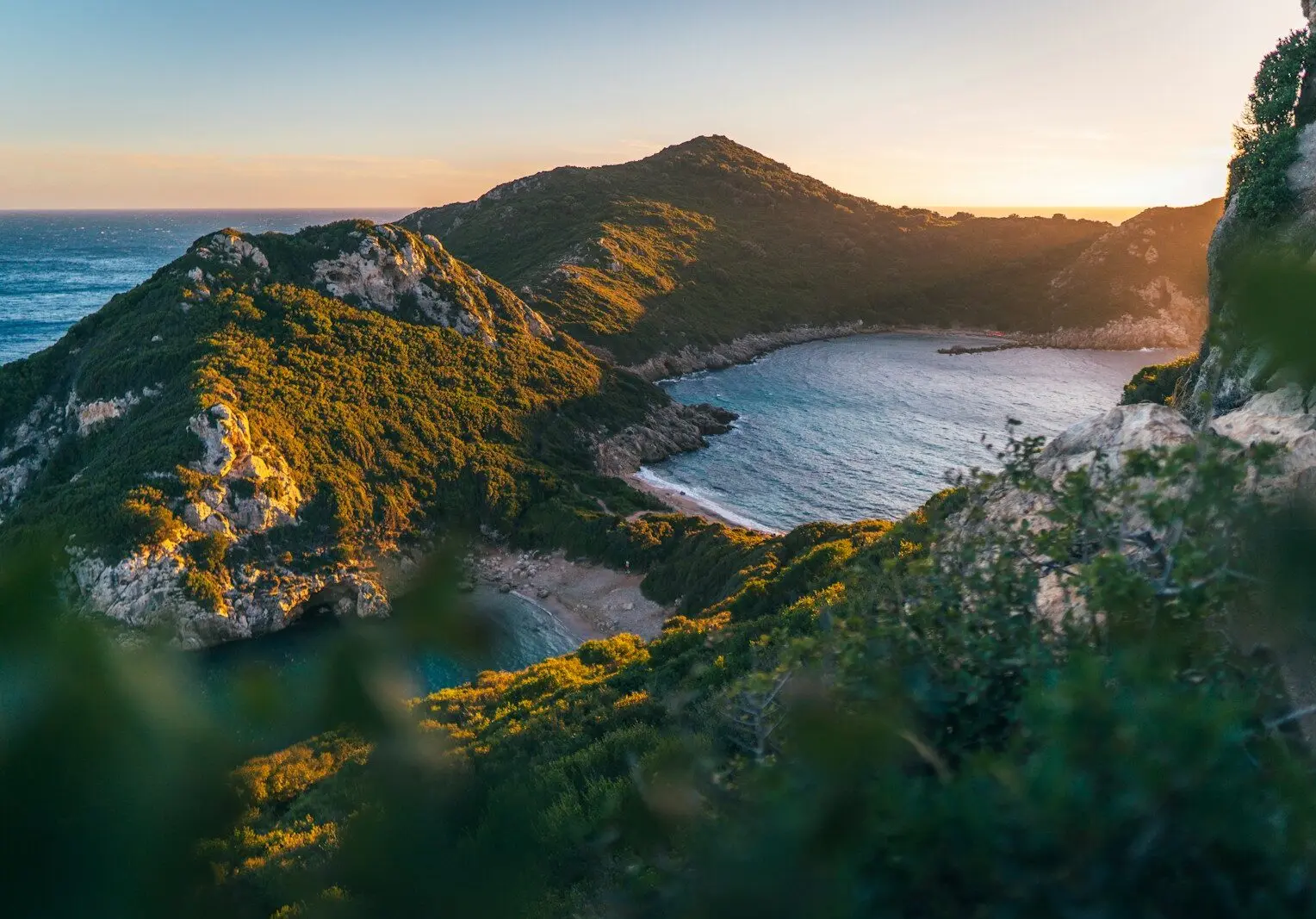
Corfu with kids is one of the easiest choices for a family holiday in the Mediterranean in 2026. The island sits at the western edge of Greece, right next to the Albanian coast, and the flight takes just 2 hours 30 minutes. That is the shortest flight of all the Greek islands. For a family of four, where the younger child copes badly with long journeys and the older one starts asking for something new to do after two hours in a seat, that difference matters a lot on the first day.
Corfu is also the greenest of the Ionian islands. Cypresses, olive trees growing since Venetian times and pine-covered cliffs above the bays of Paleokastritsa give it a completely different feel from sun-scorched Crete or rocky Rhodes. In the main guide Greece with kids, Corfu is one of three islands best suited to families looking for gentle greenery, easy distances and convenience. Compared with Crete with kids, the island is less spread out and more compact – almost everything is within an hour’s drive of your base. That is a big advantage when you do not want to wake the younger child at six every morning to beat the heat at the other end of the island.
A unique draw of Corfu is its closeness to Albania. A catamaran leaves the port in Corfu Town for Saranda in just 30 minutes, and a separate trip to the beaches of Ksamil gives families two countries in one holiday. We plan the cross-cluster trip in our guide Albania with kids, where you will find details on beaches, hotels and the logistics of the day. In this article we collect the specifics about Corfu itself: where to stay with kids, how to plan Aqualand, how much the ferry costs in 2026, which beaches have shallow entry and which have cliffs. A 7-day plan and ten questions in the FAQ at the end round off the logistics for the whole trip.
- Why Corfu with kids – 5 reasons
- Corfu Town – a Venetian UNESCO old town with two fortresses
- Paleokastritsa – things to do in Corfu
- Acharavi – a family resort with the longest beach
- Kassiopi – Venetian harbour and small coves
- Sidari and Canal d'Amour – white cliffs that children love
- Corfu beaches for families – top 10
- Aqualand – one of the largest water parks in Greece
- Ferry trip to Albania (Saranda) from Corfu
- Achilleion, Lake Korission and other day trips
- Where to stay in Corfu with children – 5 areas
- Family all-inclusive hotels in Corfu
- What to eat in Corfu – local specialities for children
- How to get to Corfu
- Corfu weather in season – when is best with children
- Do you need a car on Corfu with children
- A 7-day plan with a trip to Albania
Why Corfu with kids – 5 reasons
The first reason is flight time. A flight to Corfu airport (code CFU) takes about 2 hours 30 minutes, the shortest distance to a Greek island. For a family with a younger child that means one nap cycle, one set of snacks and one sticker game. The older child will not have time to get bored, and the trip home at the end of the holiday does not need an elaborate plan for on-board entertainment. CFU airport is literally 3 kilometres from Corfu Town, and transfers to most popular bases take between 20 and 60 minutes. By comparison, transfers on Crete can take up to two hours.
The second reason is the shape of the island. Corfu is a green, rolling island about 60 kilometres long but only 30 wide. In practice, nowhere is far. From the northern resort of Acharavi it is 35 minutes to Paleokastritsa, 40 minutes to Corfu Town and 50 minutes to Aqualand in the south. You can plan days flexibly and go back to the hotel for an afternoon nap.
The third reason is the water. The east and north coasts, sheltered from the wind, give families with the youngest children calm, warm, predictable sea. Shallow entries, the long stretch of sand at Acharavi or Roda, the small coves of Paleokastritsa – all of this works for children who are just getting to know the sea.
The fourth reason is the hotels. Corfu has long had a strong line-up of large all-inclusive resorts aimed at families. Brands such as Atlantica, Mitsis, Mareblue, Mayor and Marbella offer family rooms, restaurants with children’s menus and pool areas with mini slides. The fifth reason, decisive for many families, is the closeness of Albania. Being able to cross by catamaran to Saranda and see the beaches of Ksamil, which look like a Caribbean postcard, during a stay on a Greek island is a unique offer among the Greek islands. Corfu with kids becomes a two-destination trip for the price of one flight ticket.

Corfu Town – a Venetian UNESCO old town with two fortresses

The island’s capital is a must on any family plan. Corfu’s Old Town has been on the UNESCO list since 2007, thanks to two overlapping styles: Venetian (Corfu belonged to Venice for 400 years) and British (another 50 years under the British crown in the 19th century). It is a mix you will not see on any other Greek island. Narrow streets known as kantounia, balconies full of flowers, washing drying between the houses, small shops with local specialities – the whole thing feels more like an Italian provincial town than classic Greece. Plan the walk for the morning (start at 9:00, when the streets are still cool) or for the evening after 18:00, when the lamps come on and the temperature drops to a pleasant 25 degrees.
The heart of the old town is Spianada, one of the largest squares in Greece. It is a wide, green space surrounded by cafes, with a bandstand and avenues of plane trees giving shade. For children it is the perfect place to run around and take a short break from the narrow streets. Right next to it stands the Liston, the famous colonnade modelled on the Rue de Rivoli in Paris, built by the French. The cafes under the arcades serve frappe and ice cream – a good stop for a 30-minute break from sightseeing. The most recognisable landmark in the city also starts from the square: the Old Fortress (Palaio Frourio). It dates from the 6th century, was expanded by the Byzantines and the Venetians, and today serves as a viewpoint over the whole old town.

A ticket to the Old Fortress in 2026 is around 6 EUR for an adult, and children under 6 go free. Entry means crossing the Contrafossa channel over a small bridge – for a younger child that is already an attraction in itself. The walk to the very top of the fortress takes 30 minutes at a slow pace, and the view takes in the whole port, the airport, Mount Pantokrator and the Albanian coast in the distance. With a younger child a carrier works better than a pushchair – manoeuvring wheels over the uneven stones is a struggle. The second fortress, the New Fortress (Neo Frourio) from the 16th century, is a less crowded alternative. Entry is free, the underground corridors and terraces give shade even at midday, and children from 6 upwards enjoy exploring the tunnels.
🌐 www.visit.corfu.gr/sights/spianada-square/
A third point worth noting is the Palace of Saint Michael and Saint George on Spianada. It is the former residence of the British governors, now the Museum of Asian Art with a collection of almost 11,000 exhibits from China, Japan and India. Tickets are 6 EUR for adults, and children up to 18 from the EU go free. For children over 7 the exhibits (miniatures, samurai weapons, dolls) can be surprisingly appealing. Head towards the old port in the evening – this is where the catamarans to Albania and the ferry to Igoumenitsa moor, and the sunsets over the fort are among the best in the Ionian Sea.

Paleokastritsa – things to do in Corfu
Paleokastritsa is the most photographed place on the island – and with good reason. Six small bays cut into wooded cliffs, turquoise water with visibility of up to a dozen or so metres, a white 13th-century monastery on the headland and tour boats taking families to the sea caves. It is 45 minutes by car from the airport, through hairpin bends across the middle of the island. On your first morning in Paleokastritsa, head down to the main bay of Agios Spiridon, where the water is shallowest and the sand mixes with fine pebbles. The shallow entry works like a safe pool – a younger child can play for hours without the risk of the bottom suddenly dropping away.

The Theotokos Monastery looks down on the village from a 100-metre cliff. Entry is free, and long sleeves and covered knees are required (the monastery lends wraps at the gate). The interior takes 15 minutes to look round – a 13th-century church, a small museum with icons and a garden with views over the bays. For children the most interesting things are the large sea turtle shells shown in the museum and the cats living in the monastery garden. Open daily from 7 to 13 and from 15 to 20. It is best to drive there – it is 10 minutes up the hairpin road from the beach, with free parking right outside the gate.
Tour boats leave from the main beach every half hour and take families to the three most famous caves: the Blue Cave, the Golden Cave and the Cave of Love. The full route takes 30-45 minutes, a ticket for an adult is around 15 EUR, a child up to 12 is 8 EUR, and the youngest under 4 go free. For a child who has never been on a boat, it is a first, safe exposure to the sea. All the boats have combustion engines, so a slight smell of fuel may bother the youngest – for sensitive noses we suggest going in the morning, when the swell is minimal. Jet skiing and banana boats are options for children from 8 with an adult supervising.
Among the other bays, it is worth getting to know Liapades (a neighbouring village, beach reachable by car) and Rovinia, which you reach down a steep path (200 steps down). Rovinia is a bay completely tucked between cliffs with white pebbles and clear water – but for families with younger children the steps are a challenge, so it is better to leave this one for a day without a pushchair. In Paleokastritsa itself, accommodation is a mix of small boutique hotels and larger family resorts. Restaurants mainly serve fish and local sofrito – prices are higher than in Acharavi, but the quality is very consistent.
Acharavi – a family resort with the longest beach
Acharavi is the number one family base on Corfu and the best-connected point for both Corfu Town port (40 minutes by car) and the northern attractions: Sidari (15 minutes) and Kassiopi (20 minutes). The main draw here is the beach – 7 kilometres of continuous sand with pebbles, stretching from neighbouring Roda all the way to Almyros. The water is very shallow at the entry, the seabed is even and the waves are small – an environment practically made for the youngest children. The beach is public along its whole length, sun loungers with a parasol cost 12-18 EUR per set in season, and the water meets Blue Flag criteria.

In the town itself you’ll find a wide choice of tavernas, souvenir shops, a pharmacy, supermarkets (LIDL opened in Acharavi in 2024) and a clinic for tourists. The main street runs parallel to the beach and is wide enough to push a pram without any risk. Evening life is quiet – there are no clubs, discos or loud music. Acharavi is the opposite of crowded Kavos or Sidari – here families go to bed at 10pm and morning coffee in a taverna starts at 9. The distance from Acharavi to Pantokrator (the highest mountain on Corfu, 906 m, with a viewpoint) is 30 minutes by car through the villages of Old Perithia. For families with children aged 6+ it’s a great day trip with lunch in an old Greek taverna at the top.
Kassiopi – Venetian harbour and small coves
Kassiopi lies 8 kilometres east of Acharavi, on a headland jutting out towards Albania. It’s an affluent harbour with a Venetian character and one of the oldest settlements on Corfu – it was already mentioned by Cicero. The centre is a circular harbour full of restaurants, cafes and shops. An evening walk around the harbour takes half an hour, enough for a child to eat an ice cream and run around the fountain. Just behind the harbour rise the ruins of a Byzantine fortress, reached by stone steps (free entry, a quarter of an hour’s walk, but the path is steep).

Around Kassiopi there are seven small coves reachable from side roads: Bataria, Kalamionas, Imerolia, Avlaki, Apraos, Kalami and Agios Spiridon. Each one different, each one small, most with fine pebbles instead of sand. For the youngest we recommend Imerolia (shallow water, fine sand with pebbles) and Kalamionas (car park right by the beach, a few tavernas, a small cove sheltered from the wind). Avlaki, by contrast, is a longer, open beach with a stronger swell – for older children learning to swim it’s worth checking the conditions on the day. All the coves are within 5 kilometres of Kassiopi centre, and the drive takes no more than 10 minutes.
Sidari and Canal d’Amour – white cliffs that children love
Sidari lies 12 kilometres west of Acharavi and is one of the most popular resorts on Corfu. The main draw here is an unusual rock formation – white sandstone cliffs shaped by wind and water into channels, coves and windows. The most famous spot is Canal d’Amour, a narrow strait between two cliffs where the water flows into a long, straight cove resembling a canal. Legend says a couple who swim across the channel together will stay together for life. For a child the legend matters less – what counts is that the cliffs look like a maze from a fairy tale, with small windows and caves carved into the rock where the sea flows in.
From a family of four’s point of view, Sidari needs some care. At the height of the season (July-August) the place is heavily touristy, the beach is crowded and the water is sometimes cloudy from sand stirred up by the waves. The best time to visit is May-June or September, when you can explore the cliffs almost alone. Canal d’Amour itself is 1.5 kilometres west of Sidari centre, with a free car park and then a 5-minute walk. The steps down to the water are quite steep – with a younger child a carrier is definitely better than a pram. For older children the fun is swimming between the cliffs, diving through the narrow windows (snorkel essential) and climbing on the low rocks. Entry is free and there are no facilities – bring water and snacks with you.
In the afternoon it’s worth driving down to Sidari itself for lunch in one of the tavernas along the promenade. The main beach is long and sandy, ideal for children who don’t like pebbles under their feet. For children aged 6 and over we recommend a boat trip to the Diapontia Islands (Mathraki, Erikoussa, Othoni) leaving from Sidari port. The full route takes 6-7 hours (a whole day), tickets around 25 EUR for an adult and 12 EUR for a child, with a meal on board extra. This trip is really for families with children aged 7+, as a long crossing can be tiring for a younger child.
Corfu beaches for families – top 10
Choosing a beach on Corfu depends on three things: the age of the children, where you’re staying and the time of day. The east coast (Acharavi, Roda, Kassiopi) has the most long, shallow beaches sheltered from the wind – ideal for families with children aged 0-5. The west coast (Paleokastritsa, Glyfada, Agios Georgios Pagi) offers more dramatic, photogenic coves with cliffs and deeper water – recommended for children aged 6+. The south (Issos, Agios Georgios Argyradon) has long stretches of sand with the smallest crowds. The table below compares 10 of the best beaches chosen with families in mind.
| Beach | Area | Entry | Age | Shade |
|---|---|---|---|---|
| Acharavi | north | shallow | 0+ | parasols |
| Roda | north | shallow | 0+ | parasols |
| Paleokastritsa | west | shallow | 3+ | cliffs |
| Glyfada | west | medium | 5+ | parasols |
| Agios Georgios Pagi | west | shallow | 3+ | parasols |
| Issos | south | shallow | 3+ | none |
| Sidari | north | shallow | 3+ | parasols |
| Kalamionas | north-east | shallow | 0+ | tavernas |
| Almyros | north | shallow | 0+ | parasols |
| Barbati | east | medium | 5+ | parasols |
Acharavi and Roda are practically one beach separated only by name – 7 kilometres of continuous sand with fine pebbles right at the waterline. The shallow entry lasts for 30-50 metres, which lets preschool children splash about with close supervision. Paleokastritsa is the choice for families who like things more scenic – six coves surrounded by cliffs give the feeling of discovering a new world. Glyfada (mid-west coast, 25 minutes from Corfu Town) has the best sand on the whole island – golden, fine, almost like the Canary Islands. Issos in the south is an almost wild beach with little infrastructure, but with the biggest crowds avoided thanks to the length of the shore. Barbati is a beach for families looking for quiet with a view of the Albanian mountains – from the youngest children’s point of view, though, the water is deeper here, so it’s better with a child aged 5 and over.
Aqualand – one of the largest water parks in Greece
Aqualand Corfu is a must for families with children aged 4+. The park covers 75,000 square metres and holds 51 water slides, wave pools, lazy rivers and dedicated zones for the youngest. It’s one of the largest facilities of its kind in all of Greece, smaller only than Watercity on Crete. Location: the middle of the island, at Agios Ioannis, 16 kilometres from Corfu Town (20 minutes by car). Open daily from May to October, 10:00 – 18:00, and until 18:30 in July and August. A shuttle bus organised by tour operators is available from most holiday bases.
Ticket prices for the 2026 season: an adult around 32-36 EUR for a full day, a child aged 5-12 around 24-28 EUR, children under 4 free. An afternoon ticket (from 14:30) costs around 22 EUR for an adult and 16 EUR for a child – a good option if you’ve planned a beach morning and want to extend the day. Online tickets give a 10-15 per cent discount. The park has seven themed zones: Black Hole (a slide in the dark for children aged 12+), Kamikaze (the steepest slide, 10+), Crazy River (a fast river with rapids, 8+), Rainbow (parallel racing slides, 6+), Children’s Pool (a paddling pool with fountains and mini-slides for ages 2-5), Lazy River (a calm pool with a current, for the whole family) and Black Tornado (the newest attraction from 2024, a funnel for ages 12+).
Practical tips. First: arrive 15 minutes before the 10:00 opening, as queues get long in the afternoon, especially in July. Second: sun loungers and parasols are free, but the best ones (by the children’s pools) are taken before 10:30 – it’s worth sending one adult to reserve them while the other waits with the children for opening. Third: food and drinks inside the park are expensive (a sandwich 8 EUR, chips 7 EUR, bottled water 3 EUR for half a litre). You can bring your own snacks in a backpack, but glass bottles are banned. Fourth: lockers cost 5-8 EUR per day, with a chip wristband returned on the way out. The youngest child (under 4) is best kept in the Children’s Pool all day – the rest of the park is really for older children.
Ferry trip to Albania (Saranda) from Corfu

This is one of the things that makes Corfu stand out from other Greek islands. A catamaran leaves Corfu Town port several times a day for Saranda in Albania, and the crossing takes just 30 minutes. From Saranda port, the beaches of Ksamil (the most beautiful beaches in Albania) are 25 minutes away by car or bus. For families it’s a great chance to see two countries during one holiday. Full itineraries along the Albanian coast are in our main guide Albania with kids – here we focus on the logistics of the day from Corfu.
Catamaran tickets in the 2026 season cost around 25-35 EUR per adult one way, 12-18 EUR per child aged 4-12, and the youngest under 4 travel free. Return tickets for the same day cost around 45-55 EUR per adult, 22-30 EUR per child. Tickets can be bought online (Joy Lines, Ionian Seaways, Finikas Lines) or at the ticket windows in Corfu Town’s new port. Booking online is especially recommended in July and August, when crossings are very busy. The first catamaran usually leaves at 8:30 or 9:00, and the last return from Saranda is at 18:00 or 19:00. Boarding starts 45 minutes before departure, so allow plenty of time to get to the port.
Border formalities. Albania is not in the Schengen area, so everyone crossing the border needs a valid passport. Children need their own separate passport (this applies to the youngest too). All passports are checked twice: on boarding in Corfu (Greek check) and on arrival in Saranda (Albanian check). The whole process takes around 30 minutes, so the real journey time from Corfu to Saranda is an hour including formalities. On arrival in Saranda, local taxis wait outside the port – the price for a transfer to Ksamil is around 25-30 EUR (a taxi holds 4 people, and the driver usually stays in Ksamil and takes you back for the afternoon crossing).
Plan for the day: morning crossing at 9:00, in Saranda at 9:30 including formalities, taxi to Ksamil, beach and lunch at one of the waterfront tavernas, back to Saranda around 16:00, return crossing at 18:00, in Corfu at 18:30. With younger children, consider an organised trip with an agency – the price is 60-80 EUR per adult, 40-50 EUR per child, including transport, document checks and a choice of beach spots. For independent families, we advise not planning Saranda for the first or last day of your stay – if something goes wrong (a delayed crossing, a breakdown), you lose your buffer. We advise against taking the youngest under 2 on a 30-minute sea crossing in the middle of the day – the heat and engine noise can be tiring.
Achilleion, Lake Korission and other day trips
Achilleion Palace is one of the island’s most recognisable landmarks. Built in 1890 as the summer residence of Empress Sissi (Elisabeth of Bavaria), it was later taken over by Wilhelm II. It stands 10 kilometres south of Corfu Town, in the village of Gastouri. The interiors are full of Greek mythology – statues of Achilles, frescoes, a collection of 19th-century paintings. Admission in 2026: around 7 EUR per adult, 5 EUR reduced, children under 6 free. Open daily 8:00 – 20:00 in season. For children aged 7 and up, the gardens are interesting (with an ornamental pool, palm-lined paths and views over Garitsa Bay), as are the stories of Greek heroes told on the audio guide. A younger child will probably get bored after 30 minutes – plan 1.5 hours in total.
Lake Korission is a lagoon in the south of Corfu, separated from the sea by a narrow band of dunes. It is a nature reserve and a feeding ground for flamingos, herons, terns and cormorants. The best time for birdwatching is early morning (5:30-8:00) or evening (18:00-20:00). Issos beach on the sea side is one of the longest on the island – 6 kilometres of wild sand with minimal facilities. For families with children aged 5 and up it is a great place to spend an afternoon – children run over the dunes, catch small fish in the lagoon and watch birds in the evening. The distance from Acharavi to Korission is 75 kilometres (1 hour 30 by car), from Corfu Town – 35 kilometres (50 minutes). Entry is free.

A few other trips are worth a brief mention. Mount Pantokrator (906 metres, the island’s highest peak) – you can drive right to the top, with a panorama over the whole of Corfu and Albania, and for children aged 5 and up it is a great geography lesson. Old Perithia (a village on the slopes of Pantokrator, abandoned in the 1960s, now partly restored with two tavernas) – for families who like quiet and a sense of times gone by. Mon Repos (a British palace on a hill above Corfu Town, the birthplace of Prince Philip, husband of Queen Elizabeth II) – the park is free, the museum in the palace is 4 EUR. Vidos (a small island opposite Corfu Town with a beach and park) – a water taxi from the port, 5 EUR for the crossing, and for children aged 4 and up a great half-day outing.
Where to stay in Corfu with children – 5 areas
Your choice of base decides the character of the whole holiday. We pick out five areas, each with a different family profile.
The first and most recommended is Acharavi and Roda – a family resort with the island’s longest beach, a huge choice of all-inclusive hotels, and medical and shopping facilities. Ideal for families with children aged 0-12.
The second is Paleokastritsa – more intimate, the most scenic, recommended for families who like hills, cliffs and swimming in bays.
The third is Corfu Town and surroundings (Gouvia, Dassia) – for families with school-age children who like history and culture, and for being close to the port (if you are planning Saranda, you don’t have to get up at 6 for the transfer).
The fourth area is Kassiopi – a choice for families looking for intimacy, among smaller coves, with a good restaurant scene in the evening.
The fifth is Sidari – for families who like the feel of a classic resort with clubs and a party side, with a beach and the Canal d’Amour attraction. In peak season Sidari can be noisy, so it is not necessarily suitable for the youngest.
General rule: families with children aged 0-5 choose Acharavi/Roda or Kassiopi (shallow water, calm). Families with children aged 6-12 do better in Paleokastritsa (water activities) or near Corfu Town (sightseeing, the ferry to Albania). Teenagers will be happy with Sidari or Kavos (the most party-focused spot in the south, but we don’t recommend it for families with the youngest children).
Distance from each area to CFU airport: Acharavi – 45 minutes, Roda – 40 minutes, Paleokastritsa – 45 minutes, Corfu Town – 10 minutes, Kassiopi – 50 minutes, Sidari – 50 minutes, Kavos – 1 hour 15 minutes. For families with younger children we recommend areas within 45 minutes of the airport, so the transfer after the flight isn’t an extra challenge. Car hire at CFU airport costs 250-400 EUR per week in the 2026 season (a compact with a child seat). Hertz, Avis, Sixt – all present at the airport.
Family all-inclusive hotels in Corfu
The choice of hotels in Corfu is wide – from luxury five-star resorts to modest family apartments. Below are specific options. Marbella Corfu (Agios Ioannis Peristeron, east coast, 5 stars) – one of the most recommended resorts for families with children aged 4 and up, a huge pool with mini slides, family rooms for 4, and English-language entertainment in July-August. Price for a week all-inclusive for a family of 2+2 in the 2026 season: around EUR 1400-2100 per person.
Mareblue Beach Resort (Agios Spiridon, north coast, 4 stars) – recommended for families with the youngest children, a long shallow beach right by the hotel, a mini water park with 4 slides in the resort itself, and a great children’s menu. A week all-inclusive for 2+2: about EUR 1295-1765 per person. Capo di Corfu (formerly Mayor, Lefkimmi, south coast, 5 stars) – more intimate, for families looking for peace and quiet, a private beach, a restaurant with Greek cuisine, and English-language entertainment in July. A week for 2+2: about EUR 1645-2235 per person.

Roda Beach Resort & Spa (formerly Mitsis, Roda, north coast, 5 stars) – one of Corfu’s best-known family addresses, a mini water park, a large main pool, restaurants with children’s menus, and English-language entertainment. Weekly price for 2+2: about EUR 1530-2000 per person. Sunshine Corfu Hotel & Spa (Nissaki, east coast, 4 stars) – intimate, popular with families with children aged 6 and up, a private cove, and English-language entertainment at peak times. A week for 2+2: about EUR 1530-2000 per person. All prices are approximate and depend on the departure date – June and September are 25-35 per cent cheaper than July-August.
What to eat in Corfu – local specialities for children
Corfiot cuisine differs from the rest of Greece because of four centuries of Venetian influence. Local dishes have more sauces, garlic and tomatoes than the classic food of Crete or Rhodes. Three specialities worth trying with children. Sofrito – thinly sliced veal steak braised in a sauce of white wine, garlic and parsley, served with mash or chips. For children aged 5 and up a great option, the meat is very soft and the sauce is mild. Pastitsada – a large piece of meat (usually cockerel or beef) braised in a tomato sauce with cinnamon and spices, served with thick bucatini pasta. Children love it, the flavour is reminiscent of Italian bolognese.
Bourdeto – for families who like trying new flavours: a fish stew in a spicy sauce of peppers, garlic and tomatoes. It is spicy, so more for parents than for the youngest.

For desserts we recommend mandolato (a local nougat with almonds and honey), kumquat (liqueur and jam made from the kumquat orange, which grows in many varieties in Corfu), and galaktoboureko (filo pastry with semolina custard, every child’s favourite Greek cake). In family-friendly tavernas the children’s menu costs 6-10 EUR and includes pasta, a small cutlet with potatoes or classic breaded calamari. Lunch prices in a typical family taverna: 12-18 EUR per adult, 6-10 EUR per child, 3-5 EUR for a drink.

How to get to Corfu
Corfu Airport (CFU, Ioannis Kapodistrias) is 3 kilometres from Corfu Town, on a headland that reaches out towards the mainland. The runway separates a lake from the sea, so landings can be dramatic – the plane appears just above the waves and touches down a few dozen seconds later. Charter flights to CFU are operated by TUI, Itaka, Coral Travel, Rainbow Tours and Grecos.
Scheduled flights (Lufthansa via Frankfurt, Aegean via Athens, Olympic Air via Corfu – seasonal) are available, but for families they cost more than charters. A charter with a hotel package for 2+2 for a week in June 2026: about EUR 2,800-3,800 in total (flight, 4-star hotel with all-inclusive, transfer, luggage). In July and August prices rise by 30-50 per cent. The cheapest times are the first half of May (season opening) and the second half of September (season closing). Weather in May: 22-26 degrees, water 19-21, in June 25-29 degrees, water 22-24, in July and August 30-33 degrees, water 25-27, in September 26-29 degrees, water 24-25. The best weeks for families with younger children: the last week of May, the first half of June, the second half of September.
Corfu weather in season – when is best with children
The tourist season on Corfu runs from the start of May to the end of October. Each month gives families a different mix of weather, prices and crowds. May opens the season – air temperature 22-26 degrees, water 19-21 degrees (cold, but older children from 5 cope fine), hotels open gradually from 1 May. The pluses of May: minimal crowds, prices 35-45 per cent lower than in peak season, green landscape untouched by the sun, flowering olives and oranges. The minuses: the water is still cold for the youngest, some tavernas and attractions only open in the middle of the month, and the ferry to Albania has a less frequent timetable.
June is the golden month for families with the youngest children. Air temperature 25-29 degrees, water 22-24 degrees (already very comfortable), full availability of facilities, prices 20-30 per cent lower than in July. July and August are peak season – 30-33 degrees air temperature, water 25-27 degrees, all attractions full, highest prices. September brings comfort again – 26-29 degrees, water still warm at 24-25, the crowds thin out after 15 September, prices fall. October is the tail end – 22-25 degrees, water 22-23, but some days are already rainy. For families with school-age children (when July and August are the only options) Corfu still wins – the climate, softened by greenery and breeze, is more bearable than on Crete or Rhodes.

Do you need a car on Corfu with children
Short answer: if you plan more than a lazy week on the hotel beach, a car is practically essential. Corfu has no extensive public transport – KTEL buses link Corfu Town with the main resorts (Acharavi, Sidari, Kassiopi, Paleokastritsa), but the timetable is sparse (5-8 services a day) and the last buses finish around 18:00. For families wanting to visit many bays, smaller beaches, the wild Korission peninsula or Pantokrator, a car gives you freedom to move without planning around the timetable.
Car hire at CFU airport in the 2026 season: a compact with a child seat 250-400 EUR per week, in July and August 400-550 EUR. We recommend booking 4-6 weeks in advance (local and international firms work with a limited fleet, and in peak season the last cars are often sold out). A child seat is charged at 35-50 EUR per week – it is worth bringing your own from home, as luggage on the plane is usually free. 80 per cent of roads on Corfu are asphalt and well maintained, but the hairpins in the middle of the island (between Paleokastritsa and the north) can be narrow – take care, especially in the evening. Parking at beaches and attractions is free; in Corfu Town there is a paid zone (1-2 EUR per hour).
A 7-day plan with a trip to Albania
Below is a detailed plan for a week’s stay on Corfu with children aged 4-8, based in Acharavi or Roda, with a day trip to Saranda. The plan assumes hiring a car for 7 days, picked up at the airport and returned there before the flight home.
Day 1 – arrival: midday flight arrival, transfer to the hotel (45 minutes), check-in, afternoon on the hotel beach, dinner at the hotel. After a flight it is best to give children time to adjust – no trips planned.
Day 2 – getting to know the area: morning at Acharavi beach, lunch at a local taverna, afternoon walk around the centre of Acharavi, dinner at the hotel in the evening. A recovery day, the children get to know their new surroundings.
Day 3 – Paleokastritsa: leave at 9:00, 35-minute drive, Agios Spiridon beach until 12:00, lunch at a taverna over the bay, afternoon at the Theotokos monastery and a short boat trip to the caves, back at the hotel for 17:00.
Day 4 – beach day in Kassiopi: leave at 10:00, Imerolia or Kalamionas beaches, lunch in Kassiopi harbour, afternoon at the ruins of the Byzantine fortress, back for 18:00. An easy day, short distances.
Day 5 – Sidari and Canal d’Amour: leave at 9:30, 15-minute drive, Canal d’Amour until 12:00, lunch in Sidari, afternoon at Sidari main beach, back to the hotel. For older children, a chance to snorkel in the rock pools.
Day 6 – Aqualand: leave at 9:00, 1 hour 5 minutes’ drive, in the park 10:00-17:00 with a longer lunch break in the shade, back at the hotel at 18:00. An intense day, the evening is just for eating and sleeping.
Day 7 – trip to Albania (Saranda and Ksamil): leave the hotel at 7:00, transfer to Corfu port (40 minutes), document checks, 9:00 crossing, in Saranda at 9:30, taxi to Ksamil, beach and lunch, back in Saranda for 17:00, 18:00 crossing, back at the hotel for 20:00. A long day, but a spectacular one.
Day 8 – return: a short time on the beach in the morning, transfer to the airport, flight home. The plan can be adjusted – if the children are small, Aqualand and Saranda can be skipped and replaced with lazy beach days. If you are choosing an alternative Ionian island, have a look at Zakynthos with children to compare what the islands are like.
Acharavi and neighbouring Roda are number one for children aged 0-5. The beach is part of the long Roda-Acharavi-Almyros stretch (about 7 km of unbroken sand) with fine shingle, a shallow entry for 30-50 metres, and small waves thanks to shelter from the north wind. Umbrellas and sun loungers are available in season (12-18 EUR per set), and the water meets Blue Flag criteria. An alternative is Kalamionas near Kassiopi – a smaller cove sheltered from the wind, with tavernas right by the beach.
Two types run from Corfu Town port (New Port): fast catamarans (about 30 min, more expensive) and a traditional car ferry (about 70-90 min, cheaper). Several crossings a day in season. One-way ticket in 2026: 25-35 EUR adult, 12-18 EUR child aged 4-12, under-4s free. Everyone (including the youngest child) must have a valid passport – Albania is not in Schengen. Documents are checked twice – on entry and on arrival. From Saranda to the beaches of Ksamil, a taxi is 25-30 EUR.
Full-day ticket: adult 32-36 EUR, child aged 5-12 24-28 EUR, under-4s free. Afternoon ticket (from 14:30): adult around 22 EUR, child 16 EUR. Online tickets give a 10-15 per cent discount. The park is open from May to October, 10:00-18:00, and until 18:30 in July and August. Sun loungers and umbrellas are free, but lockers cost 5-8 EUR per day. Food and drink in the park are expensive – a sandwich is 8 EUR, water 3 EUR for half a litre.
Yes, Corfu is well set up for families with babies. A short 2:30 flight minimises travel stress, and the resort bases in Acharavi and Roda have hotels with facilities for the youngest guests (cots, bottle warmers, toddler menus). The shallow, sheltered beaches of the north coast allow safe paddling. Pharmacies are available in every larger town, and there is a university hospital in Corfu Town. We recommend May-June or September – the milder climate (25-28 degrees) is better for babies than the hot July-August (32-35 degrees).
On the west coast (Paleokastritsa, Glyfada) mosquitoes are present because of the green areas and humidity. The most mosquitoes are found in the evening by Lake Korission. Family hotels come as standard with mosquito nets on beds and windows. We recommend bringing child-safe repellent for children from 1 year old (Mugga or Off Family) and mosquito patches. Acharavi and Roda have fewer mosquitoes thanks to drained land and exposure to the sea breeze. There are fewer mosquitoes in July-August than in June and September.
Corfu wins on the short flight (2:30 vs 3:00-3:30), the green landscape, its compact size (everything within 60 minutes of your base) and unique access to Albania by ferry. Crete with children comes out better for families looking for history (Knossos, Spinalonga), a bigger choice of hotels and a drier climate (fewer mosquitoes). For families with children aged 0-5 we recommend Corfu (shorter flight, greener, easier). For families with children aged 6-12 both islands are good – the decision depends on whether culture (Crete) or beaches (Corfu) is the priority.
The main Agios Spiridon beach has the shallowest entry, ideal for the youngest. The Theotokos monastery (13th century) on the cliff 100 metres above the bay – free entry, open 7-13 and 15-20, shoulders and knees must be covered. Boat trips to the sea caves (Blue, Golden, Love Cave) – a 30-45 minute cruise, adult 15 EUR, child 8 EUR. For older children from 6, we recommend Rovinia cove (200 steps down) with its wild scenery. Restaurants mainly serve fish – prices are higher than in Acharavi, but the quality is very good.
Yes, for children from 5 the UNESCO old town is a great lesson in history and architecture. Spianada (one of the largest squares in Greece) gives space to run around, the Old Fortress (ticket 6 EUR adult, under-6s free) has a viewpoint over the city, and the New Fortress (free entry) offers underground corridors and terraces. The Palace of St Michael and St George has a museum of Asian art with exhibits that appeal to children aged 7+. Plan sightseeing for the morning (9-11) or evening (after 18) to avoid the heat. The narrow kantounia streets can get crowded in summer – better with a carrier than a pushchair.
Roda Beach Resort & Spa (formerly Mitsis) in Roda has its own mini water park with several slides, a good main pool and entertainment in July-August. A weekly price for 2+2 in the 2026 season: about EUR 1,530-2,000 per person. Marbella Corfu in Agios Ioannis Peristeron, for families with children aged 4+, has a large pool with mini slides. Mareblue Beach Resort in Agios Spiridon – for families with the youngest, it has a mini water park with 4 slides on site. If a full-scale water park is what you want, it is best to choose a hotel in Acharavi/Roda and take a day trip to Aqualand (45 minutes by car).
May is a great month for families looking for calm before the peak season. Air temperature is 22-26 degrees, water 19-21 degrees (cooler, but fine for swimming for older children from 5). Fewer tourists, hotel prices 30-40 per cent lower than in July-August, no restaurant queues. Corfu in May is green (most vegetation not yet scorched by the sun), with olive and orange trees in blossom. An ideal time to explore Corfu Town and Paleokastritsa without the crowds. The youngest children under 2 may still need warm baths – it is safer to keep them in a heated hotel pool.