Compiled with the help of artificial intelligence, based on Spanish-language information. Source below the article.
Canary Islands nears one car per person as vehicle numbers soar
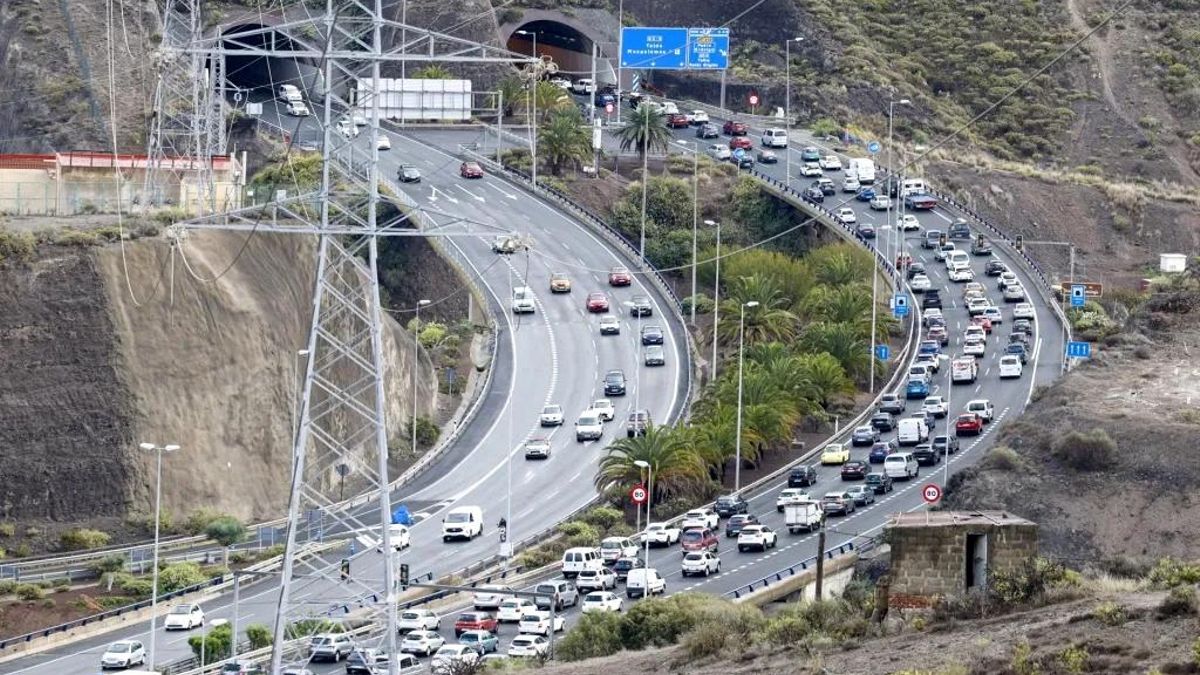
The Canary Islands now has almost as many cars as people. The archipelago closed August 2026 with more than two million vehicles for a population of just over 2.2 million residents. That gives a rate of 830 vehicles per 1,000 inhabitants and places the Islands as the seventh territory with the highest density of cars in the world, comfortably ahead of the United States. And the figure keeps on rising.
Registration data indicate that the fleet continues to grow after 32,587 registrations so far in 2026, meaning that in nine months more than 60% of all passenger cars registered in the whole of 2025 have already been recorded, according to the Canary Islands Statistics Institute (ISTAC). All of this comes amid a whirlwind of attempts by the Canary Islands Government and the island councils to ease traffic congestion, efforts that have collided with the orographic, economic and urban realities of the Islands.
Three structural factors behind the surge
The extremely high density of vehicles in the Canary Islands is down to three structural factors. The first is the tourist rental fleet. A large proportion of registered cars do not belong to private individuals but to massive rent-a-car fleets serving the tourism industry. Julián Sastre, president of the Institute of Mobility and an expert in sustainable transport, explained to Canarias Ahora that the prevailing tourism model in the archipelago particularly favours the rental vehicle as a means of reaching beaches, natural spaces, rural settlements and other points of interest with more limited public transport coverage, and that this has consequently fuelled demand, increasing pressure on road networks and reinforcing the presence of the car in everyday journeys.
Second is the absence of an interurban rail network. Unlike the mainland, the island topography has limited railway development, with the exception of Tenerife’s local tram, forcing near-total dependence on the car and the bus. Sastre stresses this point, arguing that the main problem is that the model of territorial occupation, characterised in many areas by highly dispersed settlements alongside numerous protected natural spaces, conditions the continuity of transport networks and hinders efficient connections between the different population centres.
The final component is differential taxation. The application of IGIC rather than VAT makes the cost of buying new vehicles relatively cheaper, another factor that helps explain the large size of the Canary Islands vehicle fleet.
Seventh highest car density in the world
The Canary Islands thus ranks seventh in the world for the highest number of cars per inhabitant, behind only San Marino (1,606 cars), Guernsey (1,389), Jersey (1,234), Andorra (1,214 cars), Malaysia (1,102) and Taiwan (999 cars).
This relentless acceleration takes us back to the pandemic. In absolute terms, the growth of the archipelago’s vehicle fleet has added more than 150,000 vehicles to its roads since the end of health restrictions, breaking a historic barrier in the summer of 2026. Data recorded by ISTAC and the DGT show the escalation of road saturation. In 2022 there were 1,870,173 vehicles, 8% fewer than the more than two million circulating in the Canary Islands today. But the real starting point is 2021, when the fleet closed at around 1.84 million vehicles. That was still a year marked by economic shutdown and pandemic uncertainty. Rent-a-car fleets had not been renewed and private purchases remained practically stagnant. It was therefore from 2023 that the real boom in registrations began, with the recovery of tourism and the replenishment of rental fleets. Since then, the fleet has not stopped growing, adding almost 37,000 vehicles during 2025 alone.
Two important milestones have also been reached. The province of Las Palmas surpassed one million registered vehicles for the first time in its history, closing 2025 with 1,016,398. Santa Cruz de Tenerife, meanwhile, reached 961,456.
Free buses, but traffic keeps growing
Against this backdrop, the Canary Islands Government and the island councils have spent years trying to get cars off the roads. They have made public transport cheaper, planned trains, promoted low-emission zones and unsuccessfully proposed BUS-VAO lanes, but it has not been enough. Free bus travel has sent passenger numbers soaring, although it has not had the same effect on traffic. A good share of the new users are people who previously walked, paid for a ticket or did not travel at all. For those who need to cross the island for work, the problem remains time, since public transport cannot always compete with the car.
César García, a computer engineer and head of Mobility and Innovation at Sagulpa (the Municipal Parking Company of Las Palmas de Gran Canaria), explained to Canarias Ahora that free travel is a measure that encourages the use of collective public transport, but that more infrastructure is needed so that buses can run exclusively in BUS-VAO lanes, along with infrastructure to encourage the use of last-mile bicycles. García does not believe the remedy is to create lanes for more cars, but rather to remove them and design those BUS-VAO lanes.
He also points out that more investment is needed in bus routes that increase frequency, comparing it to the time between one metro stop and the next in Madrid, which is usually around 10 minutes at most: “If we do not reach the concept of the Madrid Metro, where it does not matter if you miss one because another is coming, we will never change the private vehicle,” he argues. Above all, he focuses on the creation of park-and-ride facilities at the point of origin. “By origin I mean that we have to tackle the movement of the private vehicle from where it starts, not from the destination,” he explains. “If we set up park-and-ride facilities exclusively at the destination, the vehicle ends up making the journey anyway, which means we never really solve the problem of the different traffic jams or encourage shared use.”
He therefore believes the solution lies in placing these car parks at the start of journeys, in each municipality, and offering them at a very low price to encourage users to leave their vehicle there and continue their trip on public transport. As an example, he cites the El Rincón park-and-ride facility, next to the Las Arenas shopping centre, which has 912 spaces and allows all-day parking for 3 euros.
On BUS-VAO lanes, Sastre agrees that they can form part of the solution, although he points out that the challenge goes beyond road infrastructure. In his view, the key lies in creating an urban planning and mobility policy as an inseparable pairing, based on urban concentration and densification and on promoting public transport as the crown jewel of motorised mobility. To achieve this, he considers it necessary to develop quality public transport that can compete with the car on its three fundamental pillars: journey time, door-to-door travel and comfort. This, he says, is a path already being pursued through the Canary Islands Sustainable and Smart Mobility Strategy (MOVIC).
Electric vehicles remain a small minority
Of the more than two million registered vehicles, plug-in cars remain a minority. Only 0.8% – some 16,000 vehicles – are 100% electric (BEV). If plug-in hybrids (PHEV) are added, the share barely reaches 1.4%. But if we look at the cars currently being bought, in 2025 and 2026, pure electric vehicles already account for 7.2% of new sales. And if conventional hybrids are added, vehicles considered sustainable now make up 55.5% of new cars registered in the Canary Islands.
The problem is that changing to a new car does not necessarily mean retiring the old one. The Canary Islands is selling more and more new vehicles, but that does not translate simultaneously into a renewal of the fleet. Many of the cars that are no longer new simply pass to another owner and continue circulating around the Islands. In other words, for every new car sold, more than 1.2 second-hand vehicles over ten years old are traded. That is why, despite the advance of electrification in new registrations, the Canary Islands fleet remains old. Some 51% of passenger cars on the archipelago’s roads today are more than 15 years old, and one in three is over 20 years old.
Low-emission zones and Bus-VAO lanes have not changed the equation either. The former are advancing at uneven rates and the latter still have limited implementation. César García explains to this newspaper that it is national law that obliges all municipalities with more than 50,000 inhabitants to introduce a low-emission zone, which is precisely about restricting access in areas where there is genuinely pollution, and that this measure would help reduce older vehicles and renew the fleet with electric or hybrid vehicles, which would also help to reduce the number of vehicles.
Even so, he says, that still appeals to private vehicles: “If we ultimately replace a fully combustion model with a fully electric one, we are not fixing the problem of too much private vehicle traffic. It is not about carrying out a complete renewal of the current fleet, because we would have the same problem, with less pollution, but with the same density of private vehicles we have now.” The solution, he insists, is the implementation of low-emission zones and the creation of park-and-ride facilities.
Two very different realities across the islands
If we zoom in on each island, there are two very different realities. On the one hand, total volume, where the capital islands dominate thanks to their population, and on the other, density per inhabitant, where both Santa Cruz de Tenerife and Las Palmas de Gran Canaria have the highest saturation rates. In the absence of the final absolute 2026 figures by island, the data position La Palma as the territory with the highest car density in the whole country. The reason is none other than its extremely rugged topography and the wide dispersion of its population centres, which makes public transport slow and inefficient for daily travel. Many Palmeran families need one vehicle for each member of driving age, and it is not unusual for them to keep very old cars registered for short journeys or agricultural work.
Even so, Tenerife and Gran Canaria account for approximately 80% of all cars in the Canary Islands, which explains why their main motorways (the TF-5 and the GC-1) suffer the worst traffic jams in the region, despite having a slightly lower density per inhabitant than the so-called green islands.
An ageing fleet and plans to tackle it
Beyond the volume of vehicles, another problem worrying the Canary Islands Government is the age of the fleet. In interviews conducted as part of the Canary Islands Sustainable and Smart Mobility Strategy (EMSICAN), the regional government highlighted its impact both from an environmental point of view, due to the higher emissions of older vehicles, and on traffic itself, since breakdowns can cause tailbacks and affect the operation of roads.
To address this situation, two lines of action are proposed. In the short term, to strengthen the response to breakdowns with rapid-response tow trucks, capable of removing vehicles from the road more quickly and reducing their impact on traffic. In the longer term, it proposes developing a fleet renewal plan that facilitates the replacement of older vehicles with more efficient, lower-emission ones. The programme would also include additional incentives for those who hand in two old vehicles for scrapping, with the aim of accelerating renewal. A strategy that, as Julián Sastre explains, must be accompanied by other measures if the goal is to reduce not only emissions but also the pressure that the private vehicle exerts on the Islands’ roads.
What’s happening in the Canaries – straight to your phone
News, weather alerts and practical updates – direct from the islands, in English. We live here and know what’s going on – before the international media catch up. Everything lands on our WhatsApp channel – no middlemen, no algorithm. Curated for families, expats and travelers.
Bus lane to Las Teresitas beach returns this weekend
Tenerife approves €5bn sustainable mobility plan

Sumar Canarias rejects €1.8bn airport expansion plan

Tenerife South airport revamp tender left empty

Canary Islands August arrivals up 0.9% as Spain hits 12.3m

Imserso website crash sparks anger among Canary travel agencies

Binter unveils revamped BinterMás loyalty programme

Canary Islands airports to receive €1.8bn investment

Canary Islands airports to receive €1.8bn investment