
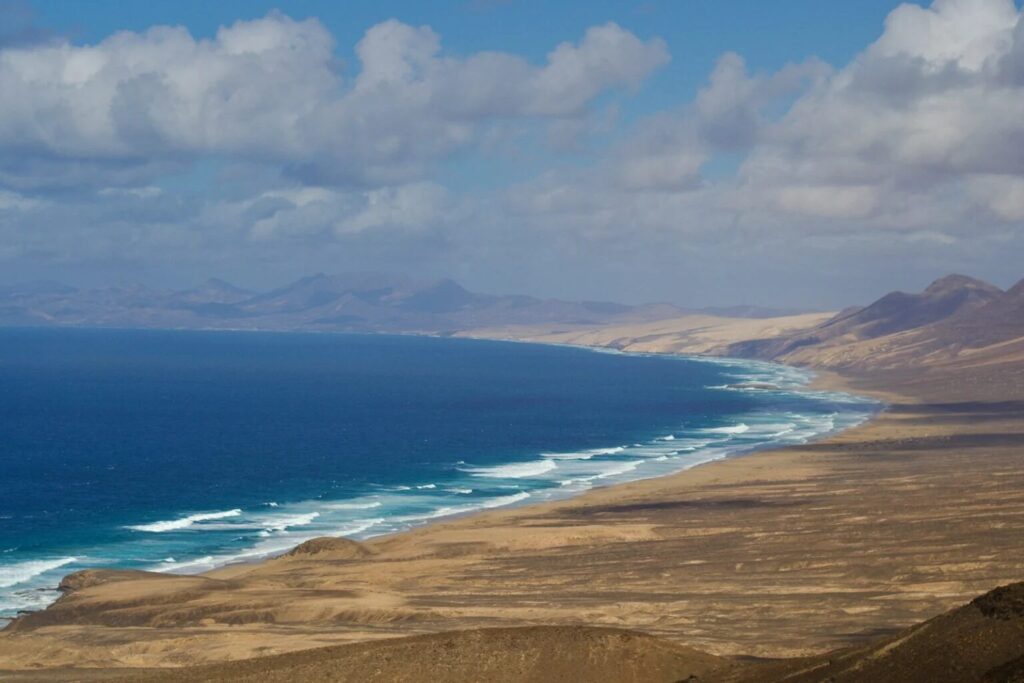
Cofete is a beach that changes your perspective. Twelve kilometres of wild, untouched coastline on the Jandía Peninsula, where the Atlantic crashes with full force onto dark volcanic sand and jagged peaks rising above 800 metres tower behind you. It is one of the last truly wild places in the Canary Islands — and perhaps in all of Europe.
How to get to Cofete
Getting to Cofete is an adventure in itself. From Morro Jable, a roughly 20-kilometre dirt road winds and bumps its way over the ridge of the Jandía Peninsula. The drive takes 45–60 minutes depending on conditions. Contrary to popular belief, a 4×4 is not strictly necessary — you can manage in a small car, but you must drive slowly and carefully. Alternatively, the ALSA bus line L111 runs several times a day from Morro Jable (about 45 minutes).
Once you arrive, there is still a short walk ahead — from the car park it takes about 10 minutes to descend steeply to the beach. It is the only “effort” required, but the reward is the sight of an endless, empty coastline stretching before you.
What makes Cofete so special
There is nothing on Cofete — no sunbeds, no parasols, no chiringuitos, no showers. There is not even shade, because across the full 12 kilometres of beach not a single tree grows. What makes this place so extraordinary is precisely its rawness. The feeling of being at the end of the world is absolutely real here.
The beach has a wild, rugged character. Dark sand contrasts with the white foam of powerful waves. Ocean currents here are extremely strong and the waves can be unpredictable — swimming at Cofete is dangerous and strongly discouraged. This is a beach for contemplation, walks and photography, not for splashing about in the water.
The mysterious Villa Winter
On the hillside, a few hundred metres from the beach, stands Villa Winter — a building erected by the German engineer Gustav Winter between 1946 and 1954 on land allegedly gifted to him by General Franco. The two-storey villa with its observation tower offering 360-degree views has fuelled speculation for decades: a U-boat base? A Nazi hideout? A staging post for escapes to South America?
Although most conspiracy theories do not stand up to scrutiny — the waters off Cofete are too shallow for U-boats, and the tower was built after the war — the atmosphere of the place keeps the legends alive. The villa is partially open to visitors (occasionally opened by local caretakers).
Practical information
- Beach length: 12 km
- Getting there: dirt road from Morro Jable (~20 km, 45–60 min)
- Facilities: none (zero amenities)
- Swimming: dangerous — strong currents and waves
- What to bring: plenty of water, food, a hat, high-SPF sunscreen, a windbreaker (it is windy!)
- Nature protection: Jandía Nature Park — take your rubbish with you
Who is Cofete for?
Cofete is not a beach for a relaxing afternoon. It is a destination for adventurers, photographers, lovers of wild nature and anyone who wants to see the Canary Islands from an entirely different perspective. If you are looking for silence, space and a genuine feeling of being cut off from civilisation — there is no better place in the entire archipelago.
Nearby beaches
If you are visiting southern Fuerteventura, it is worth exploring other beaches on the Jandía Peninsula. Playa de Barlovento is an equally wild beach on the western side of the headland. Closer to civilisation, Playa de Morro Jable is a long, well-equipped beach with full tourist facilities — perfect after the raw experience of Cofete. Consider also a trip to Playa de Sotavento, the famous kitesurfer lagoon less than 30 km to the north.
Weather at Cofete
Cofete is one of the most remote and wild beaches in the Canary Islands. It faces the open Atlantic on the west side of the Jandía peninsula, where the ocean can be rough and the wind fierce. Weather conditions here can be harsh – check the weather in Morro Jable and plan with extra time.