
Teide’s Persistent Tremors Pose Scientific and Technical Challenge
The small earthquakes recorded daily beneath Las Cañadas del Teide for almost three weeks have become one of the greatest challenges faced by Canarian science, as well as a significant technical puzzle. These minute tremors are not only a headache for volcanologists trying to decipher what is happening several kilometres deep without being able to take a peek, but also for seismologists. Their low magnitude, overlapping nature, and reverberation in cycles that last for hours make them practically undetectable, which has led the Instituto Geográfico Nacional (IGN) to seek alternatives to make analysis both faster and more accurate.
When Manual Analysis Cannot Keep Pace
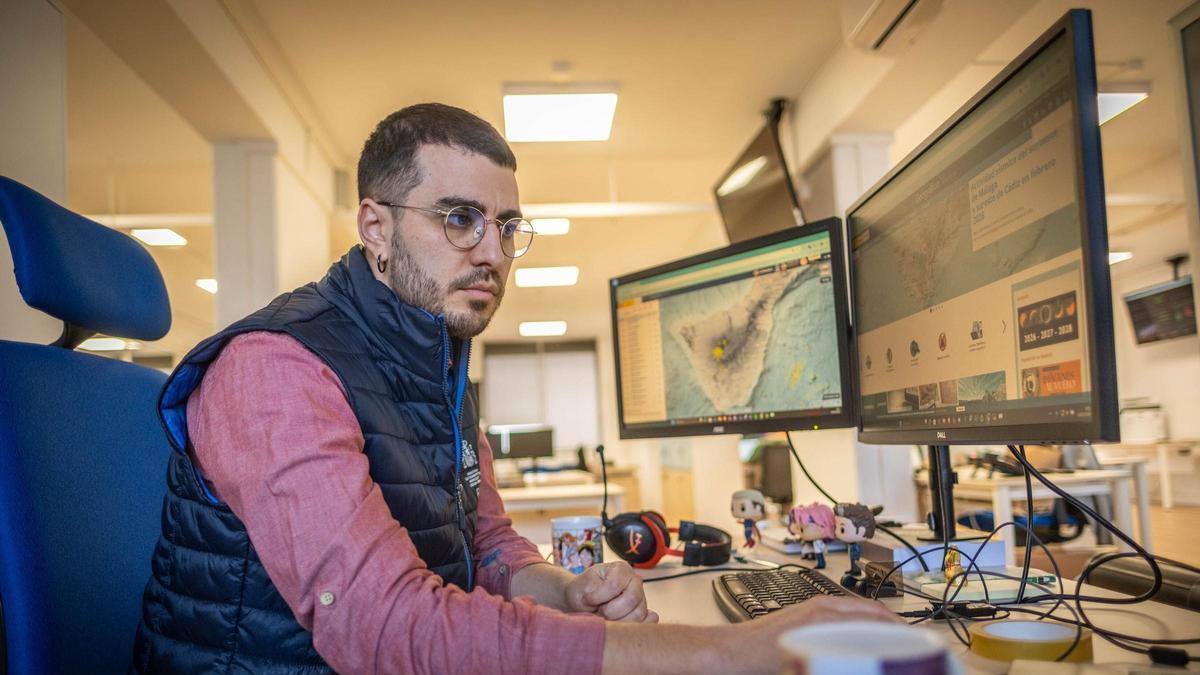
“Normally we start with a manual analysis, which is what we do routinely,” explains Eduardo Suárez, a seismologist at the IGN and one of those tasked, in recent weeks, with ‘picking’ earthquakes. This method is used when few earthquakes occur – or they are separated by a relatively long period of silence – and there is “time” to analyse them, as, on average, it takes between five and ten minutes to analyse each one. However, things change when activity skyrockets. “When we have seismic swarms like the ones we are seeing these days, the amount of seismicity increases and that prevents us from keeping up using only traditional methods,” states Suárez.
Turning to AI and Automated Methods
It is then that seismologists turn to automated methods. There are all kinds, from traditional ones analysing the classic signal, to those that train artificial intelligence to detect waveform patterns. “After the La Palma eruption, we began testing these new AI methods to check their viability in a volcanic environment like the Canary Islands,” explains Suárez. The method used, first applied in California, proved to work very well in the Canaries. “Volcano-tectonic signals are very similar to earthquakes that can occur on the continent because they have very clear patterns,” says the researcher. The AI’s job was to reanalyse the waveforms recorded during the pre-eruptive period of La Palma and compare them with those detected manually. “All the signals were somewhat similar and matched what was recorded in other geodynamic contexts,” he notes. “We saw it had great potential, as it managed to increase the detected earthquakes from 1,400 events to more than 7,000,” emphasises the researcher.
The Hurdle of Teide’s Tiny, Elusive Quakes
However, the method, although very promising, had a handicap: it could not be used in real time. An obstacle compounded by the fact it also does not work properly on hybrid earthquakes as small and low-magnitude as those occurring these days in the bowels of Teide. “The events we are seeing in recent weeks are very small; we cannot differentiate between the signal itself and the background noise,” explains Suárez, who insists this greatly hinders their view of the phenomenon. “If you try to look directly at the waveform, there are times when you can’t even see it,” he stresses. This happens because these earthquakes have “a different spectral content and are associated with other types of phenomena, so their analysis becomes complicated.”
A Novel Solution: Correlation Methods in Real Time
This situation is proving to be a real headache for IGN researchers, who become unable to detect them individually when using manual techniques. For this reason, the IGN is now testing a new technique never before used in Tenerife in real time: the use of correlation methods. “In this case, we don’t compare the earthquake signal with our manual analyses, but with each other,” relates Suárez, who highlights that its application has meant a “substantial improvement.” “It only needs supervision of the results, not a complete analysis,” he indicates. The technique comes from researchers in California.
Substantial Improvement in Detection Rates
This method was implemented last week and the results are evident. If in the first days of the swarms the IGN could barely detect 900 events, it is now able to reach 1,200 in the diagnosis of the same time period. “This is very important for us because it is information we have in real time and, in case of earthquake migration or an increase in activity, it can tell us immediately,” he insists. As Suárez points out, it is “a very good tool for analysing both low frequency and the microseismicity being recorded.” In these cases, the manual counting of earthquakes becomes “unsustainable.” “Having a person dedicating a lot of time to analysing and calculating the swarm itself ends up being draining. We are not efficient, nor can we make direct interpretations, and this is a very important part of our work,” he concludes.
Reducing Noise and Monitoring Volcanic Tremor
This new formula for earthquake diagnosis is also effective for “reducing noise.” And not just the noise from Teide’s own depths, but also natural noises like wind, thunder, or even rain. It would also be very effective if one of the most recognisable signals of eruptions were triggered: volcanic tremor. Unlike earthquakes, tremor is a continuous vibration associated with the movement of magma in a very elongated cavity, which causes that magma to resonate. It is associated with magma ascent, although sometimes it may have nothing to do with it. After all, this type of rhythmic and continuous signal can also be caused by intense degassing, hydrothermal activity, or conduit resonance. In any case, thanks to this type of earthquake diagnosis methodology, “when the signals are very continuous, we can analyse the network simultaneously.”
The Limits of Technology and the Need for Multiple Methods
But the technique is not infallible either. It would fail in the case of having to detect “earthquake migration,” that is, a progressive displacement of earthquakes towards the surface or laterally. “As they migrate, the waveform does too, and we could not establish similarities between one signal and another, which is what we are doing now,” indicates the researcher, who states: “they would not be coherent.” For this reason, and as Suárez concludes, the success of seismic surveillance at Teide lies in the “application of several methodologies at the same time” to properly understand the myriad of earthquakes emanating from the depths of Teide.
No post found!